When I first came across the homophones leach and leech, I remember how easily the words can confuse even strong English learners because they sound the same but carry different meanings. In linguistics, this is a classic case of homonyms where sound matches but usage and context change everything. In everyday usage, both belong to the wider vocabulary of science, environmental studies, and even social communication, but their parts of speech and definition diverge sharply.
One is a verb tied to a process like drain, filter, wash, remove, and dissolve a substance from soil, liquid, or material through percolation, leakage, and seepage in groundwater, while the other is a noun and sometimes verb describing a worm, a blood sucking, aquatic, invertebrate organism showing exploitative behavior, dependency, and cling in a relationship with a host. I still recall explaining it to a friend who kept mixing leaching in agriculture and chemistry with leeching in a medical or emotional sense, especially during discussions about toxicity, contamination, nutrients, and ecosystem loss.
The leach form is used in environmental science, engineering, and biology context where rainfall, chemicals, or liquid medium can filter, pass, and extract minerals, causing groundwater contamination, soil toxicity, or fertilizer runoff in agriculture systems. It connects with solid material, chemical, and physical extraction, often discussed in science table explanations, technical writing, and corpus analysis of frequency in searches and usage patterns across Google trends.
On the other hand, leech carries a strong negative connotation in social behavior, often used in figurative use like financial leech, credit stealing, or someone who takes advantage, showing exploit, dependency, and emotional or financial gain in a workplace or personal relationship.
In medical history, it even refers to treatment using a segmented worm for circulation, swelling, or blood meal, but in modern English language and grammar choice, it is rarely positive. Both words share pronunciation, including /liːtʃ/, rhyme with reach and peach, and remain a classic writing error in English usage, where correct spelling rule, meaning based usage decision, and context determine the right choice without being interchangeable.
Quick Answer
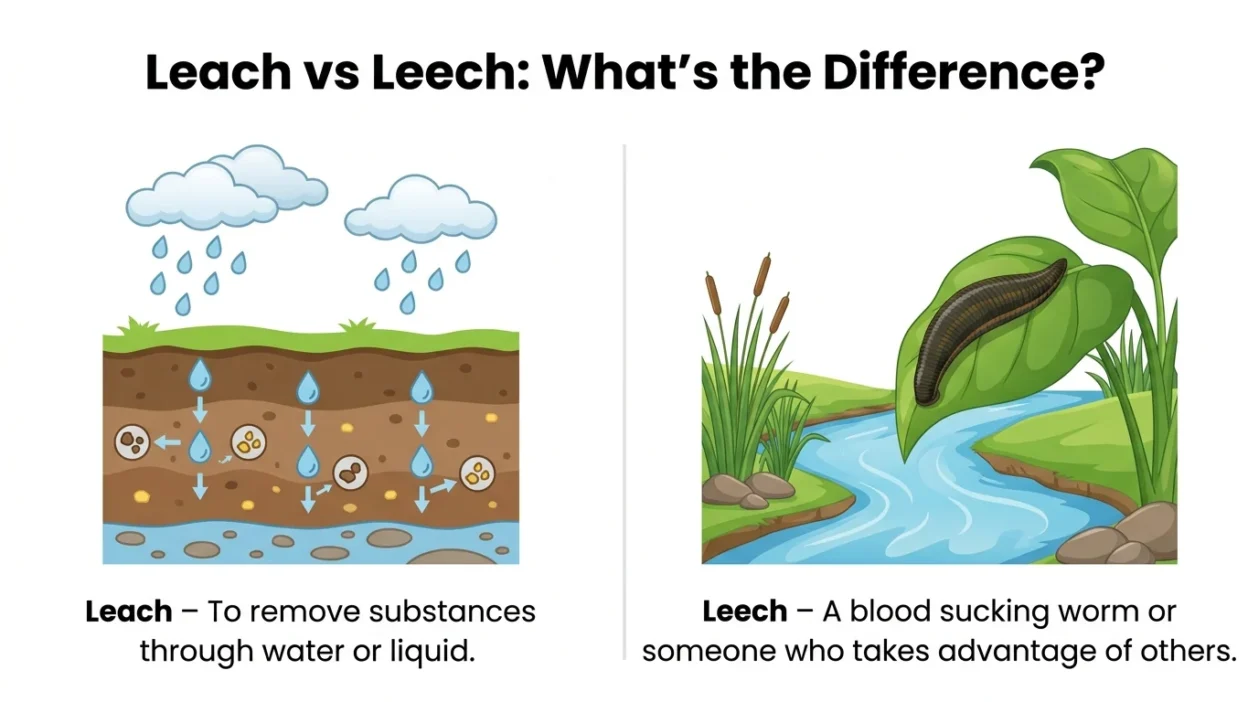
- Leach = to remove something from a material by water or another liquid.
- Leech = a blood sucking worm or a person who takes advantage of others.
- Leach is usually used in science, gardening, farming, and environmental topics.
- Leech is used when talking about the animal or someone who depends too much on another person.
- If you are talking about a worm, use leech.
- If you are talking about washing something out or removing something through liquid, use leach.
Origin or Background of the Words
Understanding where the words come from can make them easier to remember.
The Word “Leach”
The word leach has been used for many years to describe the process of removing substances through water or another liquid.
For example, when rainwater passes through soil, it may carry minerals away. This process is called leaching.
The Word “Leech”
The word leech comes from the name of a worm that feeds on blood. These worms have existed for a very long time and were even used in medicine in the past.
Over time, people also started using leech to describe someone who depends on others for money, support, or resources without giving anything back.
Clear Explanation of the Difference
The easiest way to remember the difference is to focus on what each word means.
What Does Leach Mean?
Leach is usually a verb. It means to remove something slowly through water or another liquid.
Examples:
- Heavy rain can leach nutrients from the soil.
- Chemicals may leach into groundwater.
- Water can leach minerals from rocks.
In these examples, something is being washed out or removed.
What Does Leech Mean?
Leech is usually a noun.
It can mean:
- A blood sucking worm.
- A person who constantly takes from others.
Examples:
- A leech attached itself to his leg during the hike.
- He is acting like a leech by always borrowing money and never paying it back.
In both cases, the idea is taking something from another source.
Comparison Table
| Feature | Leach | Leech |
| Part of speech | Usually a verb | Usually a noun |
| Main meaning | Remove through liquid | Blood sucking worm |
| Common topics | Science, soil, water, environment | Animals, relationships |
| Related form | Leaching | Leeches |
| Example | Rain can leach nutrients from soil. | A leech attached to the skin. |
| Memory tip | Think of washing out | Think of the worm |
Which One to Use and When
Choosing the correct word becomes easier when you think about the situation.
Use “Leach” When
You are talking about:
- Water removing substances
- Soil and nutrients
- Chemicals entering water
- Environmental processes
- Scientific discussions
Examples:
- Rain can leach minerals from the ground.
- The chemical may leach into nearby water sources.
- Excess watering can leach nutrients from plants.
Use “Leech” When
You are talking about:
- The worm
- Someone who takes advantage of others
- Blood sucking animals
Examples:
- We found a leech during our forest walk.
- Stop being a leech and help pay for expenses.
- The doctor explained how a leech works.
Common Mistakes People Make
Many learners make the same mistakes when using these words.
Using “Leech” Instead of “Leach”
Incorrect:
- Rain can leech nutrients from soil.
Correct:
- Rain can leach nutrients from soil.
Why?
Because nutrients are being removed by water.
Using “Leach” Instead of “Leech”
Incorrect:
- A leach attached to my leg.
Correct:
- A leech attached to my leg.
Why?
Because the sentence is talking about the worm.
Assuming Both Words Mean the Same Thing
Some people think the two words are simply different spellings of one word.
They are not.
Each word has its own meaning and should be used in different situations.
Everyday Real Life Examples
Emails
Correct:
- Excess watering may leach important nutrients from the soil.
Correct:
- We removed a leech from the dog’s leg after the walk.
News
Correct:
- Experts warn that chemicals may leach into drinking water.
Correct:
- Researchers studied the behavior of leeches in wetlands.
Social Media
Correct:
- Too much rain can leach minerals from garden soil.
Correct:
- That friend is such a leech—always asking for favors.
Daily Conversations
Correct:
- The fertilizer may leach into nearby streams.
- A leech bit my ankle while I was hiking.
- Water can leach salt from the soil.
- Nobody likes a leech who never contributes.
Short Learning Section for Students and Beginners
Here is a simple trick to remember the difference.
Remember “Leach” Like Water
Think of:
Leach = Liquid
Both words start with the letter L.
Whenever water or liquid removes something, use leach.
Example:
- Water can leach minerals from rocks.
Remember “Leech” Like the Worm
Think of the double e in leech.
Imagine the two e’s as the eyes of a worm.
Example:
- A leech attached itself to the swimmer’s leg.
Quick Memory Sentence
- Leach removes things through liquid.
- Leech is a worm or a person who takes from others.
This simple sentence helps many learners remember the difference.
FAQ
Is leach a real word?
Yes. Leach is a real English word that means to remove something through water or another liquid.
Is leech a real word?
Yes. Leech is a real word that usually refers to a blood sucking worm.
Which word is used in science?
Leach is commonly used in science, environmental studies, farming, and gardening.
Can leech be used for a person?
Yes. It can describe someone who depends on others and constantly takes without giving back.
What is the verb form related to leach?
The verb is leach.
Example:
- Chemicals can leach into groundwater.
What is the plural of leech?
The plural form is leeches.
Example:
- Several leeches were found near the river.
Which word is connected to soil and water?
Leach is the correct word when discussing soil, minerals, nutrients, or water movement.
How can I remember the difference quickly?
Remember:
- Leach = liquid removes something.
- Leech = worm or someone who takes advantage of others.
Conclusion
The difference between leach and leech is actually very simple once you know their meanings. Leach refers to the process of removing substances through water or another liquid, while leech refers to a blood sucking worm or a person who takes advantage of others. Although the words look almost identical, they are used in completely different situations.
A good memory tip is: Leach is linked to liquid, and leech is linked to the worm. If you keep that simple rule in mind, you will be able to choose the correct spelling with confidence every time.