
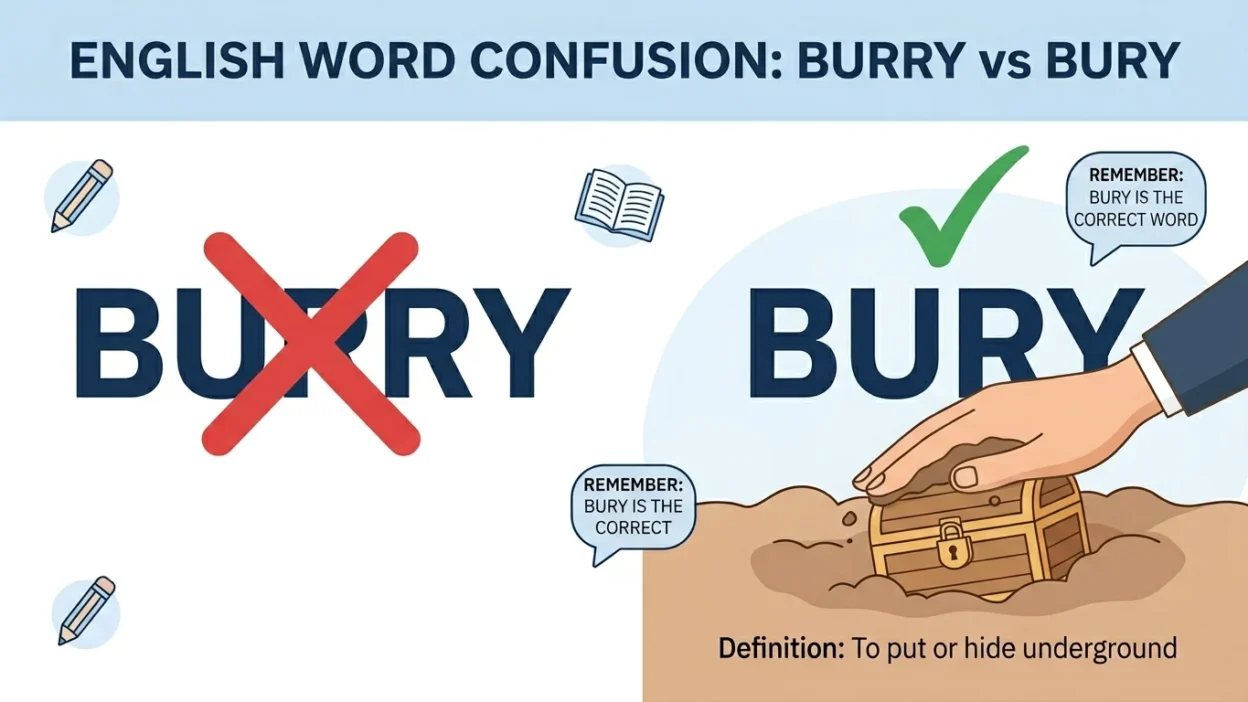
Many English learners and even native speakers confuse burry and bury because the words sound very similar. When people hear the word in conversation, they often spell it the wrong way in writing.
The confusion also happens because English spelling is not always simple. Some words sound one way but are written differently. In this case, only one spelling is correct in modern English.
If you have ever wondered whether to write burry or bury, this guide will make it very easy to understand.
Quick Answer
- Bury is the correct modern English word.
- Burry is usually considered a spelling mistake.
- Use bury when talking about:
- putting something underground
- hiding something
- covering something completely
- funerals or graves
Correct Examples
- Please bury the seeds in the soil.
- They will bury the treasure.
- The snow may bury the road.
Incorrect Example
- Please burry the seeds. ❌
In almost all situations, you should use bury.
Simple Origin or Background Explanation
The word bury is very old. It comes from early English words that meant “to place in the ground” or “to hide.”
Over time, the spelling became bury, but the pronunciation stayed a little unusual. That is why people sometimes think it should be written as “burry.”
English has many words like this. For example:
- busy
- build
- business
These words are not always spelled the way they sound.
The spelling burry does exist in very rare situations, but it is usually related to special scientific or descriptive language. Most everyday English learners never need to use it.
For normal writing, schoolwork, emails, and conversations, bury is the word you need.
Clear Explanation of the Difference
The easiest way to understand the difference is this:
Bury = Correct Everyday Word
“Bury” is a verb. It means:
- to put something into the ground
- to hide something
- to cover something completely
Examples:
- They will bury the old box.
- The dog likes to bury bones.
- Heavy snow can bury cars.
Burry = Usually Wrong in Everyday English
Most of the time, “burry” is simply a misspelling of “bury.”
People often write it because the pronunciation sounds similar to words ending in “-urry.”
But in standard English writing:
- bury ✔ correct
- burry ✘ usually incorrect
Comparison
| Word | Correct? | Meaning | Common Use |
| Bury | Yes | To place underground or hide | Everyday English |
| Burry | Usually no | Often a spelling mistake | Rarely used |
Simple Memory Tip
Think of this:
Bury has one “r.”
If you write two “r” letters, it is usually wrong.
Which One to Use and When
Use “Bury” When Talking About the Ground
Examples:
- Farmers bury seeds.
- Pirates bury treasure.
- People bury time capsules.
Use “Bury” When Talking About Funerals
Examples:
- They will bury him tomorrow.
- The family gathered to bury their loved one.
Use “Bury” When Talking About Hiding Something
Examples:
- She tried to bury her feelings.
- He buried the secret for years.
Use “Bury” for Something Covered Completely
Examples:
- Leaves can bury small plants.
- The sand almost buried the shell.
Avoid “Burry” in Normal Writing
In school essays, emails, homework, tests, and daily communication, do not use “burry.”
Common Mistakes People Make
Mistake 1: Writing the Word the Way It Sounds
Many people hear:
“ber-ee”
So they spell it:
“burry”
But English spelling does not always match pronunciation.
- bury ✔
Wrong spelling:
- burry ✘
Mistake 2: Confusing Pronunciation With Spelling Rules
Some learners think:
- hurry → hurrying
- furry → fur
So they expect:
- bury → burry
But “bury” follows its own spelling pattern.
Mistake 3: Using “Burry” in Formal Writing
This is common in:
- school assignments
- work emails
- social media posts
- articles
Teachers and readers may notice the mistake quickly.
Mistake 4: Forgetting Verb Forms
The verb changes like this:
| Form | Word |
| Base verb | bury |
| Past tense | buried |
| Continuous form | burying |
Examples:
- Yesterday they buried the treasure.
- He is burying the seeds now.
Notice there is never a double “r.”
Everyday Real Life Examples
Emails
Correct:
- Please bury the cable underground before Friday.
- Workers will bury the pipes tomorrow.
Incorrect:
- Please burry the cable. ❌
News
Correct:
- Heavy snow may bury mountain roads.
- The town will bury the victims this week.
Social Media
Correct:
- I want to bury my old memories and move on.
- My dog loves to bury toys in the yard.
Incorrect:
- My dog likes to burry toys. ❌
Daily Conversations
Correct:
- Let’s bury the box in the garden.
- Don’t bury your emotions.
School Writing
Correct:
- Ancient people often buried valuable objects.
- Animals sometimes bury food for later.
Short Learning Section for Students and Beginners
Here is a very simple way to remember the word.
Step 1: Learn the Correct Spelling
The correct spelling is:
B-U-R-Y
Only one “r.”
Step 2: Remember the Meaning
“Bury” usually means:
- put underground
- hide
- cover completely
Step 3: Practice With Easy Sentences
Try reading these aloud:
- Birds sometimes bury food.
- Snow can bury roads.
- We will bury the treasure.
Step 4: Use a Memory Trick
You can remember:
“Bury has one hole and one ‘r.’”
This small trick helps many students avoid the mistake.
Step 5: Watch for Autocorrect
Sometimes phones or typing mistakes create confusion. Always check your spelling before sending messages or homework.
FAQ
Is “burry” ever correct?
In very rare special uses, “burry” may appear as an adjective in technical language. But for normal English writing, you should use bury.
Which spelling is correct: bury or burry?
The correct everyday spelling is bury.
Why do people spell it “burry”?
Because the word sounds similar to words with double “r” letters.
Is “bury” a verb?
Yes. “Bury” is a verb.
Example:
- They will bury the box.
What is the past tense of bury?
The past tense is:
buried
Example:
- They buried the treasure yesterday.
Can “bury” mean hide?
Yes. It can mean to hide something physically or emotionally.
Examples:
- He tried to bury the truth.
- She buried her feelings.
How do I remember the correct spelling?
Remember this simple rule:
“Bury” has only one “r.”
Is “burying” correct?
Yes.
Example:
- He is burying the seeds.
Conclusion
The difference between burry and bury is actually very simple once you know the rule.
- Bury is the correct word in normal English.
- Burry is usually just a spelling mistake.
Use bury when talking about:
- putting something underground
- hiding something
- covering something completely
A simple memory trick can help:
“Bury has one ‘r.’”
Once you practice the word a few times, the confusion usually disappears completely.