Many people get confused between “stoped” and “stopped.” Both words may look correct at first glance, especially for students and English learners. But only one spelling is correct in standard English.
This confusion happens because English spelling rules can sometimes feel tricky. Some verbs double the last letter before adding -ed, while others do not. The good news is that this rule is actually simple once you understand it.
In this article, you will learn:
- Which spelling is correct
- Why the spelling changes
- When to use “stopped”
- Why “stoped” is wrong
- Easy examples from daily life
- Common mistakes learners make
By the end, the difference will feel very clear and easy to remember.
Quick Answer
Here is the simple answer:
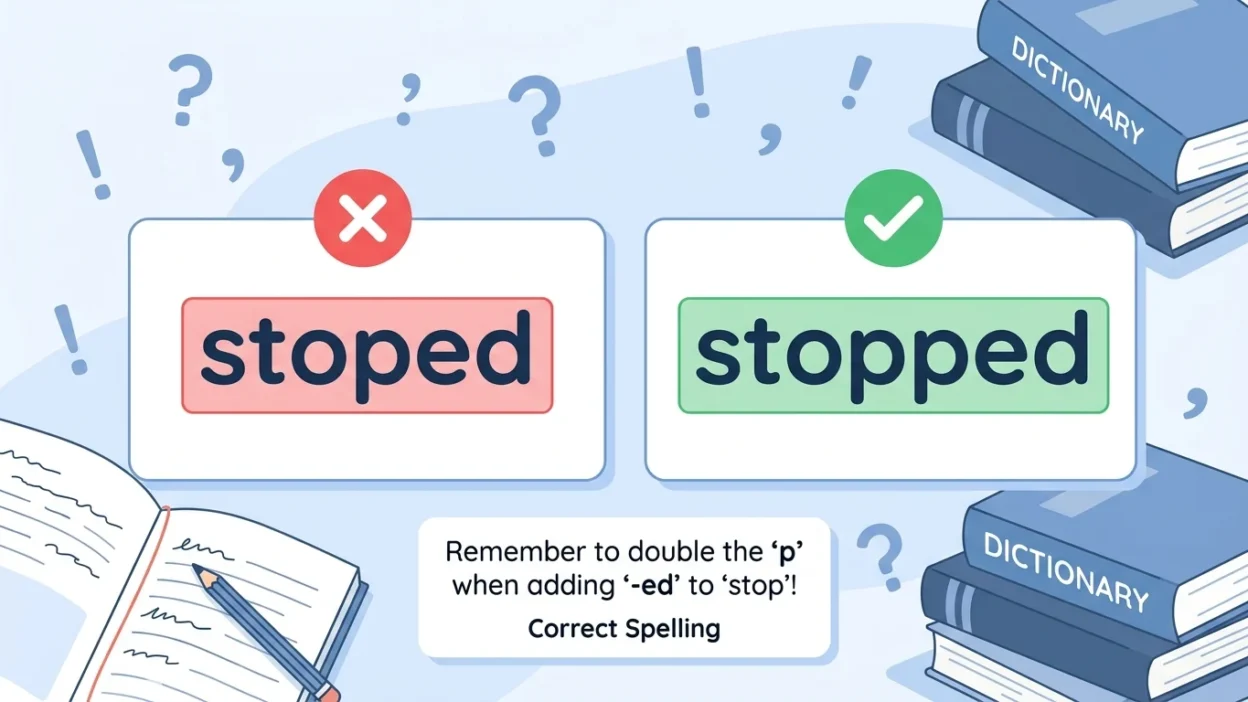
- ✅ Stopped = Correct spelling
- ❌ Stoped = Incorrect spelling
The verb “stop” becomes “stopped” in the past tense because the final consonant p is doubled before adding -ed.
Correct Examples
- She stopped talking.
- The bus stopped suddenly.
- I stopped using that app.
Incorrect Examples
- ❌ She stoped talking.
- ❌ The bus stoped suddenly.
Always use “stopped” in proper English writing.
Simple Background of the Word
The word “stop” is a very common English verb. It means:
- To end something
- To pause
- To not continue
Examples:
- Stop running.
- Please stop the music.
- He stopped the car.
When we talk about the past, we usually add -ed to regular verbs.
For example:
- walk → walked
- jump → jumped
- clean → cleaned
But some short verbs follow a special spelling rule. The verb “stop” is one of them.
Why “Stopped” Has Double P
The correct form is stopped because of an English spelling rule.
The Rule
When a verb:
- Has one syllable
- Ends in:
- one vowel + one consonant
- And you add -ed or -ing
→ You usually double the final consonant.
Example With “Stop”
- stop
- sto = vowel sound + consonant
- Add -ed
- Double the p
Result:
- stopped
Other Words That Follow the Same Rule
Here are similar examples:
| Base Verb | Past Form |
| stop | stopped |
| plan | planned |
| shop | shopped |
| clap | clapped |
| grab | grabbed |
Notice how the last letter doubles before adding -ed.
Why “Stoped” Is Wrong
The spelling “stoped” breaks the normal English spelling rule for this verb.
English speakers and writers do not use this form in correct writing.
You may sometimes see “stoped” in:
- typing mistakes
- student writing
- social media posts
- early English learning
But it is still considered incorrect.
Difference Between “Stoped” and “Stopped”
Here is the easiest way to understand the difference.
| Word | Correct or Wrong? | Meaning |
| stopped | ✅ Correct | Past tense of “stop” |
| stoped | ❌ Wrong | Not accepted in standard English |
Example
✅ Correct:
- The rain stopped after lunch.
❌ Incorrect:
- The rain stoped after lunch.
Which One Should You Use?
You should always use “stopped.”
Use it when talking about:
- something that ended in the past
- something that paused
- something that no longer continued
Examples
- He stopped laughing.
- We stopped at the store.
- The machine stopped working.
- They stopped the game because of rain.
Never use “stoped” in school writing, exams, emails, or professional communication.
“Stopped” as Different Parts of Speech
The word “stopped” can be used in different ways.
1. Past Tense Verb
This is the most common use.
Examples:
- She stopped crying.
- I stopped eating sugar.
2. Past Participle
Used with helping verbs like “has,” “have,” or “had.”
Examples:
- He has stopped smoking.
- They had stopped talking before class started.
3. Adjective Like Use
Sometimes it describes a condition.
Examples:
- a stopped clock
- stopped traffic
Common Mistakes People Make
Many learners make the same spelling mistakes with “stopped.”
Mistake 1: Writing “Stoped”
❌ Wrong:
- I stoped watching TV.
✅ Correct:
- I stopped watching TV.
Mistake 2: Forgetting the Double Letter
Some learners forget to double the final consonant.
Remember:
- stop → stopped
- not stoped
Mistake 3: Mixing Present and Past Forms
❌ Wrong:
- Yesterday I stop at the shop.
✅ Correct:
- Yesterday I stopped at the shop.
Mistake 4: Using “Stopped” Incorrectly With “Did”
After “did,” use the base verb.
❌ Wrong:
- I did stopped there.
✅ Correct:
- I did stop there.
This is because “did” already shows past tense.
Easy Trick to Remember
Here is a simple memory trick:
“Short verb? Double the ending.”
The word stop is short and ends with:
- vowel + consonant
So the final consonant doubles.
- stop → stopped
- stop → stopping
This trick helps with many English verbs.
Everyday Real Life Examples
Learning with real examples makes the rule easier.
In Emails
- I stopped using the old account.
- We stopped the project last week.
In News
- Traffic stopped after the accident.
- The company stopped production.
On Social Media
- She stopped posting online.
- I finally stopped wasting time scrolling.
In School
- The teacher stopped the lesson for questions.
- The students stopped talking.
In Daily Conversation
- We stopped for coffee.
- He stopped by my house yesterday.
“Stopped” vs “Stopping”
Both forms are correct, but they are used differently.
| Word | Use |
| stopped | past tense |
| stopping | happening now or continuous action |
Examples
Stopped
- The car stopped suddenly.
Stopping
- The car is stopping now.
Small Learning Section for Students and Beginners
Here is a quick study guide.
Base Verb
- stop
Past Tense
- stopped
Continuous Form
- stopping
Important Rule
Double the final consonant before adding:
- -ed
- -ing
Practice Sentences
Choose the correct form.
- The bus ______ suddenly.
- She ______ calling me.
- We ______ at the red light.
Answers
- stopped
- stopped
- stopped
Mini Grammar Tip
Not every English verb doubles the last letter.
No Double Letter
| Verb | Past Form |
| clean | cleaned |
| rain | rained |
| open | opened |
Double Letter
| Verb | Past Form |
| stop | stopped |
| plan | planned |
| shop | shopped |
This happens mostly with short verbs ending in vowel + consonant.
FAQ
Is “stoped” ever correct?
No. “Stoped” is not correct in standard English.
Why does “stopped” have two P’s?
Because “stop” follows a spelling rule where the final consonant doubles before adding “-ed.”
Is “stopped” a regular verb?
Yes. “Stop” is a regular verb because it forms the past tense with “-ed.”
How do you spell the past tense of “stop”?
The correct spelling is:
- stopped
Is “stopping” also correct?
Yes. “Stopping” is the present participle form.
Example:
- He is stopping the car.
Why do learners write “stoped”?
Many learners forget the double letter spelling rule in English.
Which form should I use in exams?
Always use:
- stopped
Never use “stoped.”
Is “stopped” used in American and British English?
Yes. Both American and British English use the spelling “stopped.”
Conclusion
The difference between “stoped” and “stopped” is actually very simple once you know the spelling rule.
- ✅ Stopped is the correct spelling
- ❌ Stoped is incorrect
The final p doubles because “stop” is a short verb ending in a vowel followed by a consonant.
Remember this pattern:
- stop → stopped
- plan → planned
- shop → shopped
If you keep practicing with real examples, the correct spelling will soon feel natural and easy to remember.