Many learners of English feel confused by beside and besides because the words have similar spelling, the same root, and are among the most commonly mixed up terms in the language. The basic difference is simple: beside is a preposition that shows location, physical proximity, or being next, at the side, close to, or next to something, while besides means in addition, in addition to, apart from, other than, as well, or an addition of extra information.
This distinction becomes easier to remember with a quick trick: beside contains side, while besides has an extra s for an extra point. In English Grammar Today, Gina Rancaño, BA, whose credentials include a Bachelor of Arts, certificate, professional writing, public writing, and Florida International University, explains these definitions, usage, and meaning through clear examples and practical understanding.
Think of Kaia and Rhea in the orchestra first violin section, sitting side by side, or a dream journal placed beside a bed at night. A barn beside a farmer’s house, a friend you sit beside at dinner, a table beside a book, utensils beside plates, plants beside one another, or standing beside somebody rather than in front all show physical placement.
In comparison, one car may seem tiny beside a truck, an artwork may look silly compared with another, an old phone may be compared to a new model, and small problems may seem minor beside bigger risks. These nouns, places, and relationships demonstrate how beside works grammatically, and although it can be replaced by a synonym like “next to,” the meaning remains almost identical.
Quick Answer: Simple Meaning
Here is the easiest way to understand the difference:
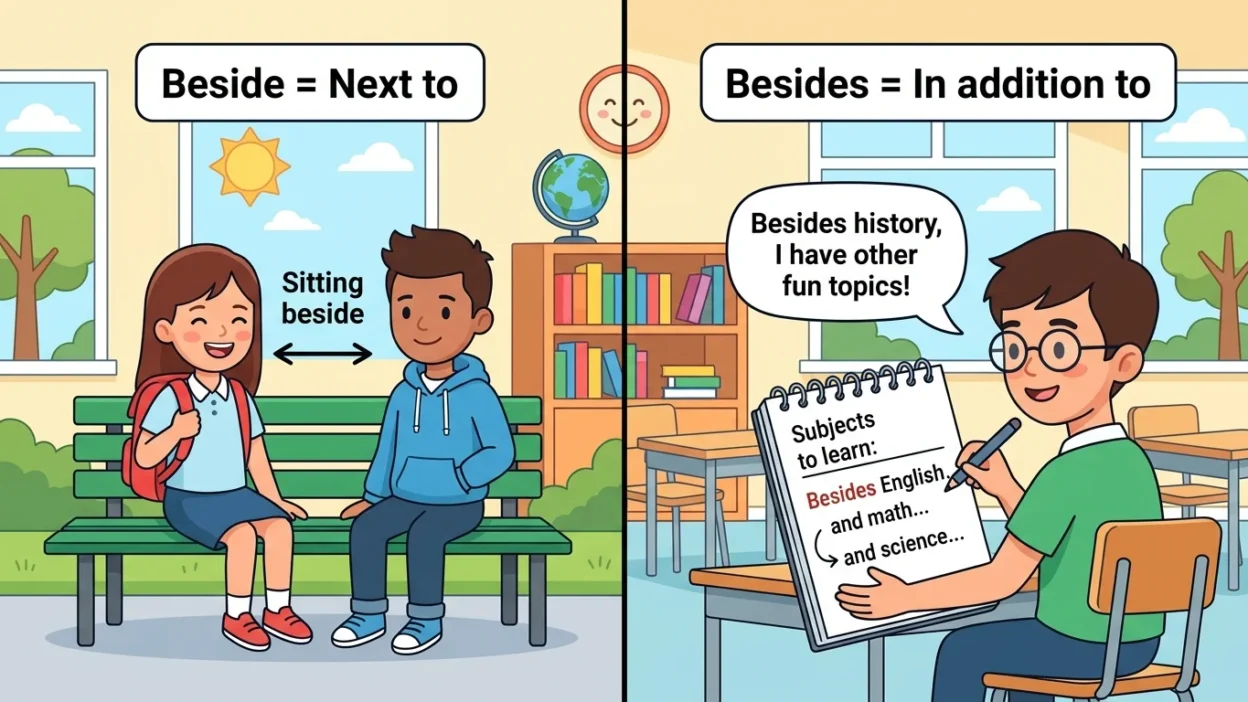
- Beside = next to / at the side of something
- Besides = in addition to / also / apart from
That’s it. Just remember:
- Beside = position (physical place)
- Besides = extra information or addition
Simple Origin or Background Explanation
Both words come from Old English and are related to the idea of “side.”
- Beside developed to mean “by the side of something.”
- Besides developed later to mean “beyond the side,” or “in addition to something already mentioned.”
Over time, English kept both words, but their meanings became more different.
Even though they share the same root idea, modern English uses them in two completely different ways.
Clear Explanation of the Difference
Let’s make it very simple.
Beside (Physical Position)
We use beside when we talk about location.
It means:
- next to
- at the side of
- close to something
Examples:
- The book is beside the pen.
- She sat beside her friend.
- The house is beside the river.
👉 Think of “beside” as something you can see in space.
Besides (Addition or Extra Meaning)
We use besides when we add extra information or mean “also” or “apart from.”
It means:
- in addition to
- also
- except for (in some cases)
Examples:
- Besides English, she speaks French.
- I don’t want to go. Besides, I am tired.
- Besides pizza, we ordered burgers.
👉 Think of “besides” as something extra in your idea or sentence.
Comparison Table (Easy to Scan)
| Feature | Beside | Besides |
| Meaning | Next to / at the side | In addition to / also |
| Type | Preposition of place | Preposition / adverb |
| Use | Physical position | Extra information |
| Example | She sat beside me | Besides me, others came too |
| Focus | Location | Addition or exception |
Which One to Use and When
This is the most important part. Let’s make it super clear.
Use “Beside” when:
- You are talking about place or position
- You can point to something physically
Examples:
- The cat is beside the door.
- He stood beside his car.
Use “Besides” when:
- You are adding extra information
- You mean “also” or “apart from”
Examples:
- Besides math, I like science.
- Do you want anything besides water?
- I don’t have time. Besides, it’s too late.
Simple Trick to Remember
- If you can replace it with “next to”, use beside
- If you can replace it with “also” or “in addition”, use besides
Common Mistakes People Make
Many learners mix these words. Here are the most common mistakes:
Mistake 1: Using “beside” for addition
❌ Beside English, I study math.
✔ Besides English, I study math.
Mistake 2: Using “besides” for location
❌ She sat besides me on the chair.
✔ She sat beside me on the chair.
Mistake 3: Thinking they are interchangeable
They are NOT the same. Meaning changes completely.
Mistake 4: Forgetting the context
Many learners choose randomly without thinking about meaning.
Everyday Real Life Examples
Let’s see how these words are used in real life.
Emails
- “Please sit beside the manager during the meeting.”
- “Besides the report, I also attached the presentation.”
News
- “The leader stood beside his team during the event.”
- “Besides economic issues, the country faces health challenges.”
Social Media
- “My best friend is beside me in this photo ❤️”
- “Besides work, I enjoy traveling and music.”
Daily Conversations
- “Come and sit beside me.”
- “What do you want besides tea?”
Short Learning Section for Students and Beginners
Here is a quick way to master both words:
Step 1: Think about meaning
Ask yourself:
- Am I talking about place? → use beside
- Am I adding extra information? → use besides
Step 2: Practice daily
Try making 3 sentences every day:
- 1 sentence with beside
- 1 sentence with besides
- 1 mixed practice sentence
Step 3: Use simple memory trick
- Beside = by the side
- Besides = extra stuff
FAQ: Common Questions
What is the main difference between beside and besides?
Beside means next to something. Besides means in addition to something.
Can I use beside and besides in the same sentence?
Yes, but they will have different meanings.
Example:
- She sat beside me, and besides that, we talked a lot.
Is besides always used for addition?
Mostly yes, but it can also mean “except for” in some sentences.
Is beside only used for physical place?
Yes, beside is mainly used for location or position.
Why do people confuse these words?
Because they look similar and sound almost the same.
Which word is more common in speaking?
Both are common, but beside is often used in physical descriptions, and besides is common in explanations.
Can besides mean “also”?
Yes, in many cases, besides means “also” or “in addition.”
What is an easy way to remember both?
Think:
- beside = next to
- besides = extra
Conclusion
The difference between beside and besides is very simple once you understand the meaning clearly. One is about position, and the other is about addition.
- Use beside when something is next to another thing.
- Use besides when you are adding extra information or meaning “also.”
If you remember just one idea, it is this:
Beside is about place, and besides is about extra meaning.
With a little practice, you will never confuse them again.