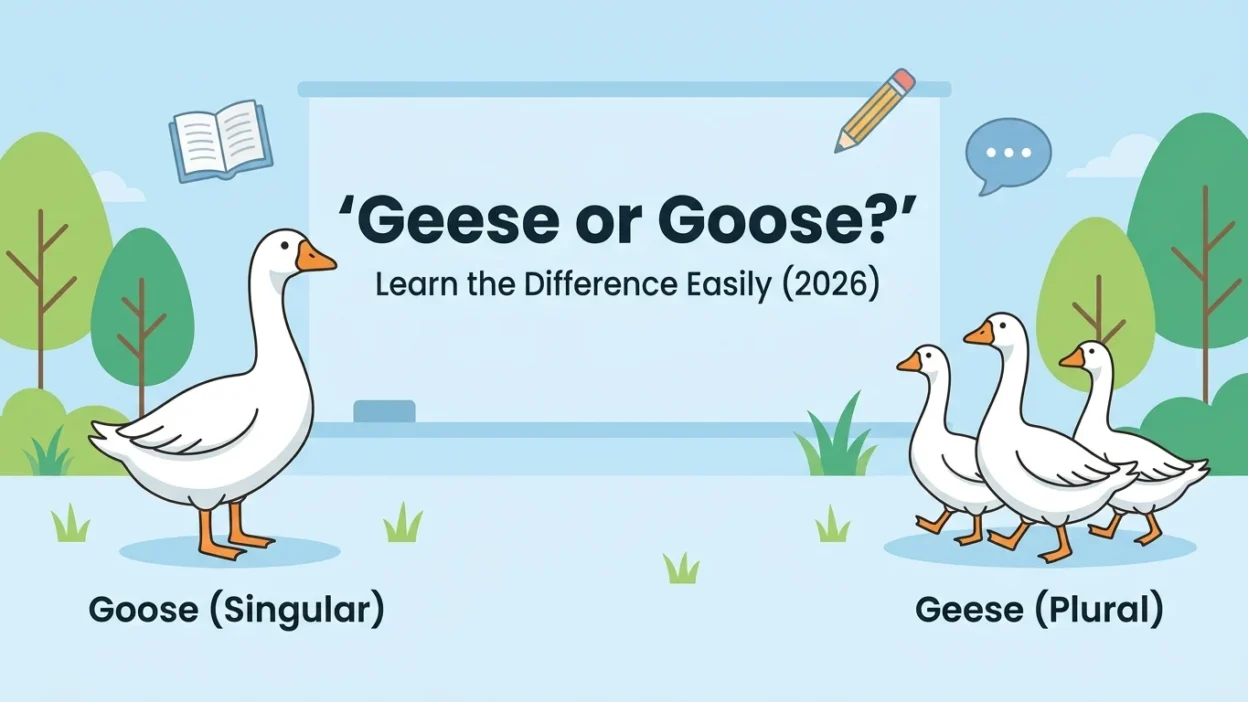
Many people get confused about geese or goose because both words talk about the same bird.
You may read a sentence like:
- “A goose is in the park.”
- “Several geese are near the lake.”
At first, this can feel confusing.
Why does the word change?
Why do we say goose sometimes and geese at other times?
This is a very common English question for students, ESL learners, and beginners. English has many words that change in unusual ways when they become plural, and goose is one of them.
The good news is that the rule is simple once you understand it.
This guide will explain everything in clear, easy English so you can use both words correctly every time.
Quick Answer
Here is the simple answer:
- Goose = one bird
- Geese = more than one bird
Examples:
- I saw a goose near the river. ✅
- I saw three geese near the river. ✅
Easy way to remember:
One = Goose
Many = Geese
That is the main difference.
Simple Background: Why Are These Words Different?
Most English nouns become plural by adding -s.
For example:
- Cat → Cats
- Dog → Dogs
- Book → Books
But some English words are different because they come from very old forms of English.
The word goose is one of these special words.
Long ago, some words changed their vowel sound instead of adding -s to make them plural.
That is why:
- Goose → Geese
- Tooth → Teeth
- Foot → Feet
- Mouse → Mice
These are called irregular plural nouns.
You do not need to memorize the history.
You only need to remember that goose is singular and geese is plural.
What Is the Difference Between Goose and Geese?
The difference is about number.
Goose
Use goose when talking about one bird.
Examples:
- The goose is swimming.
- That goose looks hungry.
- I saw a white goose.
In all these examples, there is only one bird.
Geese
Use geese when talking about two or more birds.
Examples:
- The geese are swimming.
- Many geese live near the lake.
- Two geese crossed the road.
In all these examples, there is more than one bird.
Comparison
| Word | Meaning | Number | Example |
| Goose | One bird | Singular | The goose is flying. |
| Geese | More than one bird | Plural | The geese are flying. |
Quick memory trick:
If you can count just one, use goose.
If you can count two or more, use geese.
Which One Should You Use and When?
Here is an easy guide.
Use “Goose” When:
You are talking about:
- One bird
- A single animal
- Just one goose
Examples:
- There is a goose in my yard.
- The goose is making noise.
- I fed one goose today.
Use “Geese” When:
You are talking about:
- Two birds
- Several birds
- A group of these birds
Examples:
- The geese are loud.
- Five geese were near the pond.
- Those geese are flying south.
Common Mistakes People Make
Many learners make small mistakes with these words.
Let’s fix them.
Mistake 1: Saying “Gooses”
❌ I saw three gooses.
✅ I saw three geese.
Why?
Because goose is irregular.
Its plural is geese, not gooses.
Mistake 2: Using “Geese” for One Bird
❌ That geese is big.
✅ That goose is big.
Why?
Because geese means more than one.
Mistake 3: Wrong Verb Match
❌ The geese is swimming.
✅ The geese are swimming.
Why?
Geese is plural, so it needs plural verbs like are.
Mistake 4: Mixing Up Singular and Plural
❌ One geese is here.
✅ One goose is here.
❌ Two goose are here.
✅ Two geese are here.
Everyday Real Life Examples
Here are examples you may see in daily life.
In an Email
“Yesterday, a goose walked across the parking lot.”
“Several geese were blocking the entrance.”
In the News
“A goose was rescued from the highway.”
“A group of geese delayed traffic this morning.”
On Social Media
“Look at this cute goose at the park!”
“These geese are so noisy today!”
In Daily Conversation
“Did you see that goose?”
“The geese are back this year.”
In School Writing
“The goose lives near water.”
“Many geese migrate during winter.”
These examples show how often both words appear in normal English.
Easy Learning Section for Students and Beginners
Here are simple ways to remember.
Memory Trick 1: Think About Number
Ask yourself:
Am I talking about one or many?
If one → Goose
If many → Geese
Memory Trick 2: Learn It Like Foot and Feet
Look at these pairs:
- Foot → Feet
- Tooth → Teeth
- Goose → Geese
The vowel changes.
This helps you remember the pattern.
Memory Trick 3: Practice With Sentences
Fill in the blank:
- I saw one ______ by the lake.
Answer: goose - Three ______ crossed the road.
Answer: geese - That ______ is very loud.
Answer: goose - The ______ are flying south.
Answer: geese
Practice makes it easy.
Frequently Asked Questions (FAQ)
1. Is “geese” singular or plural?
Geese is plural.
It means more than one goose.
2. Is “goose” singular?
Yes.
Goose means one bird.
3. Can I say “gooses”?
No.
The correct plural of goose is geese.
4. Why does goose become geese?
It is an old English irregular plural form.
English kept this older pattern.
5. How do I know which one to use?
Ask yourself:
Am I talking about one or more than one?
One = goose
More than one = geese
6. Is “a geese” correct?
No.
You should say:
- a goose ✅
- some geese ✅
7. Do people often confuse these words?
Yes.
Many English learners confuse them because they do not follow the normal add -s rule.
8. Are there other words like goose and geese?
Yes.
Examples:
- Mouse → Mice
- Tooth → Teeth
- Foot → Feet
These are irregular plural nouns.
Simple Practice Quiz
Choose the correct word.
- The ______ is standing near the pond.
- Two ______ are swimming.
- That ______ looks angry.
- The ______ are flying overhead.
Answers:
- Goose
- Geese
- Goose
- Geese
If you got these right, you understand the difference.
Conclusion
The difference between geese or goose is actually very simple.
Remember:
- Goose = one
- Geese = more than one
Even though the spelling changes in an unusual way, the rule is easy once you know it.
Whenever you feel unsure, ask yourself one simple question:
Am I talking about one bird or many birds?
If it is one, use goose.
If it is more than one, use geese.
With a little practice, using these words correctly will become natural and easy.