Many English learners feel confused when writing the word “received.” A very common mistake is spelling it as “recieved.” At first glance, both look almost the same, so it is easy to mix them up. This confusion happens often in school work, emails, messages, and even formal writing.
The good news is that the difference is very simple. Once you understand the rule, you will never make this mistake again. This article will explain everything in very easy English so you can clearly remember the correct spelling and use it with confidence.
Quick Answer
Here is the simple truth:
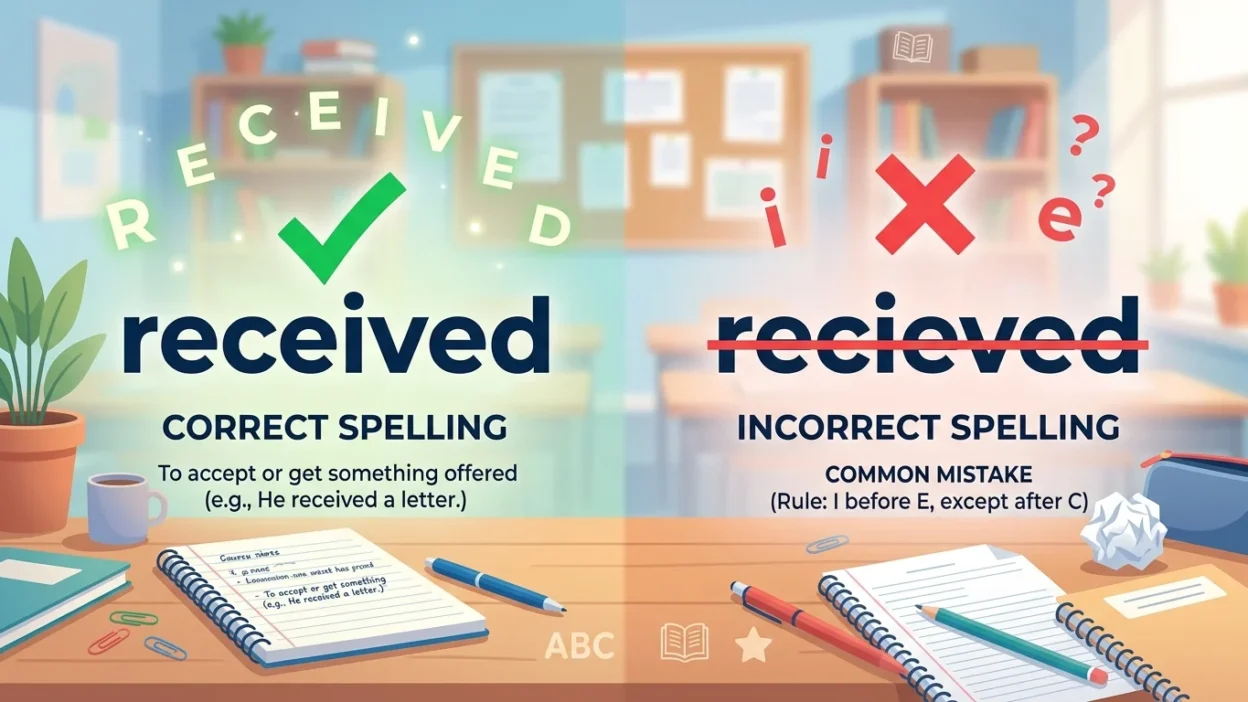
- “Received” is correct
- “Recieved” is wrong
- The correct rule: “I before E except after C” (in this case, “ceive” becomes “receive”)
- The word always keeps the same spelling in all forms:
- receive → received → receiving
- “Recieved” is a spelling mistake and should not be used in writing
If you remember just one thing, remember this: always write “received,” never “recieved.”
Simple Origin or Background
The word “receive” comes from old French and Latin roots. In English, many words ending in “-ceive” follow a similar pattern:
- receive
- perceive
- deceive
- conceive
These words all use the same “-ceive” ending. That is why the spelling stays consistent.
Over time, people started making mistakes because English pronunciation does not clearly show the spelling. When we say the word, the “ei” sound is not obvious, so many learners guess the wrong order and write “ie” instead of “ei.”
That is how “recieved” became a common mistake.
Clear Explanation of the Difference
The difference is very simple:
Received
- Correct spelling
- Past form of “receive”
- Used in normal writing and speaking
- Follows standard English spelling rules
Example:
- I received your message yesterday.
- She received a gift from her friend.
Recieved
- Incorrect spelling
- Not accepted in English grammar
- Often written by mistake
- Should always be corrected to “received”
So the only real difference is that one is correct and one is wrong.
Comparison Table
Here is a simple table to help you remember:
| Word | Correct or Wrong | Meaning | Example Sentence |
| Received | Correct | Got something | I received your email today. |
| Recieved | Wrong | No meaning (error) | ❌ I recieved your email today. |
This table shows that only “received” should be used in all situations.
Which One to Use and When
You should always use “received” in every situation.
Use it when talking about:
- Messages or emails
- Gifts or items
- Information or news
- Payments or money
- Official documents
Examples:
- I received my exam results.
- He received a letter from the bank.
- They received good news today.
No matter the situation, the spelling never changes.
The wrong form “recieved” should never be used, even in casual writing.
Common Mistakes People Make
Many learners make the same mistakes when writing this word. Here are the most common ones:
Mixing “i” and “e”
People often write “recieved” because they think the letters go in a different order.
Relying on sound
Since the word sounds like “ree-seevd,” people guess the spelling instead of remembering the rule.
Forgetting the base rule
The word “receive” always keeps “ei” after “c.”
Typing quickly
Fast typing in messages or exams leads to spelling errors.
Not checking writing
Many mistakes stay because people do not review their sentences.
If you avoid these habits, your spelling will improve quickly.
Everyday Real Life Examples
Let’s see how “received” is used in daily life.
Emails and Messages
- I have received your email and will reply soon.
- She received your message last night.
News and Information
- The school received good results this year.
- The company received approval from the government.
Social Media
- I just received a surprise gift!
- We received so much support from everyone.
Daily Life Situations
- I received my parcel today.
- He received money from his job.
- They received visitors at home.
These examples show that “received” is used everywhere in daily communication.
Short Learning Section for Students and Beginners
Here is a simple way to remember the correct spelling:
Easy Rule
- Words ending in “-ceive” always use “ei”
- Example words:
- receive
- deceive
- perceive
Memory Trick
Think like this:
👉 “C comes first, so E comes first after C”
So it becomes: re-ceive
Practice Tip
Write this sentence 5 times:
- I received my homework.
This helps your brain remember the correct spelling faster.
FAQ
Why is “recieved” wrong?
Because English spelling rules require “ei” after “c” in this word family.
Is “recieved” ever correct in any situation?
No. It is always wrong in standard English.
What is the correct spelling?
The correct spelling is “received.”
Why do people write “recieved”?
Because the sound of the word confuses them, so they guess the spelling.
Does the spelling change in past tense?
No. It stays “received” in past form.
How can I remember the correct spelling?
Remember the rule: words with “ceive” always use “ei.”
Is “receive” and “received” the same?
No. “Receive” is present tense, and “received” is past tense.
What is the easiest way to avoid mistakes?
Slow down while writing and always double check the spelling.
Conclusion
The confusion between “received” and “recieved” is very common, but the answer is simple. Only “received” is correct in English, while “recieved” is always a spelling mistake.
Once you remember the simple pattern of “ceive” words and practice a few examples, you will stop making this error. With regular use, the correct spelling will become natural in your writing.
Clear writing is not about big words it is about correct small details like this one.