
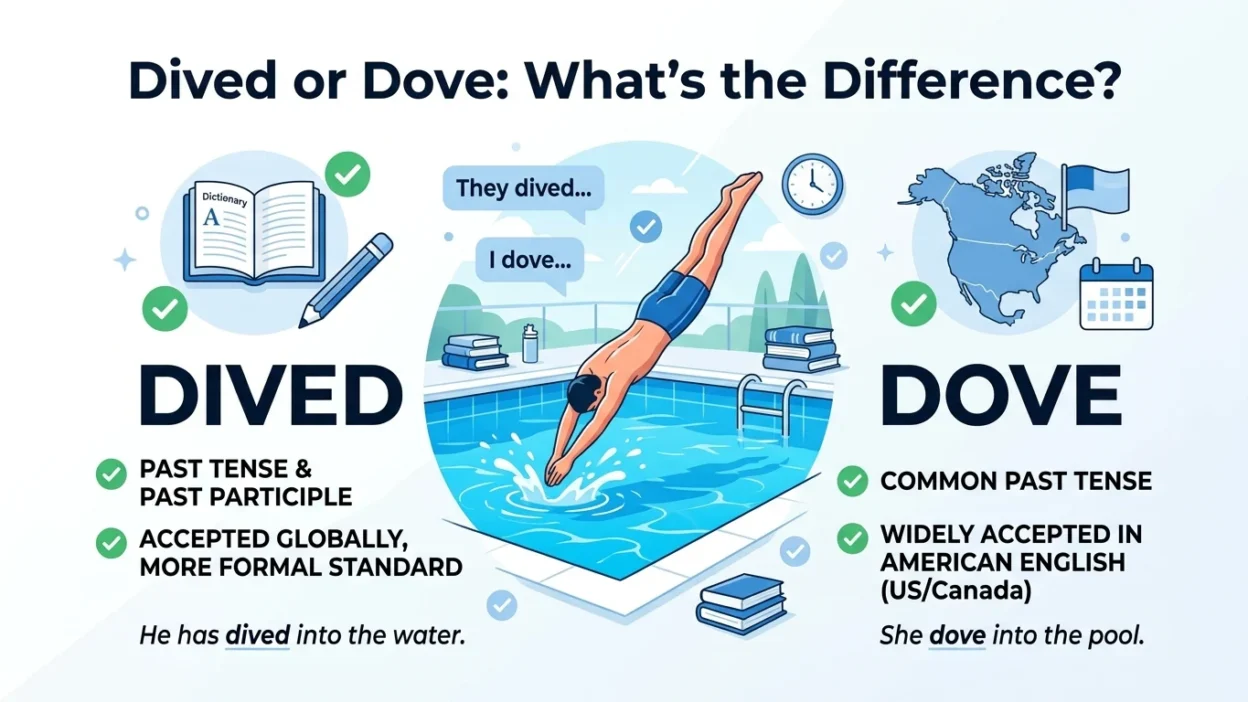
The dived vs dove question is a classic grammar and word comparison topic in the English language. Both forms are correct, accepted, and considered a past tense of the verb dive, but their usage depends on geographical preference, formality, and audience. In British English, dived is the preferred, traditional, and more standard choice, while American English commonly uses dove as a newer form and irregular variation. Canadian English often accepts both. For formal writing, academic writing, professional writing, and international English, dived remains the safe choice and a universally accepted option.
The origin, etymology, and history of this language change trace back to Old English dyfan, with a notable historical split during the 19th century, 1800s, and the period from 1850 to 2019, showing an evolution of English influenced by analogy with drive, drove, ride, rode, strive, strove, and wove.
From my own editing and research experience, most English learners, native speakers, writers, and readers gain more writing confidence when they understand the key differences between dived and dove. The past participle is normally dived, especially after have, has, or had in perfect tense and perfect tenses, making it the correct form for a global audience.
A quick grammar guide is simple: UK stays regular, US gets creative. Whether you see the word in books, movies, online articles, conversations, newswriting, social media, or spoken English, both forms have strong acceptability, but style consistency, audience matching, and regional preferences matter. If you are ever unsure during exams, professional communication, or a project, choose dived because it supports grammar accuracy, correct usage, worldwide acceptance, universal acceptance, standard usage, and clearer communication.
Quick Answer
Here is the short answer:
- Dive = present tense
- Dived = past tense and past participle
- Dove = past tense only
- Both dived and dove are accepted in modern English
- Dived is more common in many parts of the world
- Dove is especially common in American English
- When in doubt, dived is usually the safest choice for formal writing
Examples:
- Yesterday, he dived into the lake.
- Yesterday, he dove into the lake.
Both are correct.
Origin and Background
The verb dive originally formed its past tense as dived.
This follows the normal English pattern:
- Walk → Walked
- Jump → Jumped
- Dive → Dived
Over time, many English speakers started using dove as a past tense form. It developed in a way similar to other irregular verbs:
- Drive → Drove
- Ride → Rode
- Dive → Dove
As a result, both forms became common. Today, dictionaries generally accept both.
However, usage can differ depending on the country, region, and personal preference.
Understanding the Difference
The most important thing to know is that the meaning does not change.
Both words describe the action of moving quickly into water or moving downward.
Using “Dived”
Dived is the traditional and regular past tense form.
Examples:
- The swimmer dived into the pool.
- The bird dived toward the water.
- She dived under the waves.
Many teachers and grammar guides consider this form suitable in all situations.
Using “Dove”
Dove is an alternative past tense form.
Examples:
- The swimmer dove into the pool.
- The bird dove toward its target.
- He dove beneath the surface.
This form is widely used and accepted, especially in everyday American English.
Past Participle Difference
This is where learners often make mistakes.
Correct:
- She has dived into that lake many times.
- They had dived before the race began.
Usually not preferred:
- She has dove into that lake many times.
For perfect tenses, dived is generally the safer choice.
Comparison Table
| Feature | Dived | Dove |
| Past tense | Yes | Yes |
| Past participle | Yes | Usually yes in some speech, but less preferred |
| Accepted in modern English | Yes | Yes |
| Common in American English | Yes | Very common |
| Common internationally | Very common | Less common |
| Formal writing | Excellent choice | Usually accepted |
| Safe choice for learners | Yes | Depends on audience |
Which One Should You Use and When?
Choosing between dived and dove depends on your audience and writing style.
Use “Dived” When:
- Writing school assignments
- Taking English tests
- Writing formal documents
- You want the safest grammar choice
- You are unsure which form to use
Examples:
- The athlete dived into the water.
- The rescue worker dived into the river.
Use “Dove” When:
- Writing informal American English
- Creating stories or conversations
- Following a style that commonly uses it
- Speaking casually with native speakers
Examples:
- He dove into the ocean without hesitation.
- The child dove into the pile of leaves.
For ESL Learners
Many teachers recommend learning dived first because it follows the regular English pattern and works almost everywhere.
Once you understand that form, you can recognize dove when you see or hear it.
Common Mistakes People Make
Mixing Tenses Incorrectly
Incorrect:
- He dive into the pool yesterday.
Correct:
- He dived into the pool yesterday.
- He dove into the pool yesterday.
Using Present Tense Instead of Past Tense
Incorrect:
- She dive into the lake last week.
Correct:
- She dived into the lake last week.
- She dove into the lake last week.
Confusing the Bird “Dove” With the Verb “Dove”
The word dove can also be a bird.
Example:
- A white dove sat on the tree.
Here, dove is a noun, not a verb.
Using Different Forms Randomly
Consistency is important.
If you choose dived in formal writing, try to use it throughout the document.
Everyday Real Life Examples
In Emails
- The lifeguard dived into the water to help the swimmer.
- The rescue team dived several times during the search.
In News Reports
- The athlete dived from a ten meter platform.
- Witnesses said the man dove into the river.
On Social Media
- I dived into my favorite book all weekend.
- She dove right into the challenge.
In Daily Conversation
- My brother dived into the pool first.
- The dog dove into the lake after the ball.
In School Writing
- The penguin dived underwater to catch fish.
- The explorer dived beneath the surface.
Learning Tips for Students and Beginners
If you are learning English, remember these simple points:
Think of “Dived” as the Easy Choice
You can use dived in almost every situation without worrying.
Example:
- She dived into the pool.
Recognize “Dove” When Reading
You will often see dove in books, articles, and American English conversations.
Example:
- He dove into the water.
Practice Both Forms
Try making your own sentences.
Examples:
- The swimmer dived into the pool.
- The swimmer dove into the pool.
This helps you become comfortable with both versions.
Remember the Perfect Tenses
Use dived after words like:
- has
- have
- had
Examples:
- He has dived there before.
- They had dived many times.
Frequently Asked Questions
Is “dived” correct English?
Yes. Dived is completely correct and widely accepted.
Is “dove” correct English?
Yes. Dove is also accepted as a past tense form of dive.
Which form is more common?
It depends on the region. Dove is very common in American English, while dived is common in many English speaking countries.
Which form should students learn first?
Students should usually learn dived first because it follows the regular grammar pattern.
Can I use “dove” in formal writing?
Many people do, but dived is often considered the safer choice in formal situations.
Is “dove” only a bird?
No. Dove can be a bird, but it can also be the past tense of dive.
What is the past participle of “dive”?
The most widely accepted past participle is dived.
Example:
- She has dived many times.
Will native speakers understand both words?
Yes. Native speakers generally understand both dived and dove without any problem.
Conclusion
The difference between dived and dove is much simpler than many learners think. Both forms are accepted as the past tense of dive, and both are used by native English speakers.
The key point is that dived is the traditional and regular form, while dove is an alternative form that is especially common in American English.
If you want the easiest and safest option, use dived. If you see or hear dove, do not worry it is also correct in modern English.
Once you understand this simple rule, you can confidently use both words and avoid confusion in speaking and writing.