Many English learners get confused about send and sent because both words talk about giving, delivering, or moving something from one person or place to another.
You may have seen sentences like:
- “I send emails every day.”
- “I sent the email yesterday.”
At first, these two words can look very similar. Since they come from the same verb, it is easy to mix them up.
The good news is that the difference is actually very simple.
Once you understand time, you will know exactly when to use send and when to use sent.
This guide will explain everything in very easy English.
Quick Answer
Here is the short answer:
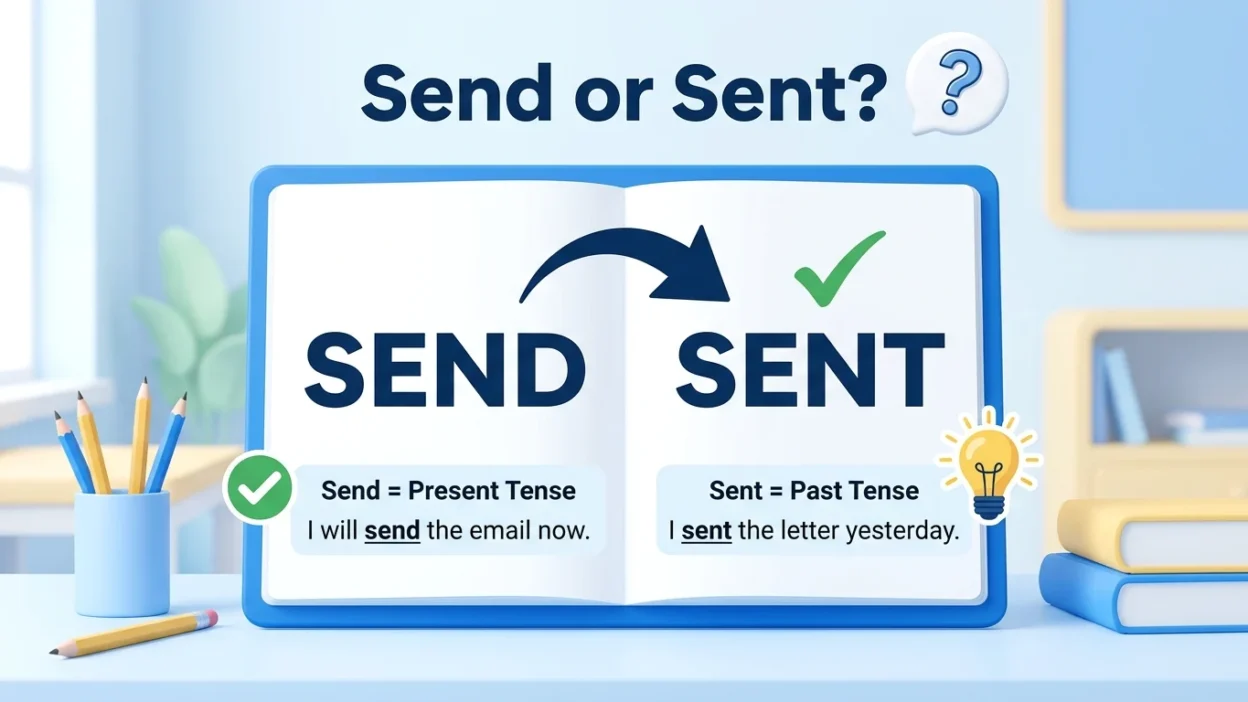
- Send = present tense (happening now, usually, or in the future)
- Sent = past tense (already happened)
Simple examples:
Send
- Please send me the file.
- I send messages every morning.
Sent
- I sent the file yesterday.
- She sent me a text last night.
Easy way to remember:
If it already happened → use “sent”
If it is happening now, regularly, or will happen → use “send”
Simple Background Explanation
The word send is a very old English verb.
It means:
- to deliver something
- to cause something to go somewhere
- to make something reach another person or place
Over time, English changed some verbs when talking about the past.
For many verbs, we simply add -ed:
- work → worked
- clean → cleaned
But some verbs are irregular.
That means they change in a different way.
Send is one of these irregular verbs:
- Present: send
- Past: sent
- Past participle: sent
This is why we say:
- I send
- I sent
- I have sent
The Clear Difference Between Send and Sent
The main difference is time.
What Does “Send” Mean?
Send is the base form of the verb.
We use it for:
1. Present actions
Things happening now.
Example:
- I send reports every morning.
2. Habitual actions
Things you do regularly.
Example:
- She sends updates every week.
3. Future actions (with helping words)
Example:
- I will send it tomorrow.
4. Commands
Example:
- Send me the details.
What Does “Sent” Mean?
Sent is the past form.
We use it for actions that already happened.
Examples:
- I sent the package yesterday.
- He sent the message last night.
- They sent the invitation last week.
The action is finished.
Comparison
| Feature | Send | Sent |
| Verb form | Base form | Past form |
| Time | Present / future | Past |
| Action status | Happening now, regular, or later | Already finished |
| Example | I send emails daily. | I sent the email yesterday. |
| Used with “will” | Yes | No |
| Used for commands | Yes | No |
Which One to Use and When
Here is a simple rule:
Use “Send” When:
You are talking about:
- something happening now
- a regular action
- a future action
- giving a command
Examples:
- Please send your homework.
- I send photos to my family.
- We will send the report tomorrow.
Use “Sent” When:
You are talking about something completed in the past.
Examples:
- I sent my homework yesterday.
- She sent the photos last week.
- We sent the report this morning.
Common Mistakes People Make
Many learners make small mistakes with these words.
Let’s fix them.
Mistake 1: Using “sent” for the present
❌ I sent emails every day.
✅ I send emails every day.
Why?
“Every day” shows a regular present action.
Mistake 2: Using “send” for the past
❌ I send the package yesterday.
✅ I sent the package yesterday.
Why?
“Yesterday” shows the past.
Mistake 3: Using “sent” after “will”
❌ I will sent it tomorrow.
✅ I will send it tomorrow.
Why?
After “will,” always use the base verb.
Mistake 4: Confusing “have sent”
❌ I have send the email.
✅ I have sent the email.
Why?
After “have/has,” use the past participle: sent
Everyday Real Life Examples
Let’s look at how people use these words in daily life.
In Emails
Send
- Please send the document today.
- I will send the final version later.
Sent
- I sent the document this morning.
- She sent the correction already.
In News Reports
Send
- The company will send supplies tomorrow.
Sent
- The company sent emergency supplies yesterday.
On Social Media
Send
- Send me the link.
- I always send funny videos to friends.
Sent
- I sent you the meme already.
- He sent me that post last night.
In Daily Conversation
Send
- Can you send me your address?
- I usually send birthday cards.
Sent
- I sent my address earlier.
- We sent them a gift.
Learning Section for Students and Beginners
Here is an easy trick to remember.
Look for Time Words
Time words tell you which verb to use.
Use “Send” with:
- now
- every day
- usually
- tomorrow
- later
- soon
Examples:
- I send updates every day.
- I will send it tomorrow.
Use “Sent” with:
- yesterday
- last night
- last week
- earlier
- already
- this morning
Examples:
- I sent it yesterday.
- She sent it earlier.
Memory Trick
Think of this:
Sent = finished
Both are short and sound complete.
If the action is done, use sent.
Frequently Asked Questions (FAQ)
1. Is “sent” the past tense of “send”?
Yes.
Example:
- Present: I send
- Past: I sent
2. Can I say “I have send”?
No.
Correct:
- I have sent
Wrong:
- I have send
3. Which is correct: “Please sent me” or “Please send me”?
Correct: Please send me
This is a command, so use the base form.
4. Is “sended” a real word?
No.
The correct past form is sent, not “sended.”
5. Can “send” talk about the future?
Yes.
Example:
- I will send it tomorrow.
6. Why does “send” change to “sent”?
Because it is an irregular verb.
English has many irregular verbs, like:
- go → went
- buy → bought
- send → sent
7. Which is correct: “I sent it” or “I send it”?
Both can be correct.
It depends on time.
- I send it = present habit
- I sent it = past completed action
8. How can I remember the difference?
Ask yourself:
Did it already happen?
- Yes → sent
- No / now / regular / future → send
Conclusion
The difference between send and sent is all about time.
Here is the simple rule to remember:
Use “send” for present, future, or regular actions.
Use “sent” for actions already completed in the past.
Examples:
- I send emails every day.
- I sent the email yesterday.
When you are unsure, check for time words like:
- yesterday → sent
- tomorrow → send
- every day → send
- last week → sent
With a little practice, choosing between send and sent will become easy and natural.