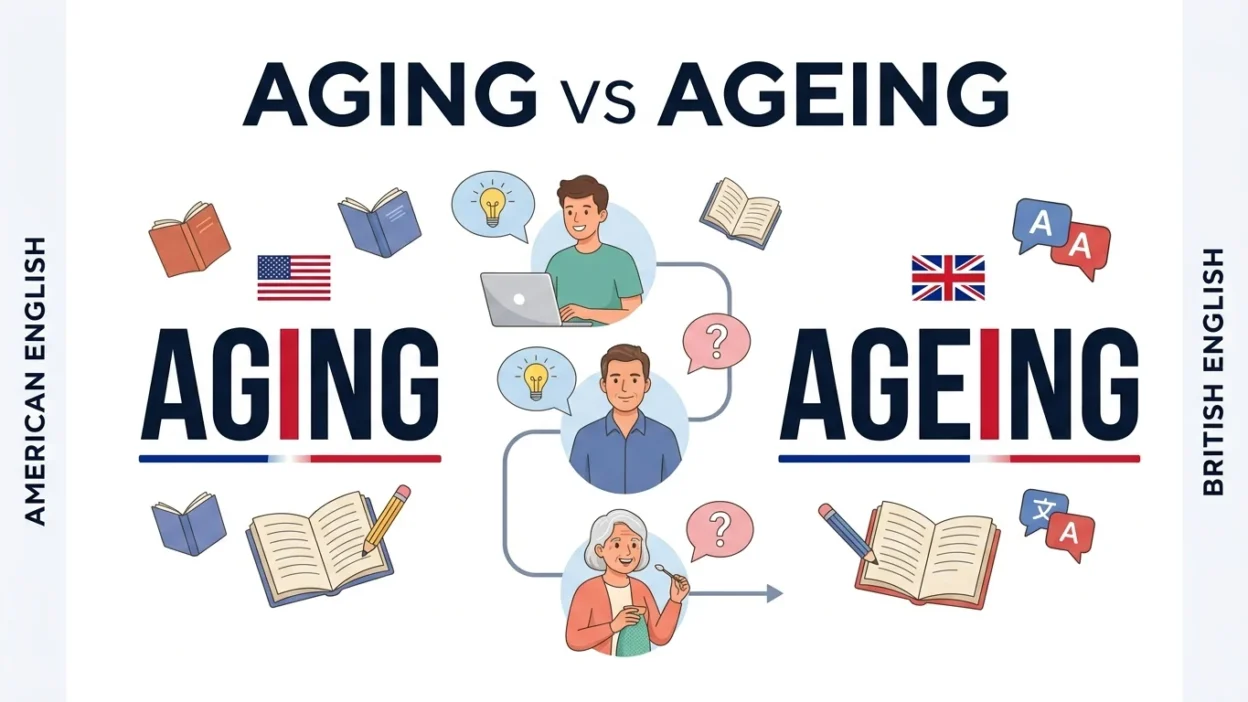
In simple terms, aging and ageing have the same meaning, definition, and process of growing older. The only real spelling difference comes from American English and British English usage. In the United States, the standard spelling is aging, while the UK, Australia, New Zealand, Canada, and other Commonwealth English regions often prefer ageing.
From my experience editing academic writing, professional writing, and online content, the best rule is to follow your audience, style guide, and language preference. Whether the word works as an adjective, noun, verb, or present participle, both forms carry the same exact meaning and remain an accepted spelling in their proper context.
The history behind this regional spelling comes from English spelling changes, Noah Webster, and later spelling reform efforts in the US. British usage often retains the silent e before adding ing, creating ageing, while American usage usually drops the e, creating aging. You can see this pattern in color/colour, organize/organise, traveling/travelling, and favorite/favourite.
Today, both forms appear in scientific publications, academic publications, healthcare, research, medical writing, marketing, government documents, and everyday communication. Whether discussing an aging population, ageing population, healthy aging, healthy ageing, aging infrastructure, anti aging creams, anti ageing creams, or physical aging, the choice depends on regional preference, writing consistency, and the expectations of your readers.
Quick Answer
- Aging and ageing have the same meaning.
- Both words describe the process of growing older.
- Aging is the preferred spelling in American English.
- Ageing is the preferred spelling in British English and many other countries.
- Neither spelling changes the meaning of the word.
- Choose the spelling that matches the English style you are using.
Simple Origin or Background Explanation
The word age has been part of the English language for hundreds of years. It refers to the number of years a person, animal, or thing has existed.
Over time, English speakers needed a word that described the process of becoming older. This led to the forms aging and ageing.
English spelling has changed throughout history. Different countries developed their own spelling preferences. As a result:
- American English usually uses aging
- British English usually uses ageing
This is similar to other spelling differences in English.
For example:
| American English | British English |
| Color | Colour |
| Favorite | Favourite |
| Traveling | Travelling |
| Aging | Ageing |
The meaning stays the same even though the spelling changes.
Clear Explanation of the Difference
The difference between aging and ageing is mainly spelling.
Aging
Aging is the standard spelling in American English.
Examples:
- The population is aging quickly.
- Scientists study aging and health.
- Aging skin needs proper care.
This spelling is commonly seen in:
- American newspapers
- American schools
- American books
- American websites
Ageing
Ageing is the standard spelling in British English.
Examples:
- The population is ageing rapidly.
- Researchers are studying ageing.
- Ageing affects everyone over time.
This spelling is commonly seen in:
- British newspapers
- British schools
- British books
- British publications
Do They Mean Different Things?
No.
Both words mean:
- Growing older
- Becoming older with time
- The natural process of life
There is no difference in meaning.
Comparison Table
| Feature | Aging | Ageing |
| Meaning | Growing older | Growing older |
| Correct spelling | Yes | Yes |
| American English | Preferred | Less common |
| British English | Less common | Preferred |
| Pronunciation | Same | Same |
| Meaning change | No | No |
| Used in formal writing | Yes | Yes |
| Used in everyday writing | Yes | Yes |
Which One to Use and When
Choosing between aging and ageing is simple once you know your audience.
Use Aging When
- Writing in American English
- Studying in an American school
- Writing for a U.S. audience
- Following American style guides
Examples:
- Aging populations are increasing.
- Healthy aging is important.
- Aging can affect memory.
Use Ageing When
- Writing in British English
- Studying in the UK
- Writing for a British audience
- Following British spelling rules
Examples:
- Ageing populations need support.
- Healthy ageing is important.
- Ageing affects everyone differently.
What If You Are Not Sure?
Choose one spelling and use it consistently throughout your writing.
Do not switch between aging and ageing in the same document unless there is a special reason.
Consistency makes your writing look clearer and more professional.
Common Mistakes People Make
Mixing Both Spellings
Incorrect:
- The ageing population is growing because people are aging longer.
While not technically wrong, mixing styles can look confusing.
Better:
- The ageing population is growing.
- The aging population is growing.
Choose one style and stay with it.
Thinking One Is Incorrect
Some learners believe one spelling is wrong.
This is not true.
Both spellings are accepted in English.
Changing the Meaning
Some people think:
- Aging = physical changes
- Ageing = getting older generally
This is incorrect.
Both words have the same meaning.
Forgetting the Audience
If you are writing for an American audience, use aging.
If you are writing for a British audience, use ageing.
Matching the audience helps your writing feel natural.
Everyday Real Life Examples
Emails
American English:
- We are discussing aging issues in the workplace.
British English:
- We are discussing ageing issues in the workplace.
News
American style:
- Experts study aging populations.
British style:
- Experts study ageing populations.
Social Media
American style:
- Healthy aging starts with good habits.
British style:
- Healthy ageing starts with good habits.
Daily Use
American English:
- My grandparents are aging gracefully.
- Aging is a natural part of life.
British English:
- My grandparents are ageing gracefully.
- Ageing is a natural part of life.
Health and Science
American English:
- Researchers study healthy aging.
British English:
- Researchers study healthy ageing.
Short Learning Section for Students and Beginners
Here is an easy trick to remember.
Remember This Rule
American English = Aging
Think of:
- Color
- Favorite
- Aging
These are common American spellings.
Remember This Rule
British English = Ageing
Think of:
- Colour
- Favourite
- Ageing
These are common British spellings.
Simple Memory Tip
If your writing uses:
- Color → use Aging
- Colour → use Ageing
This quick check can help you choose the correct spelling style.
Practice Sentences
Fill in the blank using the style you prefer:
- Healthy ______ is important.
- The population is ______.
- Scientists study ______ and health.
Answers:
- aging/ageing
- aging/ageing
- aging/ageing
Both are correct depending on the English style.
FAQ
Is aging correct?
Yes. Aging is the standard spelling in American English.
Is ageing correct?
Yes. Ageing is the standard spelling in British English.
Do aging and ageing mean the same thing?
Yes. They have exactly the same meaning.
Which spelling is more common?
Aging is generally more common worldwide because American English is widely used, but ageing remains standard in British English.
Is ageing a mistake?
No. Ageing is a correct and accepted spelling.
Can I use both spellings in one article?
It is better to choose one spelling style and use it consistently.
Which spelling should students use?
Students should follow the spelling style required by their school, teacher, or audience.
How do I remember the difference?
Remember:
- American English → Aging
- British English → Ageing
Conclusion
The difference between aging and ageing is very simple. Both words mean the process of growing older, and neither spelling is wrong. The only real difference is the version of English being used.
Use aging when writing in American English and ageing when writing in British English. The meaning, pronunciation, and purpose remain exactly the same.
Once you understand this spelling difference, you can confidently use the correct form for your audience and avoid confusion in your writing.