
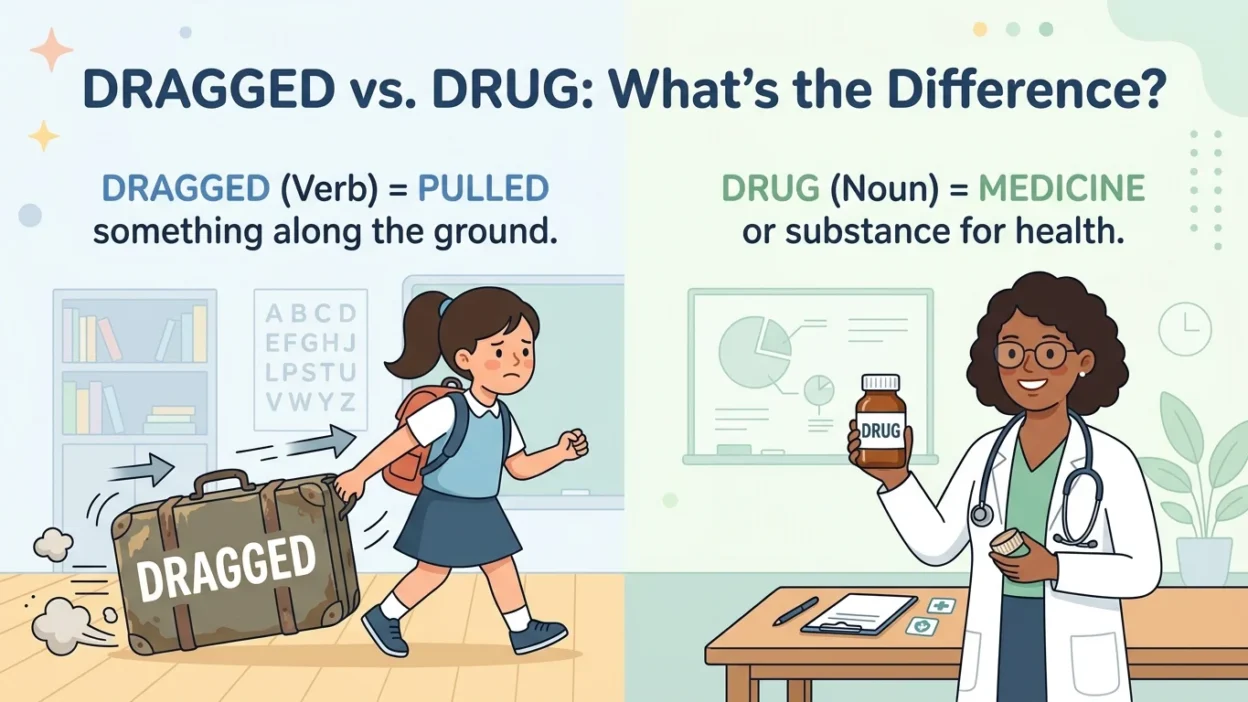
Many English learners and even native speakers get confused between “dragged” and “drug.” These two words look similar and are connected to the same verb “drag,” but they are not used in the same way.
The confusion happens because:
- One word is the normal past tense
- The other is an old or special form
- “Drug” also has a completely different meaning in modern English (medicine)
This makes people unsure when writing sentences like:
- “He dragged the bag” or “He drug the bag?”
- “She was dragged away” or “She was drug away?”
This article will make everything simple and clear so you never confuse them again.
Quick Answer
Here is the easiest way to understand the difference:
- Dragged = the normal and correct past tense of “drag”
- Drug = old past tense of “drag” (not common in modern English)
- Drug = also a noun meaning medicine or illegal substance (different meaning completely)
Simple rule:
- Use dragged in almost all situations
- Avoid using drug for past tense in modern English writing
Simple Origin or Background Explanation
To understand the difference, we need to look at the verb “drag.”
The word drag means:
- To pull something heavy on the ground
- To move something slowly with effort
Example:
- I drag the box across the floor.
Now, English has changed over time. In older English, some verbs had different past forms.
So:
- Modern past tense = dragged
- Old past tense (rare today) = drug
That old form “drug” is still sometimes seen in old books or very old style writing, but it is not commonly used in everyday English anymore.
At the same time, “drug” also became a noun meaning medicine or illegal substance, which is why the confusion is even bigger.
Clear Explanation of the Difference
The main difference is very simple:
Dragged
- Correct and modern past tense of “drag”
- Used in speaking and writing today
- Means something was pulled or moved with effort
Example:
- She dragged the suitcase upstairs.
Drug
Has two meanings:
- Old past tense of drag
- Rare in modern English
- Mostly found in older texts
- Noun meaning medicine or illegal substance
- Completely different word usage
- Example: The doctor gave me a drug.
So when people say “drug the bag,” it usually sounds incorrect in modern English unless referring to very old writing.
Comparison Table (Easy to Scan)
| Word | Type | Meaning | Usage Today | Example Sentence |
| Dragged | Verb (past) | Pulled something with effort | Very common | He dragged the chair. |
| Drug | Verb (past old) | Old form of “drag” | Rare / outdated | He drug the net (old usage). |
| Drug | Noun | Medicine or illegal substance | Very common | The medicine is a drug. |
Which One to Use and When
To keep things simple:
Use “dragged” when:
- Writing school essays
- Speaking English
- Writing emails or messages
- Describing movement or pulling something
Example:
- The boy dragged his bag home.
Avoid “drug” when:
- You are talking about past actions of drag
- You are writing modern English
Use “drug” only when:
- You are talking about medicine or illegal substances
Example:
- The patient needs a strong drug.
Simple rule to remember:
👉 If you mean “pulled something,” always say dragged
Common Mistakes People Make
Here are mistakes that learners often make:
Mixing both meanings
People write:
- “He drug the table” ❌
Correct: - “He dragged the table” ✔️
Confusing medicine meaning
People think “drug” is always related to pulling something, but:
- “drug” can also mean medicine or illegal substance
Using old English unknowingly
Some learners copy sentences from old books or movies and use “drug” incorrectly.
Spelling confusion
Because both words look similar, people think they are just spelling variations. They are not.
Everyday Real Life Examples
Let’s see how these words are used in real life.
Email Example (School or Work)
Correct:
- “I dragged the file into the folder.”
Incorrect:
- “I drug the file into the folder.”
News Example
Correct:
- “The police dragged the suspect out of the building.”
Incorrect:
- “The police drug the suspect out of the building.”
Social Media Example
Correct:
- “I dragged myself out of bed today 😅”
Incorrect:
- “I drug myself out of bed today 😅”
Daily Life Example
Correct:
- “She dragged the chair closer to the table.”
Incorrect:
- “She drug the chair closer.”
Short Learning Section for Students and Beginners
Here is a very simple way to remember:
Think of it like this:
- Drag → present tense
- Dragged → past tense (modern English)
- Drug → medicine OR old English (don’t use for everyday writing)
Easy trick:
If you are unsure, just:
👉 Add “-ed” → dragged
This will almost always be correct.
Practice sentences:
Try filling in the blank:
- Yesterday I ______ my bag to school.
Answer: dragged - The doctor gave me a ______ for pain.
Answer: drug
FAQ (Frequently Asked Questions)
Is “drug” correct as past tense of drag?
It is old English. Today, it is not commonly correct. “Dragged” is preferred.
Can I use “drug” in writing?
Only when talking about medicine or illegal substances, not as past tense of drag.
Why do some people still say “drug” for drag?
Because it exists in old English and some dialects, but modern English avoids it.
Is “dragged” always correct?
Yes, in modern English, “dragged” is the standard past tense.
What is the meaning of “drug” as a noun?
It means medicine or a chemical substance used for treatment or sometimes illegal use.
Are “dragged” and “drug” interchangeable?
No. They are not interchangeable in modern English.
Which one should students use in exams?
Always use “dragged” for past tense.
Is it wrong to see “drug” in books?
Not wrong, but it is usually old writing or special usage.
Conclusion
The difference between “dragged” and “drug” is simple once you understand it.
- Dragged is the correct and modern past tense of “drag.”
- Drug is mostly used as a noun meaning medicine or illegal substance.
- The old past tense “drug” is rarely used today.
If you remember just one rule, remember this:
👉 Use dragged for actions and drug only for medicine related meaning.
With this understanding, you can now write and speak English more confidently without confusion.