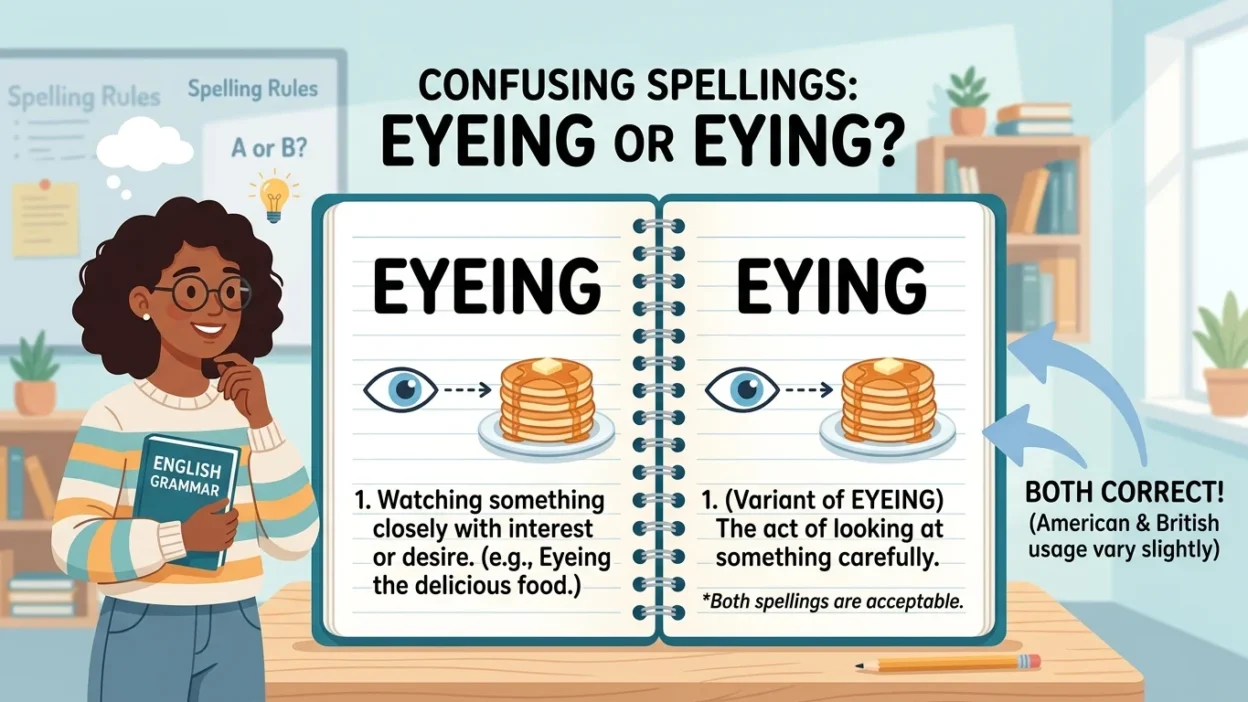
Many English learners get confused when they see the words “eying” and “eyeing.” Both look similar, and both seem related to the word “eye,” so people often wonder which one is correct.
You might see sentences online like:
- “She is eyeing the dress.”
- “She is eying the dress.”
This creates doubt:
- Are both correct?
- Is one wrong?
- Do they mean different things?
The good news is that this confusion is very common, even for native speakers. English spelling often has small variations that look strange but are still accepted.
In this article, you will learn the simple truth behind both words in very easy English.
Quick Answer: Simple Explanation
Here is the clearest answer:
- Eyeing is the most common and widely accepted spelling.
- Eying is also used, but it is less common.
- Both words mean the same thing.
What both words mean:
- Looking at something with interest
- Watching something closely
- Wanting or desiring something
- Paying attention to something carefully
Simple example:
- She is eyeing the cake.
- She is eying the cake.
Both sentences are understood, but “eyeing” is preferred in most writing.
Simple Origin or Background Explanation
To understand the difference, we need to look at the base word: eye.
The word “eye” means the organ we use for seeing. When we turn it into a verb, we add -ing to show action.
Normally, English follows a simple rule:
- Add “-ing” → eye + ing = eyeing
But English spelling sometimes changes for smoother pronunciation. That is where “eying” comes from.
Why two forms exist:
- English spelling developed over hundreds of years.
- Writers sometimes drop extra letters for easier writing.
- Both forms became accepted in different regions and styles.
So, both eyeing and eying appeared in use over time.
However, modern English prefers eyeing because it is clearer and easier to understand visually.
Clear Explanation of the Difference
Even though both words mean the same thing, there is a small difference in usage and popularity.
1. Eyeing (Most Common Form)
- Standard spelling in modern English
- Used in schools, books, newspapers
- Looks more complete and clear
- Preferred in formal writing
2. Eying (Less Common Form)
- Still correct in many contexts
- More informal or simplified spelling
- Sometimes used in older texts or casual writing
- Less common in education and official writing
Key point:
👉 Meaning is exactly the same
👉 Difference is only in spelling style and usage frequency
Comparison Table (Easy to Understand)
| Feature | Eyeing (Most Used) | Eying (Less Used) |
| Correctness | Correct | Correct |
| Usage level | Very common | Less common |
| Formal writing | Preferred | Not preferred |
| Meaning | Same | Same |
| Clarity | Very clear | Slightly less common |
| Example | She is eyeing him | She is eying him |
Which One to Use and When
If you are a student or writing in English, here is the simple rule:
Use “eyeing” when:
- Writing essays
- Writing emails
- Doing school assignments
- Writing formal messages
- Publishing content or reports
You may see “eying” when:
- Reading casual online posts
- Seeing informal writing
- Reading older content
- In some simplified writing styles
Best advice:
👉 Always use “eyeing” unless your teacher or style guide says otherwise.
This keeps your English clean, correct, and professional.
Common Mistakes People Make
Many learners make small mistakes when using these words. Let’s look at them:
1. Thinking one word is wrong
Both are correct, but “eyeing” is preferred.
2. Confusing meaning with spelling
Some think “eying” means something different. It does not.
3. Spelling it as “eye-ing”
This is not needed in normal writing.
4. Using it in the wrong context
Some learners use it for physical eyesight only, but it also means:
- Watching with interest
- Wanting something
5. Overthinking the difference
There is no big meaning difference only style and usage.
Everyday Real Life Examples
In Emails
- I am eyeing the new job opportunity.
- She is eyeing the promotion in her office.
In Social Media
- He is eyeing the latest phone release.
- Everyone is eyeing the viral video trend.
In Daily Conversation
- I am eyeing that shop’s discount sale.
- They are eyeing the best seats in the theater.
Simple idea in all examples:
👉 Someone is watching or wanting something with interest
Short Learning Section for Students and Beginners
If you are learning English, remember this simple trick:
Think like this:
- “Eye” = see
- “Eyeing” = seeing with interest
Easy memory rule:
👉 Add “-ing” to show action
👉 “Eyeing” = action of looking carefully
Practice tip:
Try making your own sentences:
- I am eyeing ______
- She is eyeing ______
- They are eyeing ______
This helps you understand and remember faster.
FAQ: Common Questions
Is “eying” correct English?
Yes, it is correct, but less commonly used than “eyeing.”
Which spelling should I use in exams?
Use eyeing because it is more standard and accepted.
Do “eying” and “eyeing” have different meanings?
No, both mean the same thing.
Why do two spellings exist?
Because English spelling changed over time and both forms were used in different styles.
Is “eyeing” formal or informal?
It can be both, but it is mainly used in formal and standard English.
Can I always replace “eying” with “eyeing”?
Yes, in most cases you can safely use “eyeing.”
Is “eyeing” American or British English?
It is used in both American and British English.
What does “eyeing someone” mean?
It means looking at someone with interest, attention, or sometimes desire.
Conclusion: Simple Final Understanding
The confusion between “eying” and “eyeing” is very common, but the answer is simple.
Both words:
- Mean the same thing
- Are understandable
- Come from the word “eye”
However, “eyeing” is the preferred and more widely used form in modern English. It is clearer, more standard, and safer for writing in school or formal situations.
If you are unsure, just remember:
👉 Use “eyeing” in most cases
👉 Understand “eying” as a less common but still correct variation
With this simple rule, you will never be confused again.