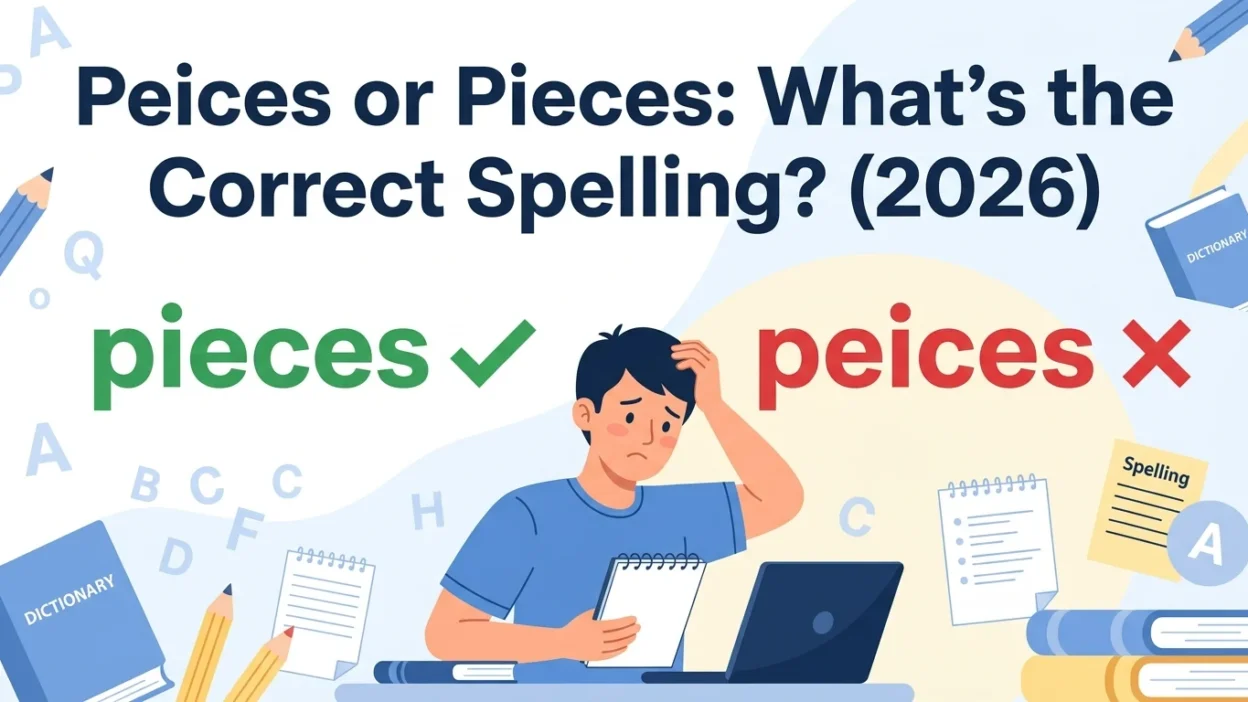
The quick answer is very simple: the correct spelling is pieces, and peices is a mistake in writing English. The total words confusion happens because of common mix of letters in wrong order, especially ie and ei, which makes the word feel confusing for many students and learning users in everyday use. The real truth is that only pieces is a real form that follows a clear rule, and peices simply does not exist, even if people often write it in fast typing, messages, or social media.
In daily life, this mistake appears in emails, reports, and even school work, where people forget the correct spelling while checking or double check their sentences. I have personally seen learners get confused when talking about food like pizza, cake, or bread, or even objects like glass, furniture, or a puzzle that must fit together. The rule is always the same: “ie follows c, so the correct form is pieces, not peices,” which helps you understand clearly, avoid errors, and improve confidence in English writing.
Quick Answer of Peices or Pieces
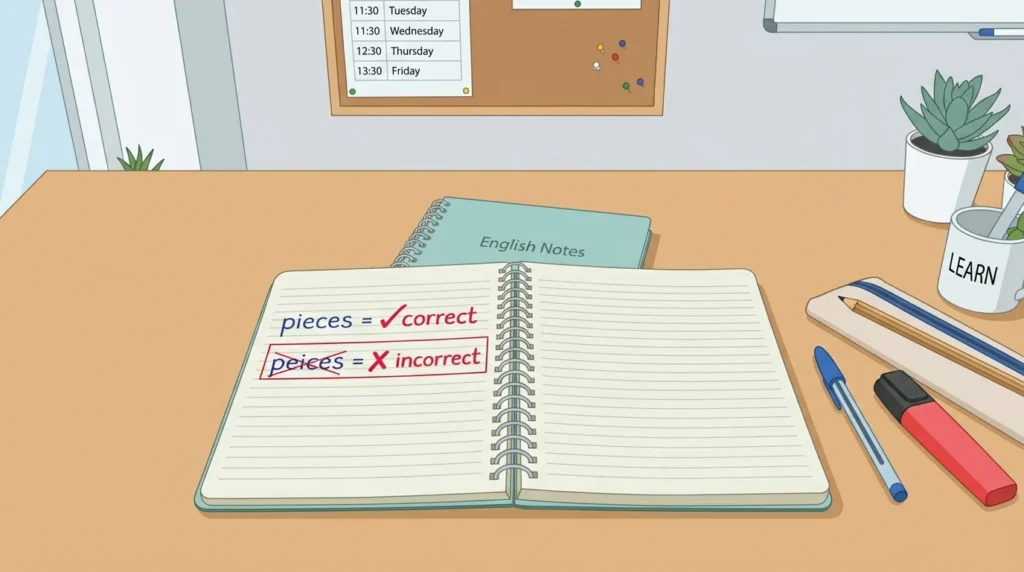
- Pieces = correct spelling
- Peices = incorrect spelling
- Use pieces when talking about parts of something
Example:
- Correct: “I ate two pieces of cake.”
- Incorrect: “I ate two peices of cake.”
The word “peices” is just a spelling mistake.
Why Do People Get Confused between Peices or Pieces?
English spelling can sometimes feel tricky. Many words do not sound exactly like they are written.
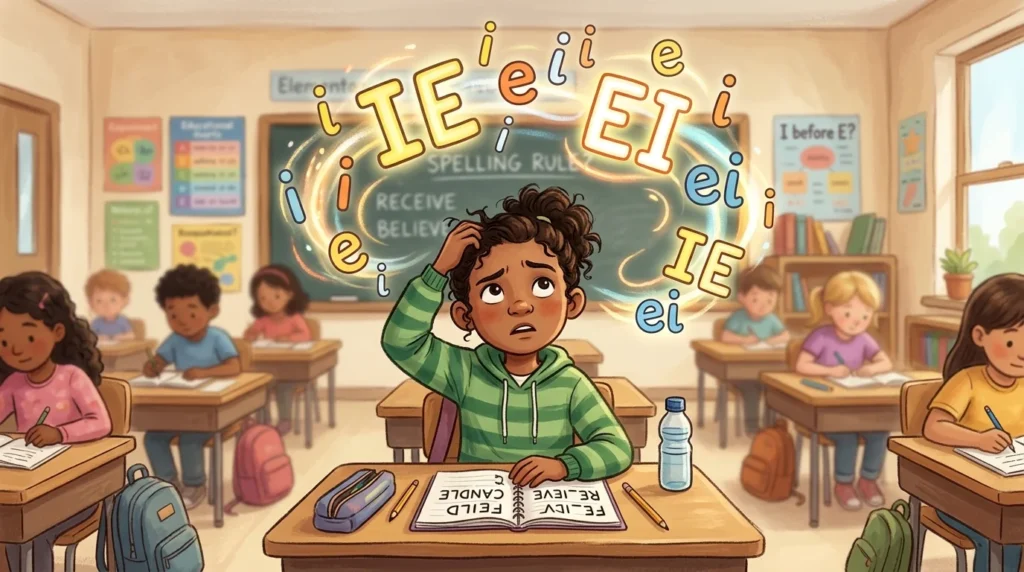
People often confuse “pieces” because of the order of the letters:
- ie
- ei
Some English words use ie, while others use ei. This makes learners unsure about which one to choose.
For example:
- believe
- friend
- receive
- piece
Because there are different spelling patterns in English, mistakes happen very easily.
Simple Background of the Words Peices or Pieces
The word “piece” has been used in English for hundreds of years. It came from older French and Latin words connected to the idea of a “part” or “section” of something.
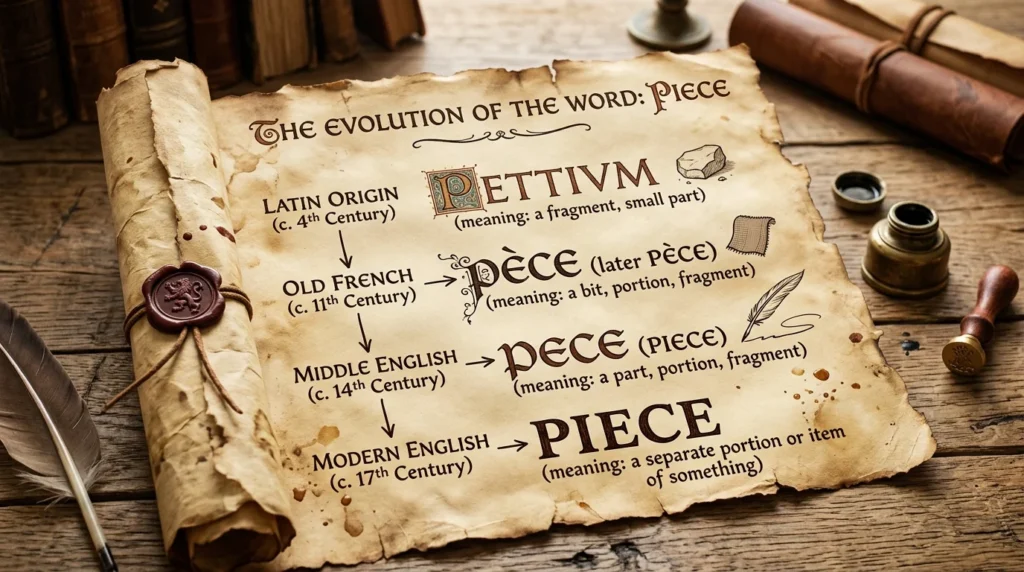
Over time, English kept the spelling piece.
When we make it plural, we simply add s:
- piece → pieces
That is why:
- one piece
- two pieces
The spelling never changes to “peices.”
What Does “Pieces” Mean?
- parts of something
- small sections
- separate items
It is the plural form of piece.
Simple Examples
- I bought three pieces of pizza.
- The glass broke into many pieces.
- She gave me two pieces of advice.
- The puzzle has 500 pieces.
Is “Peices” a Real Word?
No.
“Peices” is not a correct English word.
It is only a spelling error people make when they accidentally reverse the letters.
Wrong Letter Order
- peices ❌
Correct Letter Order
- pieces ✅
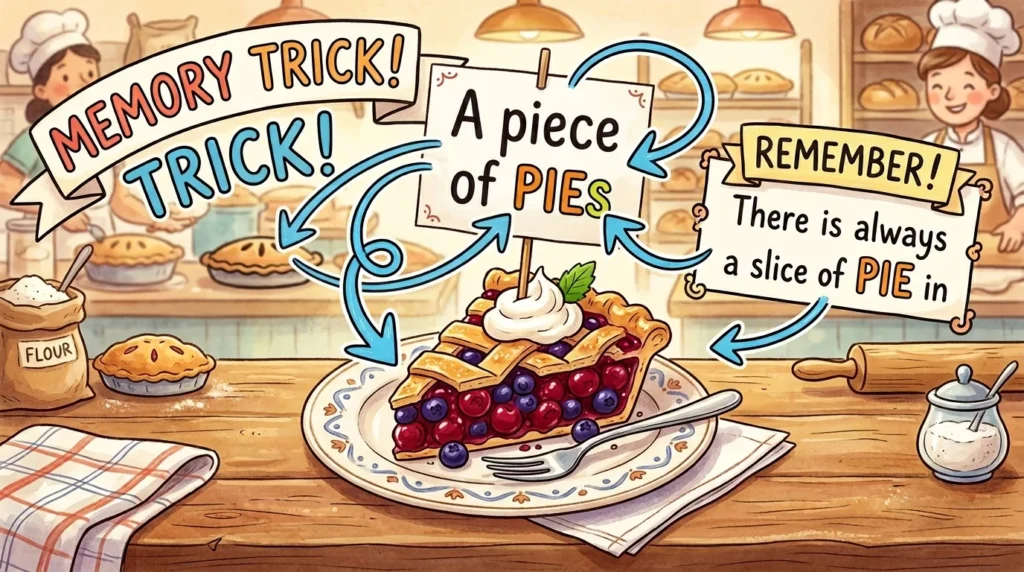
A good way to remember this is:
The word starts with pie like “piece of pie.”
- pieces = pie + ces
This little memory trick helps many students remember the correct spelling.
Clear Difference Between Peices and Pieces
The difference is very simple:
| Word | Correct or Incorrect? | Meaning |
| pieces | Correct | Parts or sections of something |
| peices | Incorrect | Spelling mistake |
There is no situation where “peices” is correct in formal English writing.
Comparison Table
Here is an easy table to help you remember:
| Feature | Pieces | Peices |
| Correct spelling | Yes | No |
| Used in dictionaries | Yes | No |
| Used in school writing | Yes | No |
| Used in emails | Yes | No |
| Accepted in exams | Yes | No |
| Common spelling mistake | No | Yes |
Which One Should You Use Peices or Pieces?
You should always use pieces.
Use “pieces” when talking about:
- food
- objects
- art
- information
- broken things
- sections or parts

Examples
- two pieces of bread
- several pieces of furniture
- missing puzzle pieces
- pieces of paper
- pieces of news
Never use “peices” in:
- homework
- exams
- emails
- job applications
- social media captions
- business writing
Spell check tools will usually mark “peices” as wrong.
Common Mistakes People Make of Peices or Pieces
1. Reversing the Letters
Many people accidentally type:
- peices
instead of:
- pieces
This usually happens because the brain mixes up ie and ei.
2. Writing Too Fast
Typing quickly on a phone or keyboard can cause spelling mistakes.
Example:
- “I need three peices of paper.”
Even good writers sometimes make this error when typing fast.
3. Following Sound Instead of Spelling
The pronunciation of “pieces” does not clearly show the correct letter order. Because of this, learners often guess the spelling incorrectly.
4. Forgetting the Rule
Some students remember the old spelling rhyme:
“i before e except after c”
But English has many exceptions, so learners become confused.
In “piece,” the correct order is:
- ie
Everyday Real Life Examples of Peices or Pieces
Here are simple examples from daily life.
In an Email
- “Please attach all the missing pieces of the report.”
In School
- “The teacher gave us pieces of colored paper.”
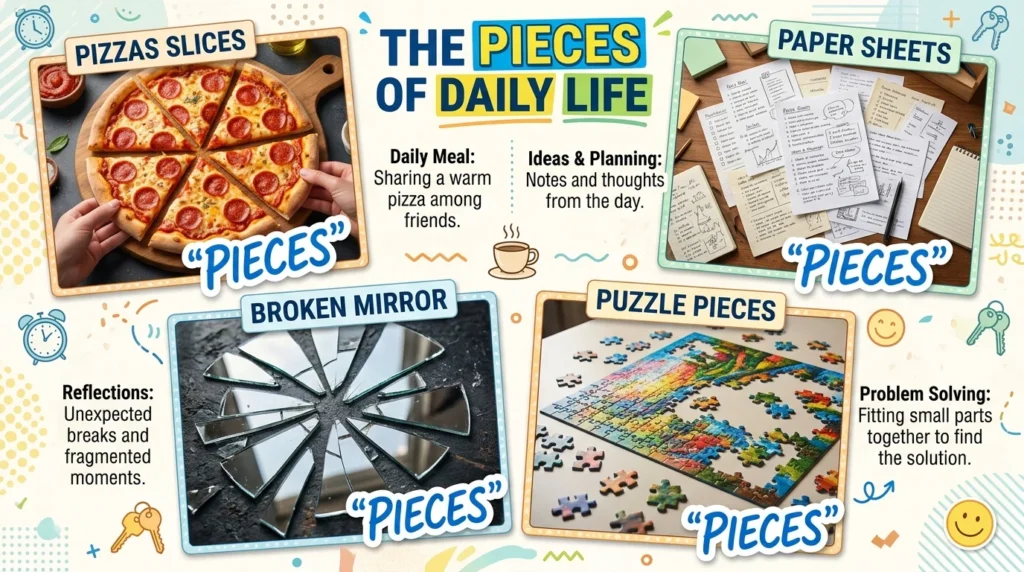
In News Writing
- “Police found pieces of the damaged car.”
On Social Media
- “Pizza night with my favorite people and extra pieces!”
In a Shop
- “This set includes 12 pieces.”
In Daily Conversation
- “Can you cut the cake into smaller pieces?”
Correct vs Incorrect Sentences
| Incorrect Sentence | Correct Sentence |
| I lost two peices of the puzzle. | I lost two pieces of the puzzle. |
| She bought five peices of candy. | She bought five pieces of candy. |
| The mirror broke into peices. | The mirror broke into pieces. |
| I need peices of information. | I need pieces of information. |
Easy Memory Tricks for Peices or Pieces
Here are some simple ways to remember the correct spelling.
Trick 1: Think of “Pie”
The word piece begins with:
- pie
Example:
- piece of pie
This helps you remember:
- pieces ✅
Trick 2: Read It Slowly
Break the word into parts:
- pie-ces
Not:
- pei-ces
Trick 3: Practice Writing It
Write the word several times:
- piece
- pieces
- pieces
- pieces
Practice helps your brain remember the correct pattern.
Learning Section for Students and Beginners of Peices or Pieces
If you are learning English, spelling mistakes are normal. Many learners struggle with words that use:
- ie
- ei
The best way to improve is:
- read more English
- write regularly
- notice correct spelling patterns
- use spell check tools carefully
Helpful Practice Activity
Fill in the blank with the correct word:
- The puzzle has many ______.
- She ate two ______ of cake.
- I need several ______ of information.
Answers
- pieces
- pieces
- pieces
Words Similar to “Pieces”
Here are some related words:
| Word | Meaning |
| piece | one part |
| pieces | more than one part |
| portion | a part of something |
| section | one area or division |
| fragment | a small broken part |
Why Correct Spelling Matters
Correct spelling helps people:
- understand your writing clearly
- take your work seriously
- avoid confusion
- improve English skills
Using the correct spelling is especially important in:
- school assignments
- exams
- professional emails
- resumes
- online writing
Small spelling mistakes can sometimes make writing look careless, even if the idea is good.
FAQ
Is “peices” ever correct?
No. “Peices” is always a spelling mistake.
What is the correct spelling?
The correct spelling is pieces.
Why do people write “peices”?
People often mix up the letters “ie” and “ei.”
Is “pieces” singular or plural?
“Pieces” is plural.
The singular form is “piece.”
How do you use “pieces” in a sentence?
Example:
- “The box contains several pieces of chocolate.”
Can spell check fix “peices”?
Usually yes. Most spelling tools will suggest “pieces.”
Is this mistake common among English learners?
Yes. Many ESL learners make this mistake.
How can I remember the correct spelling?
Think of:
- “piece of pie”
Both start with:
- pie
Conclusion
The difference between “peices” and “pieces” is actually very simple:
- Pieces is the correct spelling.
- Peices is incorrect.
The confusion happens because English spelling patterns can be difficult, especially with ie and ei words. But once you remember the correct letter order, the mistake becomes much easier to avoid.
Whenever you write about parts, sections, or small amounts of something, always use:
✅ pieces
With a little practice, the correct spelling will soon feel natural.