Many students and English learners feel confused when they see the words “suprise” and “surprise.” They look almost the same, and many people think both are correct. Because of typing fast, texting, and reading informal messages online, the spelling mistake “suprise” appears very often.
This confusion is very normal. English spelling can be tricky, and some words do not follow simple rules. In this article, you will clearly understand which spelling is correct, why the mistake happens, and how to avoid it forever in your writing.
Quick Answer: Simple Explanation
Here is the clear and fast answer:
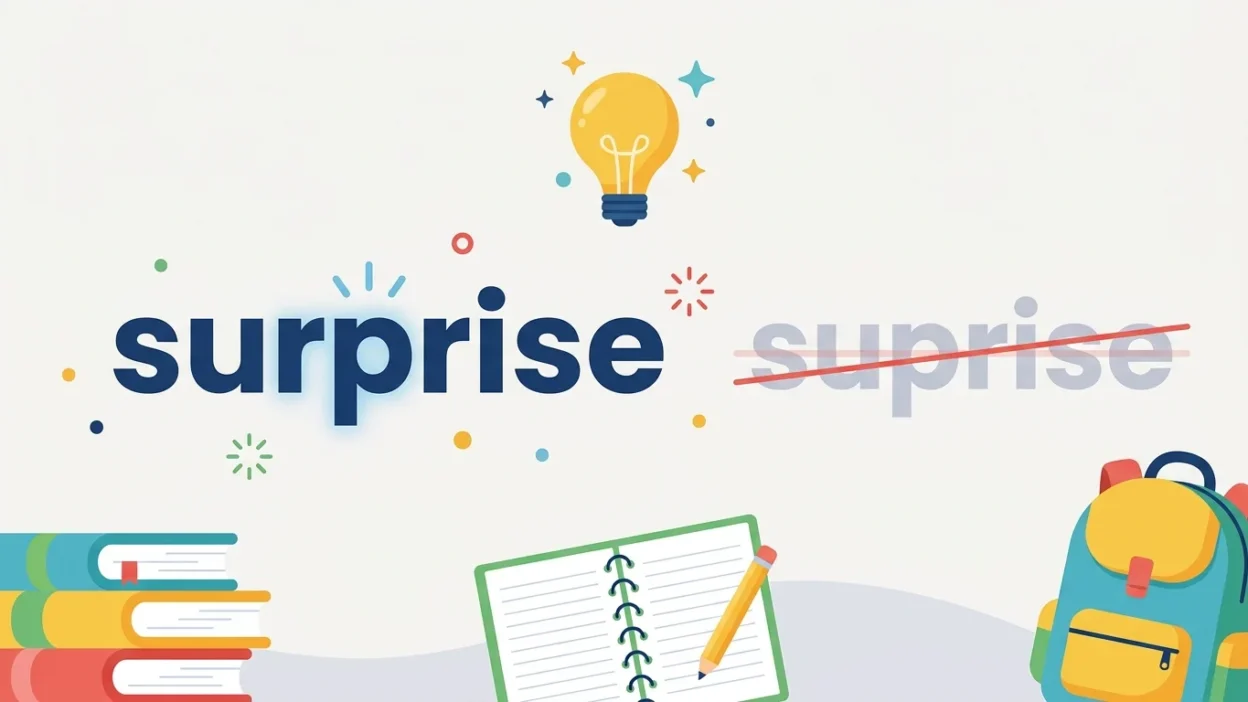
- “Surprise” is the correct spelling.
- “Suprise” is a common spelling mistake.
- Both words are pronounced the same in speech.
- Only “surprise” should be used in exams, writing, emails, and formal English.
In simple words:
👉 Always write “surprise,” never “suprise.”
Simple Origin or Background Explanation
The word “surprise” comes from old French language. It entered English many years ago and kept its original form with the letter “r” in the middle.
The word is built from parts that relate to the idea of something happening suddenly or unexpectedly. Over time, people speaking quickly sometimes dropped the “r” sound when speaking. This led to confusion in spelling when writing.
Because English spelling is not always phonetic (we don’t always write words exactly how they sound), many learners mistakenly write “suprise” without the “r.”
But historically and grammatically, the correct form has always been:
✔ surprise
Clear Explanation of the Difference
Now let’s understand the difference very simply.
“Surprise” (Correct Word)
- Correct spelling in English
- Used in all situations (formal and informal)
- Means something unexpected happens
- Can be used as a noun and a verb
Examples:
- I got a birthday surprise.
- They will surprise their teacher.
- The news was a big surprise.
“Suprise” (Incorrect Word)
- Incorrect spelling
- Missing the letter “r”
- Common typing mistake
- Not accepted in correct English writing
Examples (wrong usage):
- I got a birthday suprise. ❌
- They will suprise their teacher. ❌
Even though many people write “suprise,” it is still a mistake and should be avoided.
Comparison Table
Here is a simple table to make everything even clearer:
| Feature | Surprise | Suprise |
| Correct spelling | Yes | No |
| Contains letter “r” | Yes | No |
| Used in exams | Yes | No |
| Used in formal writing | Yes | No |
| Meaning | Something unexpected | No real correct form |
| Status | Standard English word | Spelling mistake |
Which One to Use and When
The rule is very simple:
Always use “surprise” when:
- Writing essays
- Taking exams
- Sending emails
- Writing social media captions (if you want correct English)
- Speaking or writing formally
Never use “suprise” because:
- It is not accepted in standard English
- It may lower your writing quality
- It is seen as a spelling error in schools and workplaces
A good habit is to slow down when typing and double check this word, especially because it is one of the most commonly misspelled English words.
Common Mistakes People Make
Many learners repeat the same mistake for simple reasons:
Missing the “r” while typing
People often type quickly and forget the middle letter.
Writing based on pronunciation
Since “surprise” sounds like “suh prize,” some people think the spelling should match the sound.
Auto correct confusion
Sometimes phones do not correct the word properly, especially if both versions are typed quickly.
Not learning word structure
Students sometimes learn the word by hearing it, not by seeing it written correctly.
The best way to avoid mistakes is simple practice and repeated exposure to correct spelling.
Everyday Real Life Examples
Let’s see how the correct word is used in daily life.
Emails
Correct:
- “We have a surprise for you in tomorrow’s meeting.”
Incorrect:
- “We have a suprise for you in tomorrow’s meeting.” ❌
News or Messages
Correct:
- “The company announced a surprise update.”
Incorrect:
- “The company announced a suprise update.” ❌
Social Media Posts
Correct:
- “Birthday surprise for my best friend!”
Incorrect:
- “Birthday suprise for my best friend!” ❌
Daily Conversation Writing
Correct:
- “I want to surprise my parents this weekend.”
Incorrect:
- “I want to suprise my parents this weekend.” ❌
Even in casual writing, correct spelling makes your English look more natural and confident.
Short Learning Section for Students and Beginners
If you are a student or beginner, here is an easy way to remember:
Memory Trick
Think of the word “rise” inside “surprise.”
- sur + prise = surprise
The middle sound is “rise,” so the “r” must stay there.
Practice Tip
Write the word 5 times correctly every day:
- surprise
- surprise
- surprise
- surprise
- surprise
This helps your brain remember the correct spelling naturally.
Reading Tip
Whenever you read English books, articles, or captions, pay attention to this word. Seeing it often will help you remember it better than memorizing rules alone.
FAQ: Common Questions
Why do people write “suprise” so often?
Because they type quickly and forget the “r,” or they learn the word by sound instead of spelling.
Is “suprise” ever correct in English?
No, it is always a spelling mistake.
Does “suprise” have a different meaning?
No, it has no correct meaning in standard English.
Why is “surprise” hard to spell?
Because the pronunciation does not clearly show the “r” sound in the middle.
Can I use “suprise” in informal chat?
It is better not to use it anywhere because it is still wrong.
What is the easiest way to remember the correct spelling?
Remember the word “rise” inside it: sur + prise = surprise.
Will people understand me if I write “suprise”?
Yes, but it will still look like a spelling error.
Is this mistake common among native speakers?
Yes, even native speakers sometimes type it wrong in fast texting.
Conclusion
The difference between “suprise” and “surprise” is very simple. Only “surprise” is the correct spelling in English. “Suprise” is just a common mistake caused by fast typing or confusion in pronunciation.
If you remember one thing from this article, it should be this:
👉 Always include the letter “r” in “surprise.”
With a little practice, you can easily avoid this mistake and improve your writing confidence in English.