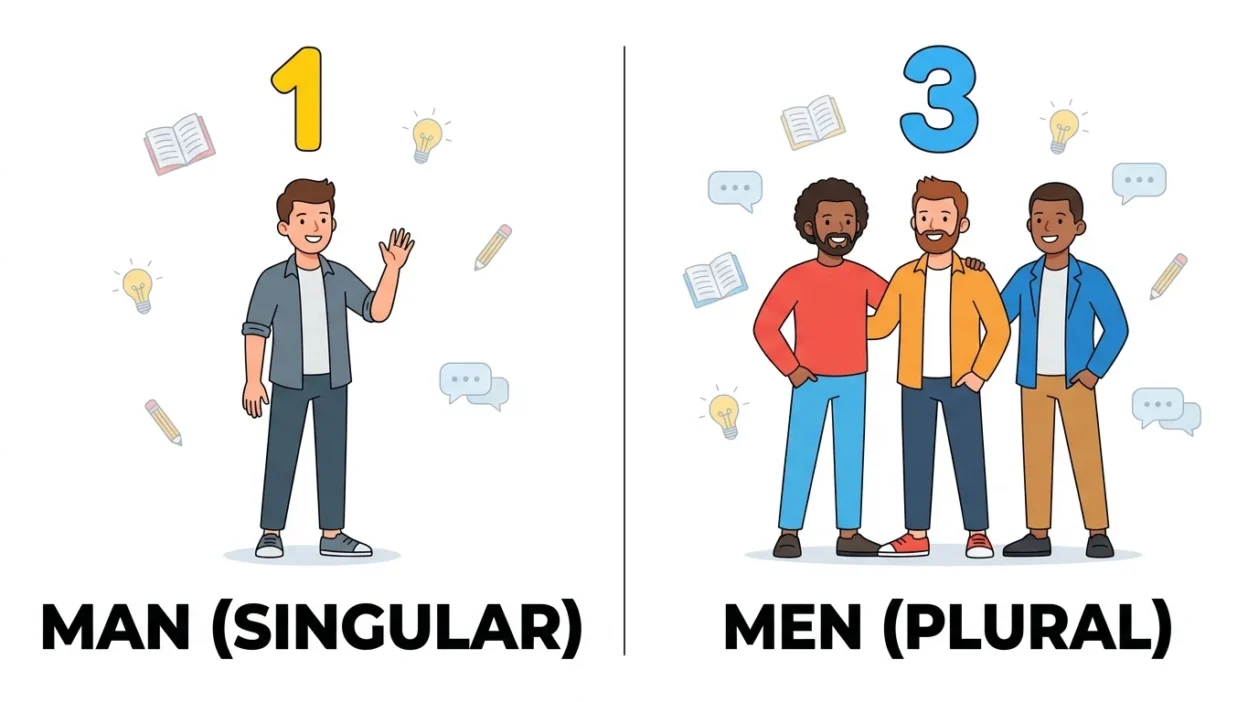
Many English learners get confused by man and men because both words talk about an adult male person. The difference is very small in spelling, but the meaning changes because one word is singular and the other is plural.
This confusion is common for students, ESL learners, and even young native speakers. Unlike many English nouns that simply add -s to become plural, the word man changes its spelling completely when it becomes plural.
The good news is that the rule is very simple once you understand it.
Quick Answer
- Man = one adult male person
- Men = two or more adult male people
- Use man when talking about one person
- Use men when talking about a group of male people
- Man is singular
- Men is plural
Examples:
- The man is waiting outside.
- Two men are waiting outside.
Origin and Background
The words man and men come from very old English.
Many years ago, English had different ways of making words plural. Instead of adding -s, some words changed their vowel sounds.
That is why:
- Man → Men
- Woman → Women
- Foot → Feet
- Tooth → Teeth
These words kept their older plural forms even as English changed over time.
Today, people simply learn them as special plural nouns.
Understanding the Difference Between Man and Men
The main difference is the number of people being discussed.
Man = One Person
Use man when talking about a single adult male.
Examples:
- The man is reading a book.
- I saw a man at the bus stop.
- That man works at the bank.
- A man helped me carry my bag.
In every example, only one male person is being discussed.
Men = More Than One Person
Use men when talking about two or more adult males.
Examples:
- The men are playing football.
- Three men entered the building.
- Many men attended the meeting.
- The men were talking loudly.
In these examples, there is more than one male person.
A Simple Rule
Ask yourself:
Am I talking about one person or more than one person?
- One person → man
- More than one person → men
That is the easiest way to remember the difference.
Comparison Table
| Feature | Man | Men |
| Meaning | One adult male | More than one adult male |
| Number | Singular | Plural |
| Example | The man is smiling. | The men are smiling. |
| Verb Often Used | Is, was | Are, were |
| Refers To | One person | A group of people |
| Correct Sentence | A man called me. | Two men called me. |
Which One Should You Use and When?
Choosing the correct word becomes easy when you look at the number of people.
Use “Man” When
- Talking about one adult male
- Referring to a single person
- Using words like a, one, or this
Examples:
- A man knocked on the door.
- One man raised his hand.
- This man is my teacher.
- The man lives nearby.
Use “Men” When
- Talking about two or more adult males
- Referring to a group
- Using words like many, several, two, or three
Examples:
- Many men work in the factory.
- Several men joined the team.
- Two men were standing outside.
- The men finished the project.
Check the Verb
The verb often helps you choose the correct word.
Singular:
- The man is here.
- The man was tired.
Plural:
- The men are here.
- The men were tired.
Common Mistakes People Make
Many learners make the same mistakes when using these words.
Using “Men” for One Person
Incorrect:
- A men is waiting.
Correct:
- A man is waiting.
Because only one person is being discussed, use man.
Using “Man” for Several People
Incorrect:
- Three man are working.
Correct:
- Three men are working.
Because there is more than one person, use men.
Using the Wrong Verb
Incorrect:
- The men is happy.
Correct:
- The men are happy.
Incorrect:
- The man are happy.
Correct:
- The man is happy.
Forgetting That “Men” Is Already Plural
Incorrect:
- Mens are playing outside.
Correct:
- Men are playing outside.
The word men is already plural. Never add -s.
Everyday Real Life Examples
In Emails
- A man from the company called today.
- Two men will attend tomorrow’s meeting.
- The man requested more information.
- Several men joined the discussion.
In News Reports
- A man was rescued from the river.
- Three men were arrested.
- The man spoke to reporters.
- The men helped during the emergency.
On Social Media
- That man has an amazing story.
- The men in the video are dancing.
- A man shared his experience online.
- Many men commented on the post.
In Daily Conversations
- The man at the store was helpful.
- Two men asked for directions.
- I met a friendly man today.
- The men arrived early.
At School
- A man visited our classroom.
- Several men gave presentations.
- The man answered questions.
- The men discussed their careers.
Learning Tips for Students and Beginners
If you are learning English, these tips can help you remember the difference.
Remember the Number Rule
Think:
- One = Man
- More than one = Men
This rule works almost every time.
Practice With Short Sentences
Write simple sentences such as:
- One man is running.
- Two men are running.
Repeating these patterns helps your memory.
Look at the Verb
Check whether the sentence uses:
- Is / Was → usually man
- Are / Were → usually men
Examples:
- The man is here.
- The men are here.
Read and Listen Often
When reading books, articles, or subtitles, pay attention to how native speakers use these words.
The more examples you see, the easier it becomes.
Create Your Own Examples
Try making sentences like:
- A man opened the door.
- Four men opened the door.
Personal practice is one of the best ways to learn.
Frequently Asked Questions
Is “man” singular or plural?
Man is singular. It refers to one adult male person.
Example:
- The man is speaking.
Is “men” singular or plural?
Men is plural. It refers to two or more adult male people.
Example:
- The men are speaking.
Can I say “two man”?
No. That is incorrect.
Correct:
- Two men
Why doesn’t “man” become “mans”?
English has some special nouns that form plurals by changing vowels instead of adding -s.
Man becomes men.
What is the plural of man?
The plural of man is men.
Example:
- One man
- Five men
Is “a men” correct?
No.
Correct:
- A man
The article a is used with singular nouns.
Which is correct: “The men is” or “The men are”?
Correct:
- The men are
Because men is plural, it uses are.
Is “man” only used for adults?
Usually, yes. The word man generally refers to an adult male. For a young male person, people often use boy.
Conclusion
The difference between man and men is simple once you know the rule. Man means one adult male person, while men means two or more adult male people. The key is to check how many people you are talking about.
Remember this easy guide:
- One person = man
- More than one person = men
With a little practice, choosing the correct word will become natural and easy. Whether you are writing emails, reading news articles, speaking in class, or using social media, understanding the difference between man and men will help you communicate clearly and correctly in English.