Many students and English learners often wonder whether they should write bachelor or bachelors. The confusion usually happens when people talk about university degrees, educational qualifications, job applications, resumes, or college admissions.
You may have seen phrases like:
- Bachelor degree
- Bachelor’s degree
- Bachelors degree
- Bachelor of Science
- Bachelor’s in English
Because these forms look similar, many people are not sure which one is correct.
The good news is that the difference is simple. Once you understand how each word is used, you can choose the right form every time.
Quick Answer
Here is the simple answer:
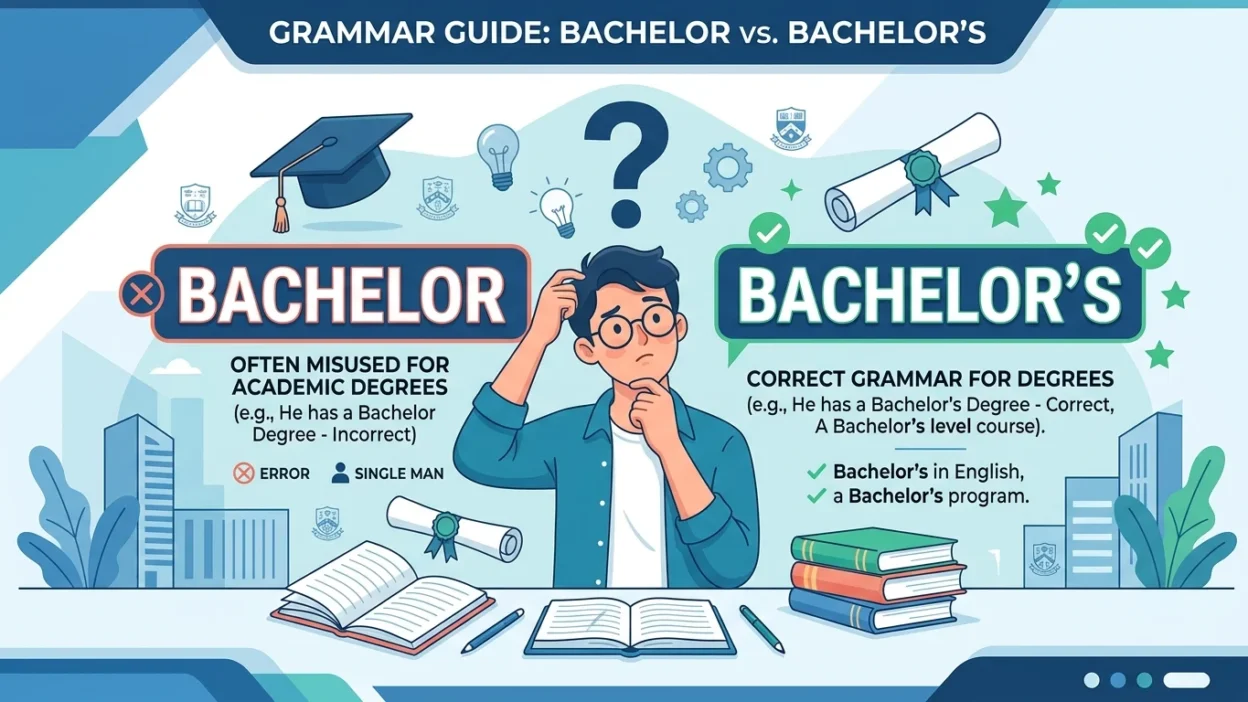
- Bachelor is usually the correct word when it is part of an official degree name.
- Bachelor’s is commonly used in the phrase bachelor’s degree.
- Bachelors without an apostrophe is usually incorrect when talking about a degree.
- Bachelor of Arts (BA) and Bachelor of Science (BS) are correct official degree names.
- I have a bachelor’s degree is correct.
- I have a bachelors degree is incorrect.
If you remember one thing, remember this:
Use “bachelor’s degree” when talking about a degree in general.
Origin and Background of the Word
The word bachelor has been used in English for hundreds of years.
Long ago, it referred to a young man who had not yet reached a higher rank. Over time, universities began using the word for students who completed their first level of higher education.
As education systems developed, the term became linked with undergraduate degrees.
Today, people around the world use the word bachelor when talking about university qualifications such as:
- Bachelor of Arts (BA)
- Bachelor of Science (BS)
- Bachelor of Business Administration (BBA)
- Bachelor of Education (BEd)
The word remains an important part of modern education.
The Difference Between Bachelor and Bachelors
The easiest way to understand the difference is to look at how each form is used.
Bachelor
Bachelor is the singular form.
It is often used:
- In official degree titles
- To describe one degree
- In educational programs
Examples:
- Bachelor of Arts
- Bachelor of Science
- Bachelor of Education
- She earned a Bachelor of Arts.
Bachelor’s
Bachelor’s contains an apostrophe.
This form is used in the common phrase:
Bachelor’s degree
Examples:
- I earned a bachelor’s degree in history.
- She has a bachelor’s degree in business.
- A bachelor’s degree is required for this job.
Bachelors
Bachelors is simply the plural form of bachelor.
It usually refers to more than one bachelor as a person.
Examples:
- Several bachelors attended the event.
- The apartment building is popular among bachelors.
When talking about education, bachelors degree without an apostrophe is normally considered incorrect.
Comparison Table
| Term | Meaning | Correct for Degrees? | Example |
| Bachelor | Official degree title or singular noun | Yes | Bachelor of Science |
| Bachelor’s | Possessive form used with degree | Yes | Bachelor’s degree |
| Bachelors | Plural form of bachelor | Usually No | Several bachelors live here |
| Bachelor’s degree | General name for an undergraduate degree | Yes | She earned a bachelor’s degree |
| Bachelors degree | Missing apostrophe | No | Incorrect usage |
Which One Should You Use and When?
The correct choice depends on what you are trying to say.
When Referring to an Official Degree Name
Use Bachelor.
Examples:
- Bachelor of Arts
- Bachelor of Science
- Bachelor of Engineering
Correct:
- He completed a Bachelor of Science.
When Talking About a Degree in General
Use Bachelor’s degree.
Correct:
- She has a bachelor’s degree.
- I am working toward a bachelor’s degree.
When Talking About More Than One Unmarried Man
Use Bachelors.
Correct:
- The show featured several bachelors.
When Writing Resumes or Applications
Most people write:
- Bachelor’s Degree in Accounting
- Bachelor’s Degree in Psychology
You may also use the official degree title:
- Bachelor of Arts in English
- Bachelor of Science in Biology
Both are commonly accepted.
Common Mistakes People Make
Many learners repeat the same errors. Here are the most common ones.
Mistake 1: Writing “Bachelors Degree”
Incorrect:
- I have a bachelors degree.
Correct:
- I have a bachelor’s degree.
Mistake 2: Adding an Apostrophe to an Official Degree Name
Incorrect:
- Bachelor’s of Science
Correct:
- Bachelor of Science
Mistake 3: Using Bachelor Alone When You Mean Degree
Less natural:
- I have a bachelor in marketing.
Better:
- I have a bachelor’s degree in marketing.
- I have a Bachelor of Business Administration.
Mistake 4: Forgetting the Apostrophe
The apostrophe is important because it forms the standard expression:
Bachelor’s degree
Without it, the phrase becomes incorrect.
Everyday Real Life Examples
Emails
Correct:
- I recently completed my bachelor’s degree in economics.
Correct:
- I hold a Bachelor of Science in computer science.
Incorrect:
- I completed my bachelors degree last year.
News Articles
Examples:
- The company requires a bachelor’s degree for applicants.
- Students celebrated after earning their bachelor’s degrees.
Social Media Posts
Examples:
- Finally finished my bachelor’s degree!
- Proud to receive my Bachelor of Arts today.
- Four years of hard work completed.
Daily Conversations
Examples:
- What is your bachelor’s degree in?
- She earned a Bachelor of Science.
- He plans to start a bachelor’s program next year.
Learning Section for Students and Beginners
A simple trick can help you remember the difference.
Remember Rule Number 1
If the words degree come after it, use:
Bachelor’s degree
Example:
- Correct: bachelor’s degree
- Incorrect: bachelors degree
Remember Rule Number 2
If it is the official name of the qualification, use:
Bachelor of…
Examples:
- Bachelor of Arts
- Bachelor of Science
- Bachelor of Education
Remember Rule Number 3
Use bachelors only when talking about multiple bachelors as people.
Example:
- Three bachelors shared the apartment.
Quick Memory Formula
- Official degree title → Bachelor
- General degree name → Bachelor’s degree
- More than one unmarried man → Bachelors
Frequently Asked Questions (FAQ)
Is it bachelor or bachelor’s degree?
The correct phrase is bachelor’s degree.
Example:
- She earned a bachelor’s degree in chemistry.
Is “bachelors degree” correct?
No. It should be written as bachelor’s degree with an apostrophe.
Why does bachelor’s have an apostrophe?
The apostrophe is part of the traditional expression bachelor’s degree, which has been used in English for a long time.
Is Bachelor of Science correct?
Yes.
Bachelor of Science is an official degree title.
Is Bachelor’s of Science correct?
No.
The correct form is Bachelor of Science.
Can I write bachelor degree?
In standard English, bachelor’s degree is preferred.
Example:
- Correct: bachelor’s degree
- Less standard: bachelor degree
How do I write my degree on a resume?
You can write:
- Bachelor’s Degree in Finance
- Bachelor of Science in Finance
Both are widely used.
What is the plural of bachelor’s degree?
The plural form is:
bachelor’s degrees
Example:
- The university awarded hundreds of bachelor’s degrees this year.
Conclusion
The difference between bachelor, bachelor’s, and bachelors is easier than it first appears.
Use Bachelor when writing the official name of a degree, such as Bachelor of Arts or Bachelor of Science. Use bachelor’s degree when talking about a degree in general. Use bachelors only when referring to more than one bachelor as a person.
A simple rule to remember is this: if you are talking about a university qualification, the phrase bachelor’s degree is usually the correct choice. By following this rule, you can avoid one of the most common English mistakes and write with confidence in school, university, job applications, emails, and everyday conversations.