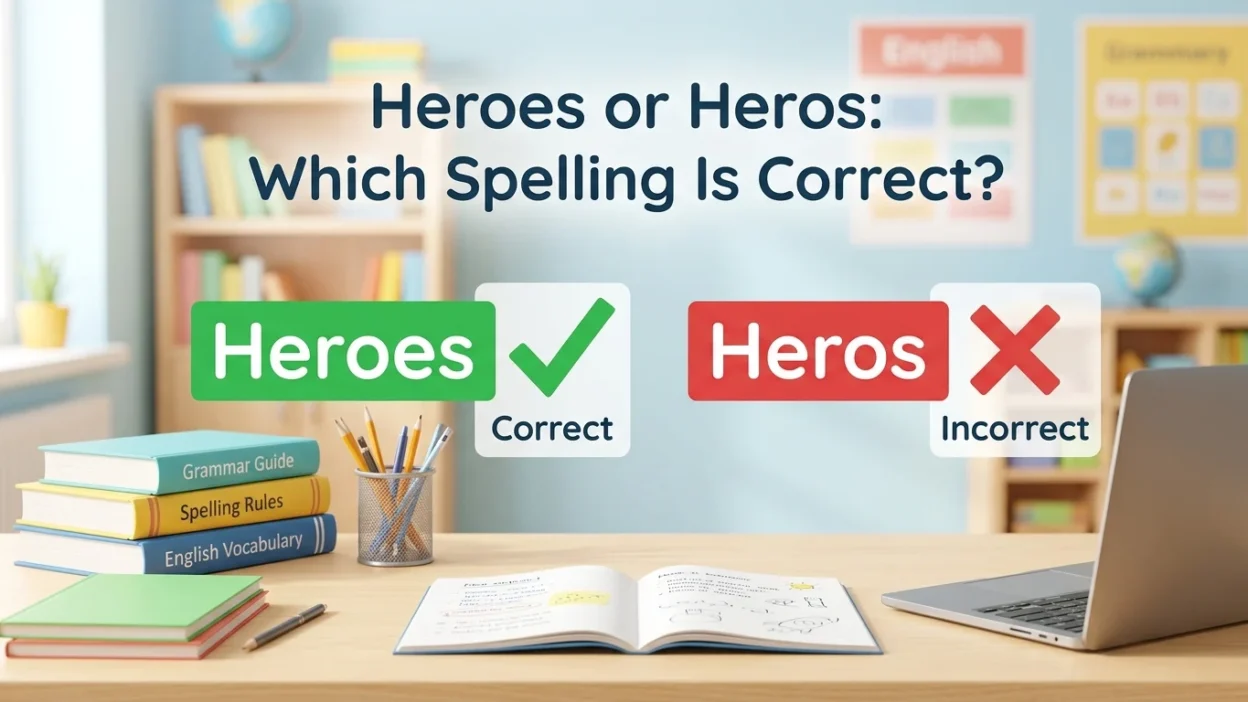
Many people get confused between “heroes” and “heros” because both words sound almost the same. When we speak, it is easy to think the plural of “hero” should simply add an s at the end.
English spelling rules can sometimes feel tricky. Some words add s, while others add es. Because of this, students, ESL learners, and even native speakers sometimes write “heros” by mistake.
The good news is that the difference is actually very simple once you understand the rule.
Quick Answer
- Heroes ❌ = Incorrect spelling
- Heroes ✅ = Correct spelling
- The singular form is hero
- The plural form is heroes
Example:
- One hero
- Two heroes
You should always use heroes when talking about more than one hero.
Simple Origin or Background Explanation
The word hero comes from old Greek language roots. It was used for brave people who showed courage, strength, or kindness.
Over time, English adopted the word and created the plural form using a common spelling rule.
Words that end in -o sometimes form plurals by adding -es.
Examples:
- hero → heroes
- potato → potatoes
- tomato → tomatoes
That is why the correct plural form is heroes, not heros.
Clear Explanation of the Difference
The main difference is very simple:
| Word | Correct or Incorrect | Meaning |
| Hero | ✅ Correct | One brave person |
| Heroes | ✅ Correct | More than one brave person |
| Heros | ❌ Incorrect | Wrong spelling |
Why “Heroes” Is Correct
When a word ends in -o, English sometimes adds -es to make it plural.
So:
- hero + es = heroes
This follows a normal English spelling pattern.
Why “Heros” Is Wrong
“Heros” breaks the spelling rule for this word. Even though it may look right at first, it is not accepted in standard English.
You should avoid using it in:
- school writing
- exams
- emails
- social media captions
- articles
- professional communication
Comparison
| Singular | Plural | Correct? |
| hero | heroes | ✅ Yes |
| hero | heros | ❌ No |
More Similar Examples
| Singular Word | Correct Plural |
| potato | potatoes |
| tomato | tomatoes |
| echo | echoes |
| hero | heroes |
Which One to Use and When
Use “Hero”
Use hero when talking about one person.
Examples:
- My father is my hero.
- The firefighter became a local hero.
- She read a story about a young hero.
Use “Heroes”
Use heroes when talking about two or more people.
Examples:
- Doctors and nurses are heroes.
- The movie had many heroes.
- Children often look up to superheroes as heroes.
Never Use “Heros”
Even if you see it online sometimes, it is considered incorrect spelling.
Common Mistakes People Make
Adding Only “S”
Many learners think every noun becomes plural by adding s.
For example:
- cat → cats
- book → books
So they naturally write:
- hero → heros ❌
But “hero” is one of the words that needs es.
Correct form:
- hero → heroes ✅
Confusing Spoken English With Written English
When people say “heroes,” the extra e is not strongly heard. Because of this, writers sometimes forget it.
But correct spelling still matters in writing.
Copying Incorrect Online Spelling
Sometimes people post incorrect spelling on social media or in comments. Beginners may copy the mistake without realizing it.
Always remember:
- heroes = correct
- heros = incorrect
Everyday Real Life Examples
Emails
Correct:
- “Our teachers are true heroes.”
Incorrect:
- “Our teachers are true heros.”
News
Correct:
- “Local heroes helped during the flood.”
Incorrect:
- “Local heros helped during the flood.”
Social Media
Correct:
- “Mothers are everyday heroes.”
Incorrect:
- “Mothers are everyday heros.”
School Writing
Correct:
- “The heroes in the story saved the village.”
Incorrect:
- “The heros in the story saved the village.”
Movies and Games
Correct:
- “The movie showed several brave heroes.”
Incorrect:
- “The movie showed several brave heros.”
Short Learning Section for Students and Beginners
Here is an easy trick to remember the correct spelling.
Memory Tip
Think about these words:
- hero → heroes
- tomato → tomatoes
- potato → potatoes
They all add es.
Simple Rule
If a word ends in -o, check whether it needs:
- s
or - es
For “hero,” the correct ending is es.
Easy Practice
Fill in the blanks:
- Batman is a famous ______.
- Firefighters are real ______.
Answers:
- hero
- heroes
FAQ
Is “heros” ever correct?
No. “Heros” is not the correct plural spelling in standard English.
What is the plural of hero?
The correct plural is heroes.
Why does hero become heroes?
Because many English words ending in -o form plurals by adding -es.
Is “heroes” used in formal writing?
Yes. “Heroes” is correct in all types of writing, including school, business, books, and news articles.
Can native English speakers make this mistake?
Yes. Even native speakers sometimes type “heros” by accident.
How can I remember the correct spelling?
Remember this pattern:
- hero → heroes
- potato → potatoes
Both use es.
Is “hero’s” the same as “heroes”?
No.
- hero’s = something belongs to one hero
- heroes = more than one hero
Examples:
- The hero’s cape was red.
- The heroes saved the city.
What about “superheroes”?
“Superheroes” is also correct because it follows the same spelling rule.
Singular:
- superhero
Plural:
- superheroes
Conclusion
The difference between heroes and heros is actually very easy once you learn the rule.
- Heroes ✅ is the correct plural form of “hero.”
- Heros ❌ is incorrect and should be avoided.
Whenever you talk about more than one hero, always use heroes.
This small spelling change can make your English writing clearer, more correct, and easier to understand. Once you practice it a few times, remembering the correct form becomes simple and natural.