Many English learners get confused between “a” and “an” because both words look almost the same in use. They both come before a noun, and they both mean the same thing in general. The problem is not the meaning, but the sound rule behind them.
Some students think it depends on spelling. Others try to memorize random rules. This makes it more confusing. The truth is actually very simple. Once you understand the basic idea of sound, you will stop making mistakes.
This article will explain everything in very easy English so you can understand it in one reading.
Quick Answer: Simple Rules You Can Remember
Here is the easiest way to understand it:
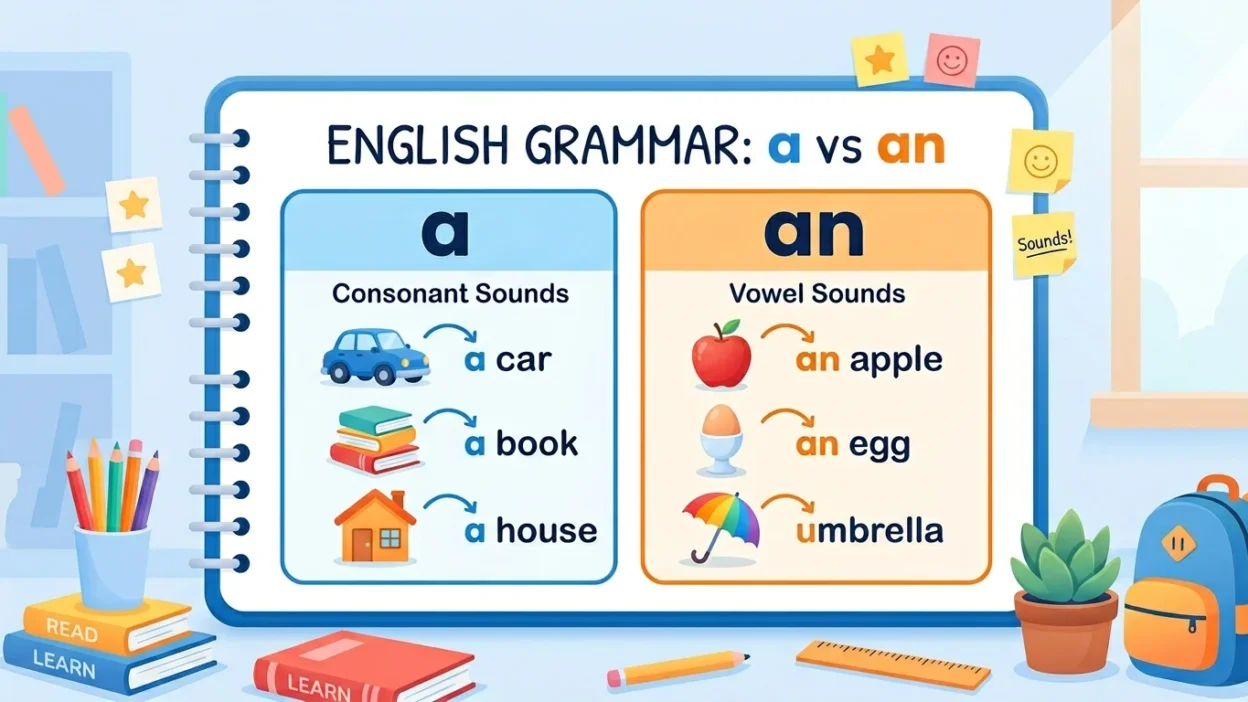
- Use “a” before words that start with a consonant sound
- Use “an” before words that start with a vowel sound
- It is about sound, not spelling
- Vowels are: a, e, i, o, u
- Consonants are all other letters
Simple examples:
- a book ✔
- a car ✔
- an apple ✔
- an egg ✔
Important point:
It is the sound of the first letter, not just the letter itself.
Simple Origin and Background
The words “a” and “an” come from old English. Long ago, English speakers used longer words to show “one” thing. Over time, those words became shorter and easier to use.
- “A” comes from an old word meaning “one”
- “An” also came from an old form used before soft or vowel sounds
People started using “an” before words that sounded smoother to say, and “a” before stronger sounds. This made speech easier and faster.
Even today, English still follows this simple sound rule to make speaking smooth and natural.
Clear Explanation of the Difference
The difference between “a” and “an” is not about meaning. It is only about pronunciation.
1. “A” is used when the next word sounds strong at the start
Example:
- a dog
- a house
- a pen
These words start with a consonant sound.
2. “An” is used when the next word sounds open at the start
Example:
- an apple
- an ice cream
- an orange
These words start with a vowel sound.
3. The most important rule: SOUND RULE
Sometimes spelling can trick you.
Example:
- an hour ✔ (silent “h” → sounds like “our”)
- a university ✔ (sounds like “yoo niversity”)
So remember:
👉 It is not spelling. It is pronunciation.
Comparison Table: A vs An
| Feature | A | An |
| Used before | consonant sounds | vowel sounds |
| Focus | sound of word | sound of word |
| Examples | a cat, a bag, a school | an apple, an egg, an umbrella |
| Common mistake | using “a” before vowels | using “an” before consonants |
| Rule type | pronunciation rule | pronunciation rule |
Which One to Use and When
Here is a very simple guide you can follow in daily life:
Use “a” when:
- The next word sounds like it starts with B, C, D, F, G, etc.
- The sound is strong at the beginning
Examples:
- a ball
- a teacher
- a university (sounds like “yoo”)
Use “an” when:
- The next word starts with A, E, I, O, U sound
- The sound feels smooth or open
Examples:
- an apple
- an elephant
- an hour (silent “h”)
Easy trick:
Say the word out loud. If it feels smooth after “an”, use “an”. If it feels better after “a”, use “a”.
Common Mistakes People Make
Many learners make the same simple mistakes. Here are the most common ones:
1. Using spelling instead of sound
Wrong: an university
Correct: a university
2. Forgetting silent letters
Wrong: a hour
Correct: an hour
3. Mixing vowel letters with vowel sounds
Wrong: an unicorn
Correct: a unicorn
4. Overthinking rules
Some learners try to memorize too much. But this rule is actually simple if you just listen to the sound.
5. Not speaking the word out loud
Reading silently can make mistakes. Saying the word helps you choose correctly.
Everyday Real Life Examples
Emails and Writing
- I am a student at a college.
- She is an honest person.
- We need a meeting tomorrow.
News and Articles
- A new school opened in the city.
- An accident happened near the road.
- A doctor gave advice to patients.
Social Media Posts
- I saw a beautiful sunset today.
- It was an amazing experience.
- She is an amazing artist.
Daily Conversations
- I need a pen.
- Can I have an umbrella?
- He is an engineer.
These examples show how often we use “a” and “an” in daily life without even noticing.
Learning Section for Students and Beginners
If you are learning English, here is a simple way to master this rule:
Step 1: Learn the rule
- “a” = consonant sound
- “an” = vowel sound
Step 2: Practice speaking
Say words out loud:
- a cat
- an apple
- a house
- an orange
Step 3: Train your ear
Listen to English speakers and notice how they use “a” and “an”.
Step 4: Practice daily
Try writing 5 sentences every day using both words.
Step 5: Don’t rush
This is a small rule, but practice makes it automatic.
FAQ: Simple Questions and Answers
Why do we use “a” and “an” in English?
We use them to show one single thing and make sentences sound smooth and natural.
Is it about spelling or sound?
It is about sound, not spelling.
Why do we say “an hour” but “a house”?
Because “hour” has a silent “h” sound, so it starts with a vowel sound.
Can I use “an” before every vowel letter?
No. It depends on sound. For example, “a university” is correct.
What is the easiest way to learn this rule?
Say the word out loud and listen to the first sound.
Do native speakers think about this rule?
No. They use it naturally without thinking.
Is this rule important for speaking English?
Yes. It helps your speech sound smooth and correct.
Can I make mistakes and still be understood?
Yes. People will understand you, but correct usage sounds more natural.
Conclusion
The difference between “a” and “an” is very simple once you understand the main idea: it is all about sound, not spelling. Many learners get confused at first, but with practice, it becomes automatic.
Remember this easy idea:
- Use “a” for consonant sounds
- Use “an” for vowel sounds
If you speak the word out loud and listen carefully, you will almost never make mistakes again. Over time, this small rule will become natural in your English speaking and writing.