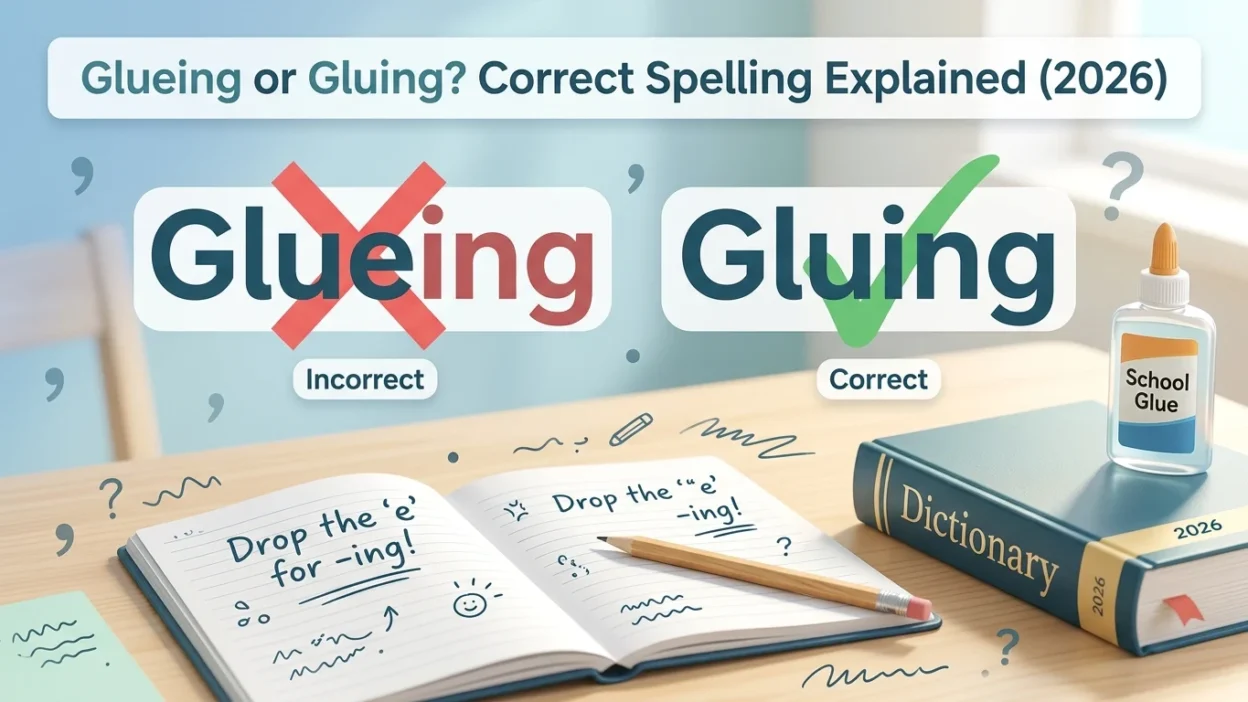
Many people get confused between “glueing” and “gluing.” Both words look possible, and both seem like they should work in English. Because of this, students, writers, and English learners often stop and wonder which spelling is correct.
The confusion usually happens because English spelling rules are not always simple. Some words keep the “e” before adding “-ing,” while others drop it. So it is natural to ask:
- Is it glueing?
- Or is it gluing?
The good news is that the answer is very simple once you understand the rule. This guide will explain everything in easy English so you can remember it forever.
Quick Answer
Here is the short and simple answer:
- Gluing is the correct spelling.
- Glueing is considered incorrect in modern English.
- Use gluing when talking about joining things with glue.
Correct Examples
- I am gluing the paper together.
- She is gluing photos into her notebook.
Incorrect Example
- I am glueing the paper together.
Simple Background Explanation
The word glue is a noun and a verb.
As a noun:
It means a sticky substance used to join things.
Example:
- Pass me the glue.
As a verb:
It means to stick things together.
Example:
- Please glue the pieces together.
When we change the verb into an -ing form, English usually follows spelling rules.
For many verbs ending in -e, we remove the final e before adding -ing.
Examples:
| Base Verb | -ing Form |
| make | making |
| bake | baking |
| smile | smiling |
| glue | gluing |
That is why gluing is correct.
Clear Explanation of the Difference
The main difference is very simple:
| Word | Correct or Incorrect? | Meaning |
| gluing | Correct | Joining things with glue |
| glueing | Incorrect in modern English | Usually seen as a spelling mistake |
Why “Gluing” Is Correct
The word gluing follows the normal English spelling rule:
- Remove the final e
- Add -ing
So:
- glue → gluing
This is the same pattern used in many other verbs.
Why People Write “Glueing”
People often write glueing because:
- They want to keep the original word “glue” visible
- The spelling “gluing” may look strange at first
- English has many irregular spelling patterns
Even native English speakers sometimes make this mistake.
Comparison
Here is an easy comparison table to help you remember the difference quickly.
| Feature | Gluing | Glueing |
| Correct modern spelling | Yes | No |
| Used in dictionaries | Yes | Rarely |
| Common in schools and writing | Yes | No |
| Follows normal spelling rules | Yes | No |
| Recommended for exams | Yes | No |
| Looks natural to native speakers | Yes | Usually no |
Which One to Use and When
You should use gluing in almost every situation.
Use “Gluing” In:
- School assignments
- Emails
- Social media posts
- News articles
- Books
- Work documents
- Everyday conversations
Examples
At School
- The students are gluing pictures onto cardboard.
At Home
- Dad is gluing the broken chair.
In Art Class
- We spent an hour gluing decorations.
In an Email
- I am gluing the labels today and will send the package tomorrow.
Avoid Using “Glueing”
Most teachers and grammar checkers will mark glueing as incorrect.
Even if some people understand it, it is not the standard spelling used today.
Common Mistakes People Make
1. Keeping the “e” Before Adding “-ing”
Many learners think:
- glue + ing = glueing
But English usually removes the final “e.”
Correct:
- gluing
Incorrect:
- glueing
2. Copying Incorrect Spellings Online
Sometimes people see “glueing” online and believe it is correct. Not everything written online follows proper English rules.
Always check trusted dictionaries or grammar guides.
3. Thinking Both Spellings Are Equal
Some words in English have two accepted spellings, especially between British and American English.
Example:
- color / colour
But this is different.
For gluing, there is only one standard spelling in modern English.
4. Confusing It With Other Words
Some learners compare it with words like:
- seeing
- agreeing
These words keep the double vowels because their spelling patterns are different.
But glue follows the “drop the e” rule.
Everyday Real Life Examples
Seeing words in real situations helps people learn faster. Here are simple examples from daily life.
In Text Messages
- I’m still gluing the project together.
On Social Media
- Spent all night gluing decorations for the party!
In News or Articles
- Workers were gluing damaged parts back together.
In a Classroom
- The children are gluing shapes onto paper.
In DIY Projects
- He is gluing wood pieces to make a shelf.
In Craft Videos
- Start by gluing the edges carefully.
Short Learning Section for Students and Beginners
Here is an easy trick to remember the correct spelling.
Simple Rule
If a verb ends in e, remove the e before adding -ing.
Examples
| Verb | Correct -ing Form |
| dance | dancing |
| smile | smiling |
| write | writing |
| glue | gluing |
Memory Tip
Think:
“Drop the e before adding ing.”
So:
- glue → gluing
Practice Sentences
Choose the correct spelling.
1.
She is ______ the paper together.
✅ Correct answer: gluing
2.
We are ______ the photos into the album.
✅ Correct answer: gluing
3.
The kids spent the afternoon ______ crafts.
✅ Correct answer: gluing
FAQ Section
Is “glueing” ever correct?
In modern English, gluing is the standard and correct spelling. “Glueing” is usually treated as incorrect.
Why does “gluing” look strange?
It may look unusual because the word loses the final “e.” But this follows a normal English spelling rule.
Is “gluing” used in both British and American English?
Yes. Both British and American English use gluing.
How do you spell the verb form of glue?
The correct verb form with “-ing” is:
- gluing
Do grammar checkers accept “glueing”?
Most grammar tools and dictionaries prefer gluing and may mark “glueing” as a mistake.
What is the rule for verbs ending in “e”?
Usually:
- remove the final “e”
- add “-ing”
Example:
- make → making
- smile → smiling
- glue → gluing
Is “glueing” an old spelling?
Some older texts may contain “glueing,” but modern English almost always uses gluing.
How can I remember the correct spelling?
Remember this simple line:
“Drop the e before ing.”
So:
- glue → gluing
Conclusion
The difference between glueing and gluing is actually very simple once you know the rule.
The Correct Spelling Is:
✅ gluing
The Incorrect Modern Spelling Is:
❌ glueing
English usually removes the final e before adding -ing, and the word glue follows this pattern.
So whenever you write about sticking things together, always use:
- gluing
Now you can write the word confidently in schoolwork, emails, social media posts, and everyday English without confusion.