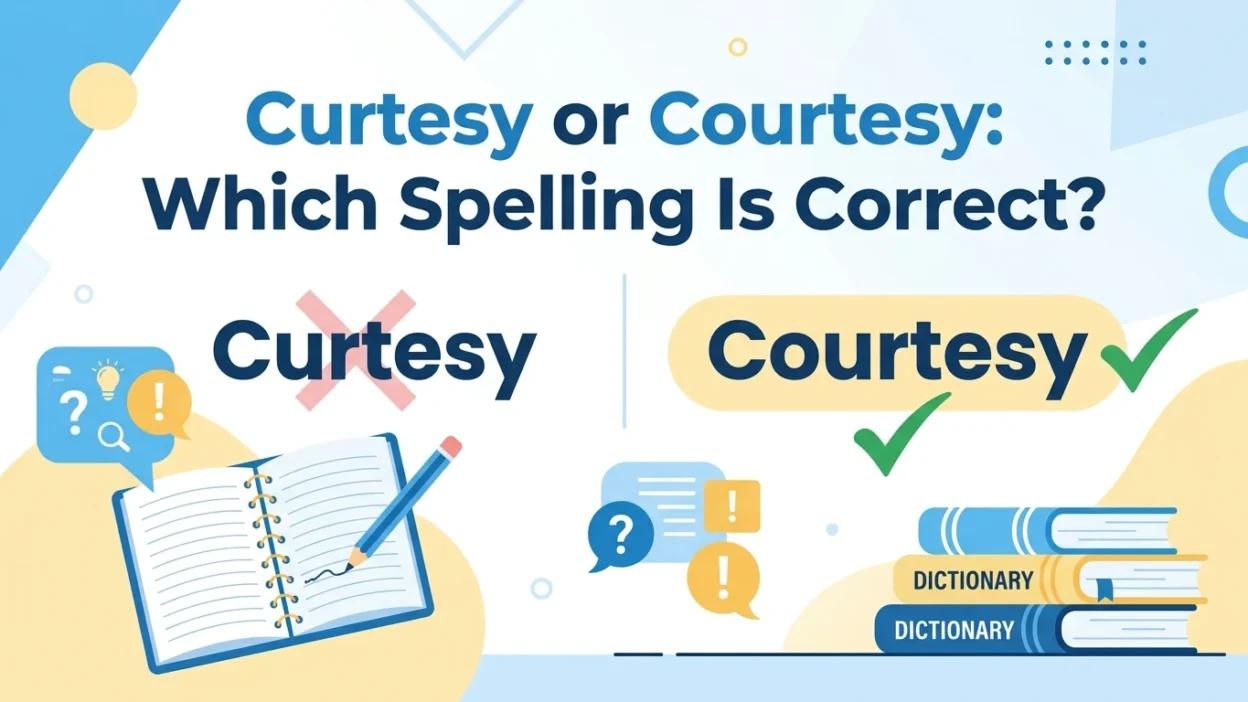
Many English learners and even native speakers get confused between curtesy and courtesy. The two words look very similar, and when spoken quickly, they can sound almost the same.
Because of this, many people accidentally write curtesy when they actually mean courtesy. This spelling mistake is common in emails, school assignments, social media posts, and everyday writing.
The good news is that the difference is very simple.
Once you understand which spelling is correct and why, you will probably never mix them up again.
Quick Answer
- ✅ Courtesy is the correct spelling for kindness, politeness, and good manners.
- ❌ Curtesy is usually a spelling mistake when people mean courtesy.
- ✅ Use courtesy in emails, messages, articles, school work, and everyday writing.
- ❌ Do not replace courtesy with curtesy.
- ✅ Remember: courtesy = polite behavior and respect for others.
Example:
- Correct: Thank you for your courtesy.
- Incorrect: Thank you for your curtesy.
Origin and Background of the Word
The word courtesy has a long history. It comes from an old word connected with the behavior expected in a royal court. People in a court were expected to show respect, good manners, and kindness toward others.
Over time, the meaning became broader. Today, courtesy simply means being polite, respectful, thoughtful, and considerate.
The spelling courtesy has been accepted in standard English for many centuries.
The spelling curtesy sometimes appears because people hear the word and write it the way it sounds. However, it is not the standard spelling for the meaning of politeness or respect.
The Difference Between Curtesy and Courtesy
The easiest way to understand the difference is this:
Courtesy
Courtesy is the correct English word.
It means:
- Politeness
- Good manners
- Respectful behavior
- Kind treatment of others
Examples:
- She thanked him for his courtesy.
- The staff treated customers with courtesy.
- As a courtesy, we informed everyone about the schedule change.
Curtesy
In modern everyday English, curtesy is generally considered a spelling mistake when someone intends to write courtesy.
Examples of mistakes:
- Incorrect: Thank you for your curtesy.
- Incorrect: We appreciate your curtesy.
- Incorrect: He showed great curtesy to the guests.
Correct versions:
- Thank you for your courtesy.
- We appreciate your courtesy.
- He showed great courtesy to the guests.
Simple Rule
If you are talking about:
- kindness
- politeness
- respect
- good manners
always use courtesy.
Comparison
| Feature | Courtesy | Curtesy |
| Correct modern spelling? | Yes | No (usually a mistake) |
| Means politeness and respect? | Yes | No |
| Used in formal writing? | Yes | No |
| Used in emails? | Yes | No |
| Used in school assignments? | Yes | No |
| Found in dictionaries as the standard word? | Yes | Yes, but not as the modern spelling for politeness |
| Safe choice for everyday English? | Yes | No |
Which One Should You Use and When?
Use Courtesy in Everyday Writing
Use courtesy whenever you want to talk about polite behavior.
Examples:
- Thank you for your courtesy.
- The hotel staff showed great courtesy.
- Please extend the same courtesy to others.
- He answered with courtesy and respect.
Use Courtesy in Professional Situations
Courtesy is common in:
- Business emails
- Customer service
- Workplace communication
- School writing
- Official notices
Examples:
- We appreciate your courtesy and cooperation.
- Thank you for the courtesy shown during the meeting.
Avoid Curtesy
If your sentence is about politeness or respect, avoid writing curtesy.
A good spelling check can help, but it is even better to remember the correct form yourself.
Common Mistakes People Make
Mistake 1: Writing the Word as It Sounds
Many learners hear the word and spell it:
- Curtesy ❌
Instead of:
- Courtesy ✅
English spelling does not always match pronunciation perfectly.
Mistake 2: Typing Too Quickly
Fast typing often creates errors.
Example:
- Thank you for your curtesy. ❌
Correct:
- Thank you for your courtesy. ✅
Mistake 3: Copying Incorrect Online Usage
Sometimes people repeat spelling mistakes they see online.
Always double check important writing before sending it.
Mistake 4: Using Spellings Interchangeably
Some people think both spellings are equally acceptable.
For modern everyday English, this is not true.
Use courtesy when talking about politeness and respect.
Everyday Real Life Examples
Emails
Correct examples:
- Thank you for your courtesy and patience.
- We appreciate your courtesy during this process.
- Your courtesy is greatly valued.
Incorrect example:
- Thank you for your curtesy. ❌
News Writing
Correct examples:
- The mayor thanked citizens for their courtesy.
- Visitors were treated with courtesy and respect.
Social Media
Correct examples:
- A little courtesy can make someone’s day better.
- Please show courtesy when discussing different opinions.
Daily Conversations
Correct examples:
- She always speaks with courtesy.
- Common courtesy is important.
- His courtesy impressed everyone.
Customer Service
Correct examples:
- The employee handled the complaint with courtesy.
- Customers appreciate courtesy and professionalism.
Learning Section for Students and Beginners
Easy Memory Trick
Look at the beginning of the word:
COURtesy
Think of the word court.
People in a royal court were expected to have good manners.
This can help you remember the correct spelling:
COURTESY = politeness and respect
Quick Practice
Choose the correct spelling.
- Thank you for your _____.
- Courtesy ✅
- Curtesy ❌
- She treated everyone with _____.
- Courtesy ✅
- Curtesy ❌
- Common _____ helps people get along.
- Courtesy ✅
- Curtesy ❌
Fill in the Blank
- We appreciate your __________.
- The teacher showed __________ to every student.
- He responded with __________ and respect.
Answers:
- courtesy
- courtesy
- courtesy
Frequently Asked Questions (FAQ)
Is courtesy the correct spelling?
Yes. Courtesy is the correct spelling when talking about politeness, kindness, and respect.
Is curtesy a word?
The spelling curtesy exists in some historical contexts, but when people mean politeness or good manners, it is usually considered a spelling mistake. In everyday modern English, use courtesy.
Which spelling should students use?
Students should use courtesy in essays, homework, exams, and other school writing.
Can I use curtesy in an email?
No. If you mean politeness or respect, use courtesy.
What does courtesy mean?
Courtesy means showing good manners, kindness, respect, and consideration toward others.
Why do people misspell courtesy?
Many people spell it based on how it sounds. Because the pronunciation can be confusing, they accidentally write curtesy.
Is courtesy a formal word?
Yes, but it is also common in everyday English. It can be used in both formal and informal situations.
How can I remember the correct spelling?
Remember the spelling COURTESY and think of courtly manners or good manners in a court. This simple connection helps many learners remember the correct form.
Conclusion
The confusion between curtesy and courtesy is very common, but the solution is simple. When you are talking about politeness, respect, kindness, or good manners, the correct spelling is courtesy.
In modern English, courtesy is the spelling you should use in emails, school work, professional writing, social media posts, and daily communication. The spelling curtesy is usually a mistake when people mean courtesy.
A simple way to remember it is: Courtesy = the correct word for polite and respectful behavior. Once you learn this rule, choosing the right spelling becomes easy.