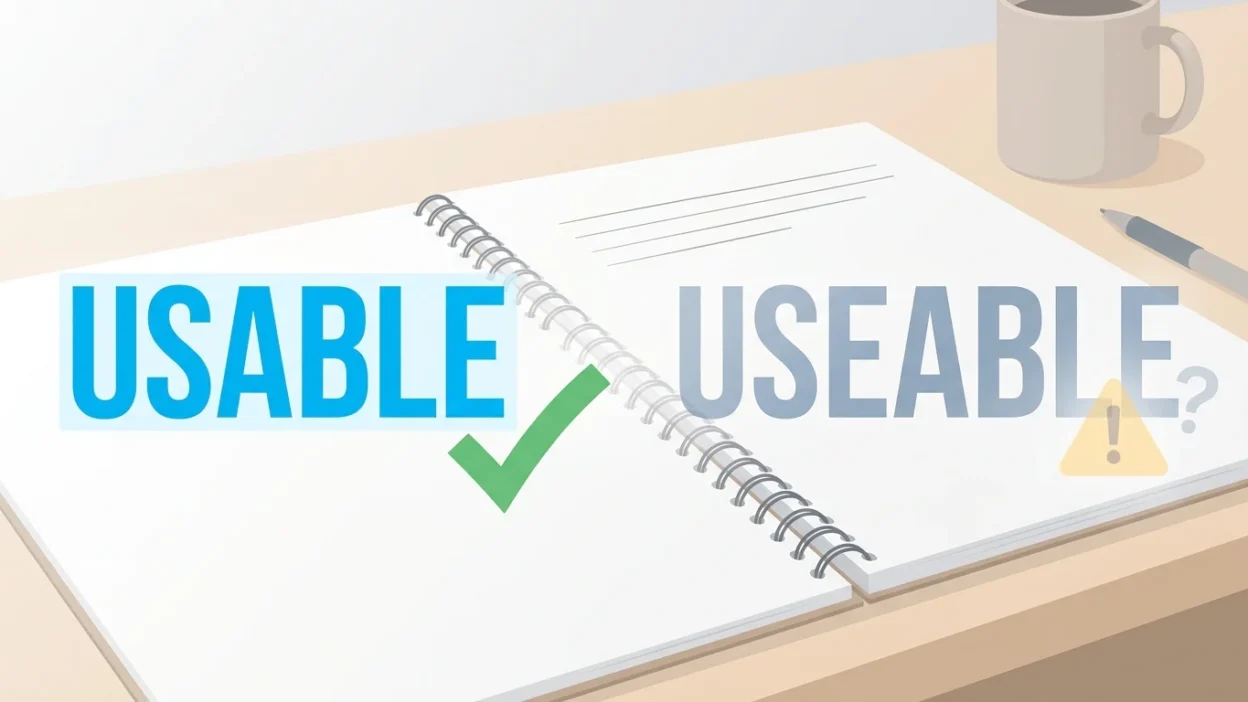
Many English learners and even native speakers get confused between “usable” and “useable.” They look very similar, and both seem correct at first sight. Because of this, people often wonder if they mean the same thing or if one is wrong.
The confusion becomes stronger because English spelling is not always consistent. Some words change their form depending on usage, while others have old and modern versions.
In this article, you will learn the simple truth behind these two words so you never mix them up again.
Quick Answer: Simple Points You Should Know
Here is the easiest way to understand it:
- Usable is the most common and correct modern spelling.
- Useable also exists, but it is rarely used today.
- Both words mean: something that can be used.
- In everyday writing, usable is always preferred.
- You will see usable in books, exams, emails, and official English.
So, if you are unsure, always choose usable.
Simple Origin and Background
To understand this better, let’s break the word down.
The word comes from:
- Use = to do something with an object or tool
- -able = can be done or possible
So, the meaning becomes:
👉 “able to be used”
Now, here is where spelling confusion comes in.
In older English writing, some words added an extra “e” before “-able” to make pronunciation smoother. That is how useable appeared.
But over time, English became simpler. The extra “e” was removed in most cases. That is why usable became the standard form.
Today:
- Usable = modern standard English
- Useable = old or rare variant
Clear Explanation of the Difference
Even though both words look similar, their usage is not equal.
Usable (Most Important Form)
- This is the standard spelling in modern English.
- Used in schools, exams, books, and professional writing.
- Preferred in American and British English.
- Clear, simple, and widely accepted.
Example:
- This phone is still usable after repair.
- The water is safe and usable for cooking.
Useable (Rare Form)
- This is an older spelling.
- Still correct in meaning, but not commonly used.
- You may see it in older books or very formal traditional writing.
- Some people still use it, but it is not preferred.
Example:
- The machine is still useable after cleaning. (less common today)
👉 Important point: The meaning does not change. Only the spelling style changes.
Comparison Table (Easy to Understand)
| Feature | Usable | Useable |
| Meaning | Can be used | Can be used |
| Common today | Yes | No |
| Correct in modern English | Yes | Rarely used |
| Style | Simple and standard | Old style spelling |
| Where you see it | Books, exams, daily writing | Older texts, rare usage |
| Recommendation | Always use this | Avoid in modern writing |
Which One to Use and When
If you are writing anything today, here is a simple rule:
Use “usable” when:
- Writing essays
- Taking exams
- Writing emails
- Speaking in English
- Doing school homework
- Writing social media posts
Avoid “useable” unless:
- You are reading or copying old text
- You are studying historical English writing
- You are quoting an old document
👉 Golden rule:
If you are not sure, always use usable.
This will always be correct in modern English.
Common Mistakes People Make
Many learners make simple mistakes with these words. Let’s fix them.
Mistake 1: Thinking both are equally common
Some people think both words are used the same way. That is not true. “Usable” is far more common.
Mistake 2: Adding extra “e” everywhere
English learners sometimes add “e” because they think it sounds more correct. But in this case, it is unnecessary.
Mistake 3: Overthinking spelling
People sometimes stop writing because they are unsure. Remember, only one choice is needed: usable.
Mistake 4: Mixing British and American rules
Even though English has small differences, both British and American English prefer usable today.
Everyday Real Life Examples
Let’s see how “usable” appears in daily life. This makes it very easy to understand.
Email Example
- “Please confirm if the file is still usable after the update.”
Social Media Example
- “My old laptop is still usable, so I don’t need a new one.”
Daily Conversation Example
- “Is this water safe and usable for drinking?”
School Example
- “The calculator is usable during the test.”
News Style Example
- “The bridge is now usable after repair work.”
These examples show that “usable” fits naturally in all types of English.
Short Learning Section for Students and Beginners
If you are learning English, here is a simple way to remember this word:
Think like this:
- Usable = modern and correct
- Useable = old and rare
Easy memory trick:
👉 “Usable is usual”
This means:
- Usable is the usual form you will see everywhere.
Practice Tip:
Try writing 5 sentences using the word “usable.” This will help your brain remember it faster.
Example practice:
- My phone is usable.
- This pen is still usable.
- The room is usable after cleaning.
FAQ: Simple Questions and Answers
Is “useable” wrong?
No, it is not wrong, but it is rarely used in modern English.
What is the correct spelling today?
The correct and most common spelling is usable.
Do both words have the same meaning?
Yes, both mean “can be used.”
Why do two spellings exist?
Because English spelling changed over time, and older forms like “useable” stayed in rare use.
Will I lose marks if I write “useable” in exams?
In most cases, yes, because teachers prefer modern spelling like “usable.”
Is “usable” used in British and American English?
Yes, both use “usable” as the standard form today.
Can I still see “useable” anywhere?
Yes, but mostly in old books or rare writings.
Which one should beginners learn first?
Always learn usable first because it is the correct modern form.
Conclusion: Simple Final Understanding
The difference between usable and useable is very small, but important for clear English writing.
Both words mean the same thing: something that can be used. However, modern English prefers the shorter and simpler form: usable.
If you remember one rule from this article, keep it simple:
👉 Always use “usable” in your writing.
This will keep your English correct, natural, and easy to understand in every situation.