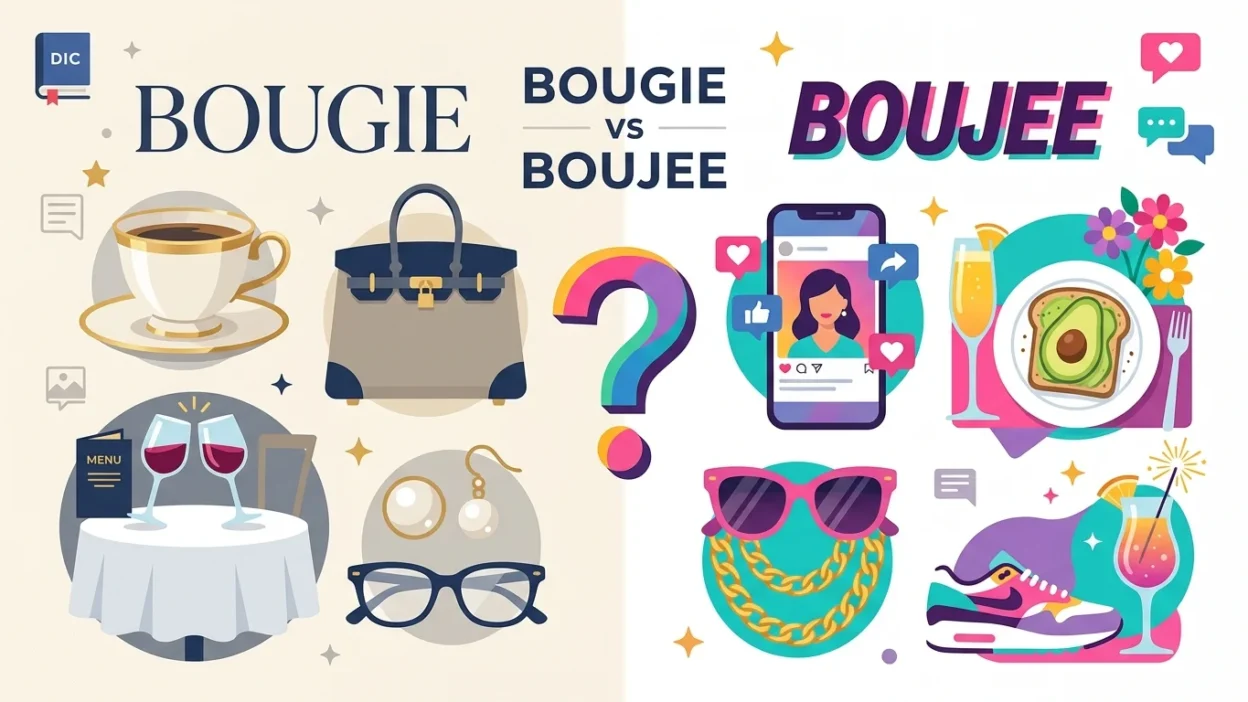
Many people see the words boujee and bougie online and wonder if they mean the same thing. You may find one spelling on social media and another spelling in a text message, song, news article, or conversation.
The confusion happens because both words sound almost the same. They are often used to describe someone who likes expensive things, luxury lifestyles, or fancy experiences. Because people use them in similar ways, it can be difficult to know which spelling is correct.
The good news is that the difference is actually quite simple. Once you understand where the words come from and how people use them today, you will easily know when to use each one.
Quick Answer
- Bougie is the older and more traditional spelling.
- Boujee is a newer and more modern spelling.
- Both words are usually pronounced the same way: BOO-zhee.
- Both can describe someone who likes fancy, expensive, or high class things.
- Bougie is more common in general writing.
- Boujee is often seen in social media, entertainment, and casual conversations.
- In everyday English, many people use the two words with the same meaning.
Origin and Background
To understand these words better, it helps to know where they came from.
The word bougie comes from the French word bourgeois. Long ago, bourgeois referred to people in the middle or upper social classes. Over time, English speakers shortened the word and started using bougie in casual speech.
As language changed, people began using bougie to describe someone who seemed fancy, wealthy, or interested in luxury.
Later, another spelling appeared: boujee. This version became popular through music, social media, and internet culture. It kept a similar meaning but developed a more modern and trendy feel.
Today, both words are widely recognized, especially among younger speakers.
Understanding the Difference
Although the meanings overlap, there are some small differences in how people use these words.
Bougie
Bougie is usually seen as the standard spelling.
People often use it to describe:
- Fancy tastes
- Expensive habits
- Luxury products
- High class behavior
- Someone trying to look wealthy
Examples:
- She only drinks expensive coffee because she is a little bougie.
- His apartment looks very bougie.
- They prefer luxury hotels and fancy restaurants.
Boujee
Boujee is often viewed as a modern and stylish spelling.
People commonly use it:
- On social media
- In casual conversations
- In entertainment and pop culture
- To describe a glamorous lifestyle
Examples:
- That vacation looked so boujee.
- Her birthday party was super boujee.
- They posted a boujee dinner photo online.
The Main Idea
For most situations, the meanings are nearly the same. The biggest difference is usually the spelling and the style of communication.
Comparison Table
| Feature | Bougie | Boujee |
| Meaning | Fancy or luxury focused | Fancy or luxury focused |
| Pronunciation | BOO-zhee | BOO-zhee |
| Age of spelling | Older | Newer |
| Common in writing | Yes | Less often |
| Common on social media | Yes | Very common |
| Formality | Slightly more standard | More casual |
| Modern trendy feel | Sometimes | Often |
| Accepted in conversation | Yes | Yes |
Which One Should You Use and When?
The best choice depends on your situation.
Use “Bougie” When
- Writing articles
- Writing school assignments
- Creating professional content
- Using standard English
- Speaking to a wide audience
Example:
- The restaurant has a bougie atmosphere.
Use “Boujee” When
- Posting on social media
- Writing casual messages
- Talking with friends
- Describing a trendy lifestyle
Example:
- We had a boujee brunch this morning.
If You Are Unsure
Choose bougie.
It is generally the safer and more widely accepted spelling in many situations.
Common Mistakes People Make
Thinking the Words Have Completely Different Meanings
Many learners believe bougie and boujee describe different types of people.
In reality, the meanings are usually very similar.
Assuming One Spelling Is Always Wrong
Some people think only bougie is correct.
Others think only boujee is correct.
Both spellings are used today, although bougie is usually considered the more traditional form.
Using the Words in Very Formal Writing
These words are informal. They work best in casual communication.
For very formal writing, you may choose words like:
- Luxurious
- Elegant
- Expensive
- High end
- Upscale
Mispronouncing the Words
Both words are commonly pronounced:
BOO-zhee
Some learners try to pronounce every letter separately, which can sound unusual.
Everyday Real Life Examples
In Emails
Casual email:
The hotel looked a little bougie, but the service was excellent.
Friendly message:
We found a boujee café downtown and loved it.
In News and Entertainment
You might see sentences such as:
- The celebrity showed off her bougie lifestyle.
- The actor attended a boujee event.
On Social Media
Examples include:
- Feeling boujee today.
- Boujee dinner with friends.
- Living my boujee life.
In Daily Conversations
Friend 1: Why did you buy that expensive candle?
Friend 2: Because I’m feeling bougie today.
Another example:
- Their wedding was really boujee.
- That new apartment looks bougie.
Learning Tips for Students and Beginners
If you are learning English, remember these simple rules:
Easy Memory Trick
Think of it this way:
- Bougie = traditional spelling
- Boujee = trendy spelling
Focus on Meaning First
The most important idea is that both words usually relate to:
- Fancy things
- Expensive tastes
- Luxury experiences
- Stylish lifestyles
Notice the Context
When reading online:
- Social media often uses boujee.
- Articles and general writing often use bougie.
Practice With Simple Sentences
Try writing your own examples:
- My friend likes bougie restaurants.
- That hotel looks boujee.
- Their house feels very bougie.
- We enjoyed a boujee vacation.
Practicing helps you remember the difference naturally.
FAQ
Is bougie the same as boujee?
Yes. In most situations, they have very similar meanings and can often be used interchangeably.
Which spelling is correct?
Both spellings are used today. Bougie is generally considered the older and more traditional spelling.
How do you pronounce bougie?
Most people pronounce it as BOO-zhee.
How do you pronounce boujee?
Most people also pronounce it as BOO-zhee.
Is bougie a compliment or an insult?
It depends on the situation. It can be playful and positive, or it can suggest someone is overly focused on expensive things.
Can I use bougie in school writing?
You can, but only if informal language is appropriate. In formal assignments, more standard words may work better.
Why is boujee popular online?
The spelling became popular through entertainment, social media, and modern internet culture.
Which word should ESL learners use?
Bougie is usually the easiest and safest choice because it is more commonly accepted in general writing.
Conclusion
The confusion between boujee and bougie is understandable because both words sound the same and usually have the same meaning. They are commonly used to describe fancy tastes, luxury lifestyles, expensive products, or stylish experiences.
The simplest way to remember the difference is this: bougie is the older and more traditional spelling, while boujee is the newer and trendier spelling often seen online. In everyday conversation, most people understand both versions without any problem.
If you are unsure which one to use, choose bougie. If you want a more modern and casual feel, boujee works well too.