
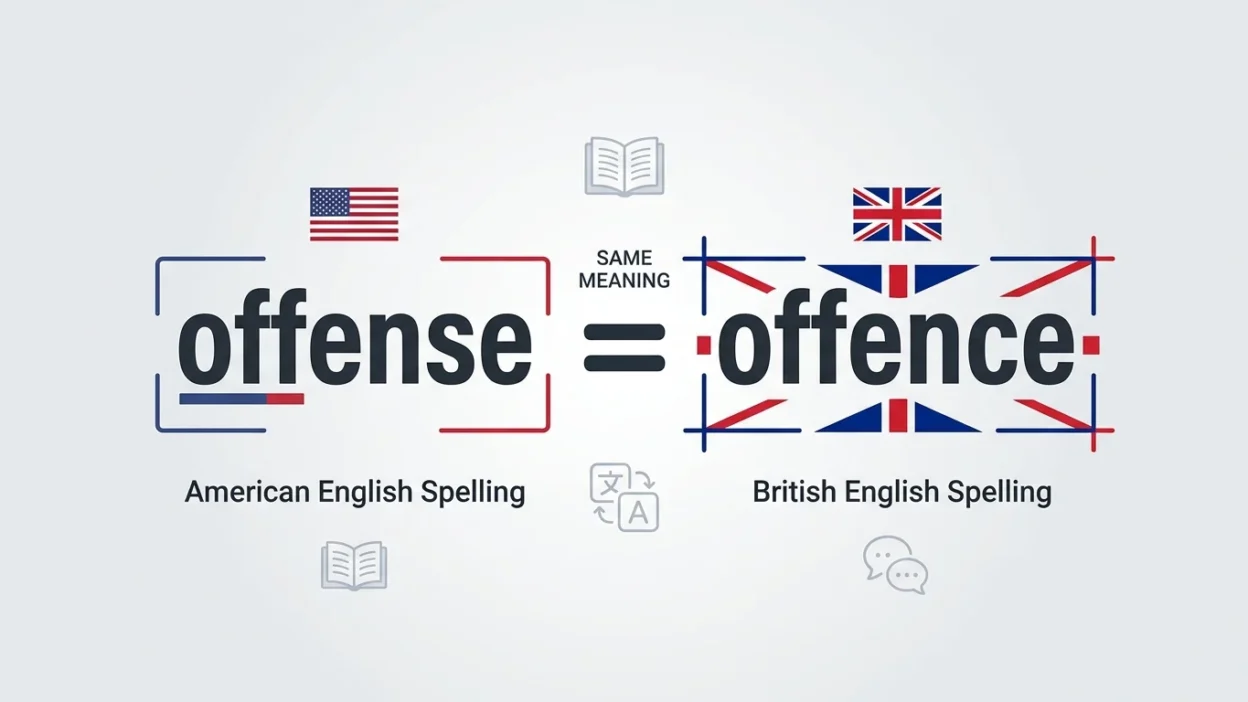
Many English learners get confused when they see the words “offense” and “offence.” They look almost the same, but one letter is different. This small change can make people wonder if they have different meanings or if one is wrong.
The truth is simple: both words mean the same thing, but they are used in different places. The confusion happens because English is spoken in different countries, and spelling rules are not always the same everywhere.
In this article, you will learn the meaning of both words in the easiest way possible. By the end, you will never mix them up again.
Quick Answer
Here is the simplest way to understand it:
- Offense = American English spelling
- Offence = British English spelling
- Both words have the same meaning
- The meaning depends on context, such as:
- Breaking a rule or law
- Something that hurts feelings
- A sports rule violation
So, the difference is only in spelling, not in meaning.
Simple Origin or Background Explanation
The words come from old French and Latin origins. Long ago, English borrowed many words from French. Over time, English changed in different regions.
- In Britain, the spelling stayed closer to older French style spelling, which uses “-ence.”
- In the United States, spelling was simplified over time to make words shorter and easier, changing “c” to “s” in many words.
That is why:
- British English uses offence
- American English uses offense
This same pattern also appears in other words like:
- Defence (UK) → Defense (US)
- Licence (UK) → License (US, noun form)
So, the difference is part of a bigger spelling system difference between two English styles.
Clear Explanation of the Difference
Even though spelling is different, meaning stays the same. Let’s break it down simply.
Meaning of Offense / Offence
Both words can mean:
- Breaking a law or rule
- Saying or doing something rude
- A sports violation
- Something that causes emotional hurt
Example in simple words
- If someone breaks a rule, they commit an offense/offence
- If someone says something rude, it can be an offense/offence
- In sports, breaking a rule is also an offense/offence
Key point
There is no difference in meaning, only spelling style based on region.
Comparison Table (Easy to Scan)
| Feature | Offense | Offence |
| English type | American English | British English |
| Meaning | Same | Same |
| Usage country | USA, Canada | UK, India, Pakistan, Australia |
| Context | Law, sports, behavior | Law, sports, behavior |
| Correctness | Correct in US English | Correct in UK English |
| Pronunciation | Same | Same |
This table shows that both words are equal in meaning and usage, just different in spelling style.
Which One to Use and When
Choosing between “offense” and “offence” depends on where you are writing or who will read your text.
Use “Offense” when:
- You are writing for American readers
- You are using US English in school or exams
- You are writing for international tech or business content that follows US English
Use “Offence” when:
- You are writing for British English readers
- Your school or teacher uses UK English
- You are in countries like the UK, Australia, or many Commonwealth countries
Simple rule to remember:
- US English = offense
- UK English = offence
If you are unsure, just choose one style and stay consistent in your writing.
Common Mistakes People Make
Many learners make small mistakes when using these words. Here are the most common ones:
Mixing both spellings in one text
Some people write “offense” in one sentence and “offence” in another. This looks incorrect in formal writing.
Thinking they have different meanings
They do NOT mean different things. Only spelling changes.
Using both in exams
Students sometimes mix both styles in tests. Teachers usually expect one style only.
Overthinking the word
Many learners spend too much time worrying about which one is “correct.” Both are correct depending on English type.
Everyday Real Life Examples
Let’s see how the word is used in daily life. These examples will make it very clear.
In emails
- “We regret to inform you that your action was a serious offense/offence against company rules.”
In news
- “The player was punished for a minor offense/offence during the match.”
In social media
- “That comment was taken as an offense/offence by many users.”
In daily conversation
- “I did not mean any offense/offence.”
- “Talking loudly in class is an offense/offence.”
In school rules
- “Cheating in exams is a serious offense/offence.”
These examples show that the word appears in many situations, but spelling changes based on region.
Short Learning Section for Students and Beginners
If you are a student, here is an easy way to remember:
Step 1: Think of two English types
- American English
- British English
Step 2: Match the spelling
- American → offense
- British → offence
Step 3: Practice with sentences
Try reading these aloud:
- “He committed an offense.”
- “He committed an offence.”
Both sound the same because pronunciation does not change.
Step 4: Focus on consistency
Pick one style and stick with it in your writing.
FAQ (Simple Questions and Answers)
Is offense the same as offence?
Yes, both words have exactly the same meaning. Only spelling is different.
Which spelling is correct?
Both are correct. It depends on whether you are using American or British English.
Does pronunciation change?
No, both are pronounced the same way.
Is offense American English?
Yes, “offense” is used in American English.
Is offence British English?
Yes, “offence” is used in British English and many other countries.
Can I use both in one essay?
It is better not to mix them. Choose one style and stay consistent.
Do they have different meanings in law?
No, in law they still mean breaking a rule or law. Only spelling changes.
Why does English have two spellings?
Because English developed differently in the UK and the US over time.
Conclusion
The difference between offense and offence is very simple once you understand it. They are the same word with the same meaning. The only difference is spelling style based on American or British English.
- “Offense” is used in American English
- “Offence” is used in British English
- Both are correct and widely accepted
If you remember just one thing, it should be this: meaning never changes, only spelling changes.
Once you understand this rule, you will never feel confused again when you see these words in books, exams, news, or daily writing.