
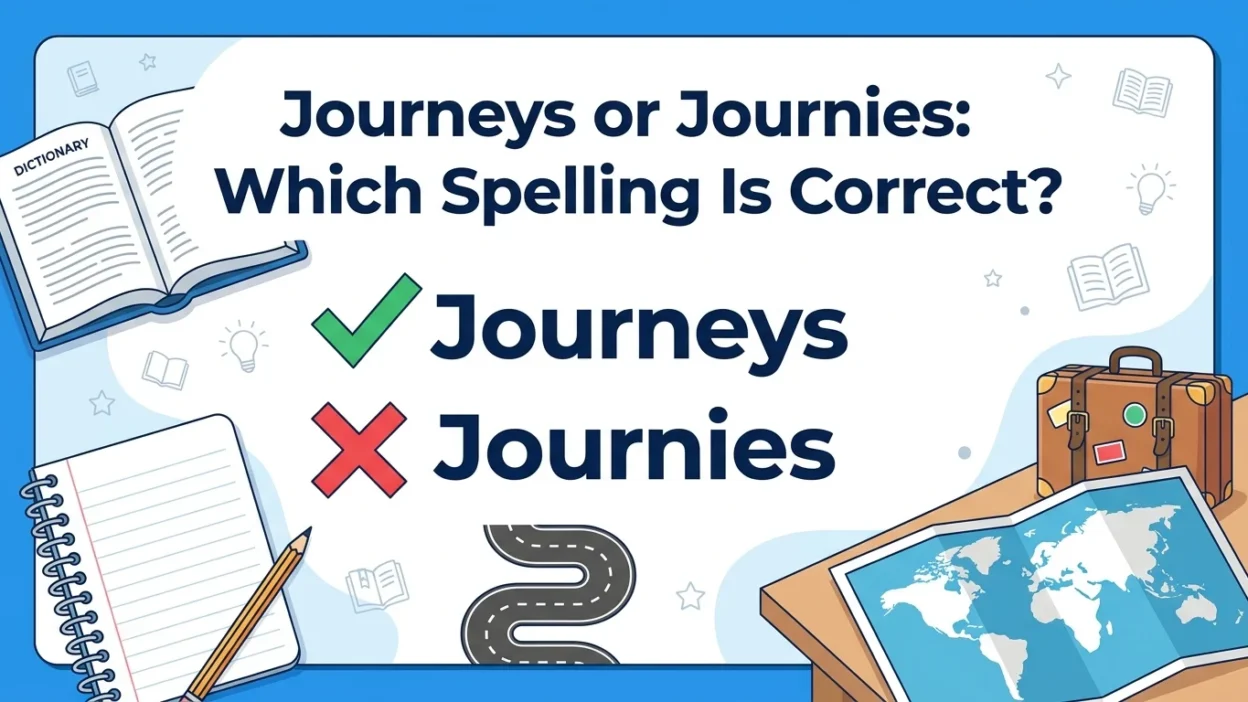
Many English learners get confused between “journeys” and “journies.” At first look, both words seem correct. They sound the same when spoken, and both look like they could be plural forms of the word journey.
But only one of them is correct in English.
This confusion happens because English spelling rules are not always simple. Many words change their endings when they become plural, and not all follow the same pattern. Some people guess the spelling based on how it sounds, and that leads to mistakes like journies.
In this article, you will clearly understand which spelling is correct, why the other one is wrong, and how to use the right word in daily English.
Quick Answer: What Is Correct?
Here is the simple answer:
- Journeys → ✔ Correct spelling (plural of journey)
- Journies → ✘ Incorrect spelling (not used in standard English)
Easy way to remember:
- One trip = a journey
- Many trips = journeys
That’s it. No special rule needed.
Origin or Background of the Word
The word journey comes from old French language, where it meant “a day’s travel or trip.” Over time, English adopted the word and started using it to describe travel from one place to another.
In modern English, “journey” does not only mean physical travel. It can also mean:
- Life experience
- Personal growth
- Emotional progress
- Learning process
For example:
- “Her journey to success was long.”
- “He is on a healing journey.”
When English speakers needed a plural form, the natural rule was applied:
- Add -s → journey + s = journeys
The spelling “journies” likely appeared because many English words ending in -y change to -ies in plural form, like:
- city → cities
- baby → babies
But “journey” is different because the letter before “y” is a vowel (e), so it follows a different rule.
Clear Explanation of the Difference
The difference between journeys and journies is very simple:
Journeys (Correct)
- This is the correct plural form
- Used in all formal and informal English
- Follows standard spelling rules
- Found in books, exams, and real communication
Example:
- “They went on many journeys across Europe.”
Journies (Incorrect)
- This spelling is wrong in standard English
- Not accepted in dictionaries
- Not used in professional writing
- Often a spelling mistake
Example:
- ❌ “They went on many journies.” (Incorrect)
Why the mistake happens
People often think:
“Change y to ies = journies”
But this rule only works when:
- The word ends in a consonant + y (like city → cities)
Since “journey” ends in a vowel + y (e + y), we only add s.
Comparison Table (Easy to Understand)
| Feature | Journeys (Correct) | Journies (Incorrect) |
| Spelling | Correct | Wrong |
| Dictionary status | Accepted | Not accepted |
| Usage | Formal & informal | Not used |
| Grammar rule | Add “s” | Wrong rule applied |
| Meaning | Multiple trips | No valid meaning |
| Example | life journeys | not used correctly |
Which One to Use and When
You should always use “journeys” in all situations.
Use “journeys” when talking about:
- Travel experiences
- Life stories
- Personal growth
- Trips and travel routes
Examples:
- “We had two long journeys this year.”
- “Her journeys taught her many lessons.”
- “Air travel makes international journeys easier.”
Never use “journies”
Even if you see it online, treat it as a spelling mistake.
Common Mistakes People Make
Many learners repeat the same errors when writing this word. Here are the most common ones:
Thinking all “-y” words change to “-ies”
Not true. Only some words follow this rule.
Spelling based on sound
“Journeys” and “journies” sound the same, so people guess the spelling.
Copying incorrect internet usage
Sometimes social media posts contain spelling errors, and learners copy them.
Forgetting vowel + y rule
If the word ends in a vowel before “y,” you just add “s.”
Everyday Real Life Examples
Here are simple examples of how “journeys” is used in real life.
Travel situations
- “Our journeys to different cities were exciting.”
- “Bus journeys can be long but interesting.”
School or learning
- “Reading books takes students on journeys of imagination.”
- “Learning English is a long journey for many students.”
Personal life
- “Everyone has different life journeys.”
- “His recovery journey was slow but steady.”
Social media
- “Posting about my travel journeys!”
- “Life journeys make us stronger.”
Short Learning Section for Students and Beginners
If you are learning English, remember this simple rule:
Rule:
- If a word ends in vowel + y, just add s
- journey → journeys ✔
Easy trick to remember:
Think of “journey” as a smooth word that already ends nicely. You don’t need to change it too much.
Practice examples:
Try changing these words:
- valley → valleys
- toy → toys
- journey → journeys
Notice the pattern? If there is a vowel before “y,” just add “s.”
FAQ: Common Questions About Journeys and Journies
Is “journies” ever correct?
No, “journies” is not correct in standard English.
What is the correct plural of journey?
The correct plural is journeys.
Why do people write “journies”?
Because they confuse grammar rules for words ending in “y.”
Is “journeys” used in formal writing?
Yes, it is used in books, exams, essays, and professional writing.
Can “journeys” be used for life experiences?
Yes, it is commonly used for both travel and life experiences.
How can I remember the correct spelling?
Remember this: vowel before “y” → just add “s”.
Is this a common English mistake?
Yes, many beginners make this mistake.
Does pronunciation change between the two?
No, both sound the same, but only one spelling is correct.
Conclusion: Simple Way to Remember
The difference between journeys and journies is very small but important.
- Journeys is always correct and widely used
- Journies is a spelling mistake and should be avoided
The easiest way to remember is:
If the word ends in a vowel + “y,” just add “s”.
So, the next time you write about travel, life experiences, or personal growth, always choose “journeys.”
It is simple, correct, and used everywhere in English communication.