
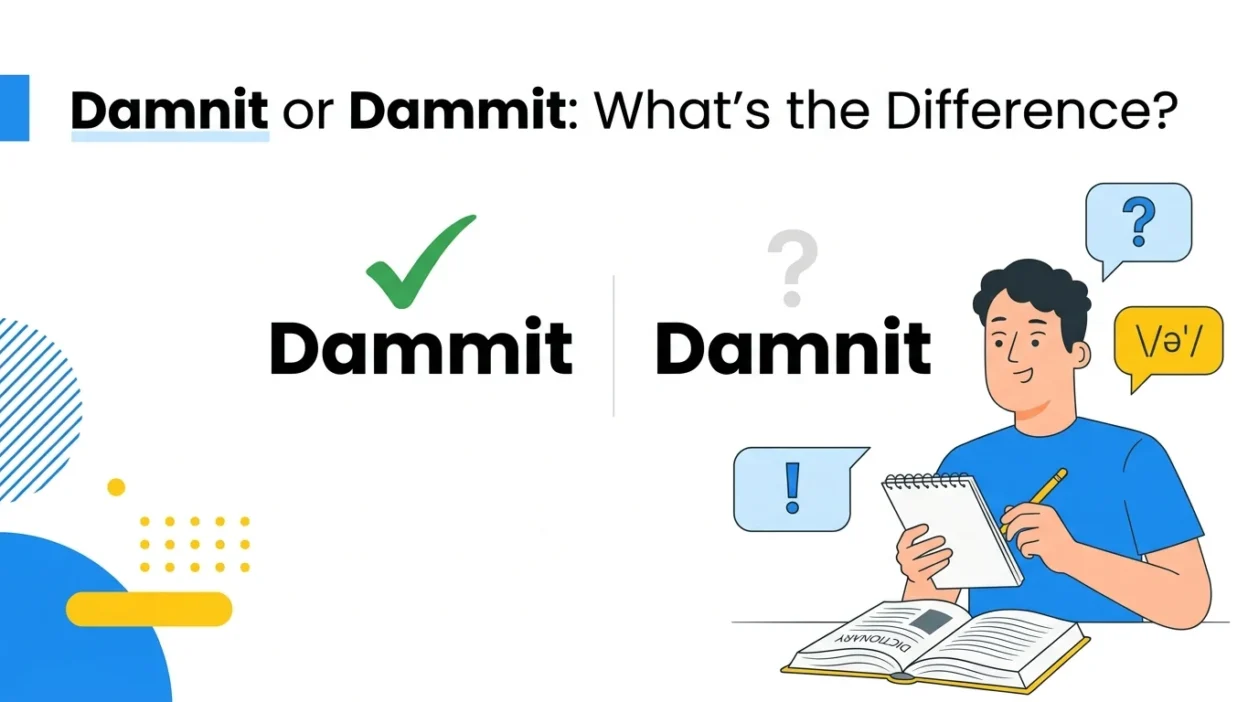
Many people see both damnit and dammit online and wonder if they mean different things. You may find one spelling in social media posts, text messages, movies, comments, or everyday conversations.
Because both words sound very similar when spoken, it is easy to think they are equally correct. Some people use them without even knowing there is a spelling difference.
The good news is that the confusion is easy to clear up. Once you understand where the word comes from and how it is commonly written, choosing the correct spelling becomes much simpler.
In this guide, you will learn exactly what damnit and dammit mean, how they are used, and which spelling is generally accepted.
Quick Answer
- Dammit is the standard and widely accepted spelling.
- Damnit is an alternative spelling that some people use because it matches the way the word sounds.
- Both forms express frustration, anger, disappointment, or annoyance.
- In most writing situations, dammit is the better choice.
- If you want the safest and most commonly recognized spelling, use dammit.
Origin and Background
To understand the difference, it helps to know where the word comes from.
The expression dammit developed from the phrase:
“Damn it!”
In this phrase:
- Damn is an exclamation showing anger, annoyance, or frustration.
- It refers to a situation, mistake, problem, or event.
Over time, people began saying the phrase very quickly.
Instead of saying:
“Damn it!”
People often pronounced it more like:
“Dammit!”
As a result, the combined spelling dammit became common.
Later, some people started writing damnit because the spoken sound sometimes seems closer to “nit” than “mit.” This created a second spelling, although it is not as widely accepted.
The Difference Between Damnit and Dammit
The biggest thing to know is that the meaning is basically the same.
Both words are used to express:
- Frustration
- Anger
- Annoyance
- Disappointment
- Surprise after something goes wrong
However, there is a difference in acceptance and usage.
Dammit
This is the standard spelling.
It appears more often in:
- Books
- Scripts
- Dictionaries
- Published writing
- Professional content
Damnit
This spelling is less common.
People often use it in:
- Text messages
- Informal online conversations
- Social media comments
- Personal posts
Most readers recognize it, but many style guides and dictionaries prefer dammit.
Comparison Table
| Feature | Dammit | Damnit |
| Meaning | Frustration or annoyance | Frustration or annoyance |
| Origin | From “damn it” | Alternative spelling |
| Commonly accepted | Yes | Less commonly accepted |
| Used in formal writing | Sometimes | Rarely |
| Used online | Yes | Yes |
| Dictionary preference | Usually preferred | Usually not preferred |
| Best choice for most situations | Yes | No |
Which One Should You Use and When?
For most situations, use dammit.
It is the spelling that readers are more likely to recognize as standard.
Use “Dammit” When:
- Writing stories
- Creating dialogue
- Posting online
- Writing articles
- Communicating with a broad audience
Example:
“Dammit, I forgot my keys again.”
Use “Damnit” When:
- Copying a character’s unique speech style
- Reproducing someone’s original wording
- Writing very informal text messages
Example:
“Damnit, my phone battery died.”
Even in casual writing, many people still prefer dammit.
Simple Rule
If you are unsure, choose dammit.
It is the safer and more widely accepted option.
Common Mistakes People Make
Thinking the Meanings Are Different
Many learners believe the two spellings have different meanings.
They do not.
Both express similar emotions.
Assuming Both Are Equally Standard
This is another common mistake.
Although both spellings are seen online, dammit is generally considered the standard form.
Using Them in Formal Writing
These words are informal and may sound rude to some readers.
In formal writing, it is often better to choose a different expression.
Examples:
- “Unfortunately”
- “That is frustrating.”
- “What a mistake.”
- “Oh no.”
Misspelling the Phrase
People sometimes write:
- damm it
- damnit
- dammnit
The most commonly accepted combined spelling is:
Dammit
Everyday Real Life Examples
Emails
Informal email:
“Dammit, I attached the wrong file.”
Professional email:
“I accidentally attached the wrong file.”
The second version sounds more professional.
News
News organizations usually avoid words like dammit unless they are quoting someone directly.
Example:
The witness reportedly shouted, “Dammit!” after the accident.
Social Media
Social media users often write both spellings.
Examples:
“Dammit, I missed the concert tickets.”
“Damnit, my internet stopped working again.”
Many readers will understand both.
Daily Conversations
People commonly use the expression when something goes wrong.
Examples:
“Dammit, I dropped my phone.”
“Dammit, I took the wrong bus.”
“Dammit, I forgot the meeting.”
These examples show everyday frustration.
Learning Tips for Students and Beginners
If English is not your first language, remembering the correct spelling can feel difficult.
Here are some simple tips.
Remember the Original Phrase
Think about:
Damn it
When the words are joined together, the accepted spelling becomes:
Dammit
Focus on Common Usage
You will usually see:
- Dammit ✔
- Damnit ✔ but less common
This makes dammit easier to remember.
Learn the Context
Use the word only when expressing frustration.
Examples:
- Losing something
- Making a mistake
- Missing an event
- Forgetting important information
Avoid It in Formal Writing
Students should generally avoid using dammit in:
- School assignments
- Academic essays
- Business reports
- Formal letters
A more neutral expression is usually better.
Frequently Asked Questions (FAQ)
Is dammit a real word?
Yes. It is a commonly accepted spelling that developed from the phrase “damn it.”
Is damnit correct?
Some people use it, and many readers understand it. However, it is generally considered less standard than dammit.
Which spelling is more common?
Dammit is more common and more widely accepted.
Do dammit and damnit mean different things?
No. Both express frustration, annoyance, or anger.
Can I use dammit in school writing?
It is usually better not to. Most school assignments require more formal language.
Why do people write damnit?
Many people spell it that way because it matches how they hear the word when spoken.
Is dammit considered rude?
Some people may consider it mild profanity. It depends on the audience and situation.
What is the safest spelling to use?
Dammit is the safest choice because it is the most commonly accepted spelling.
Conclusion
The confusion between damnit and dammit comes from the fact that they sound almost the same when spoken. Both words express frustration, annoyance, or disappointment, and most people understand either spelling.
However, dammit is the standard and more widely accepted form. It comes from the phrase “damn it” and is the version most readers expect to see. While damnit appears in informal writing and online conversations, it is less common and less widely accepted.
If you ever have to choose between the two, dammit is usually the better option. It is familiar, recognizable, and appropriate for most informal situations.