
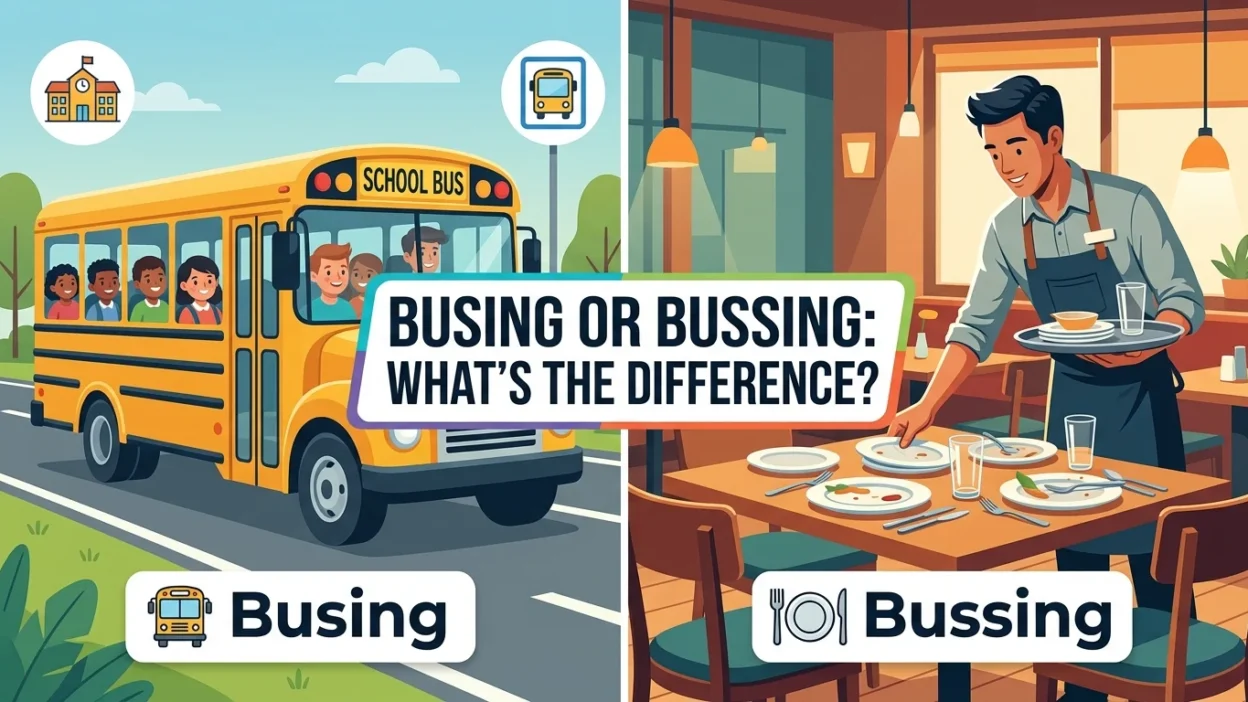
Many English learners and even native speakers get confused when they see the words busing and bussing.
At first glance, both spellings look correct. You may see one spelling in a newspaper and another on social media. Some dictionaries accept both forms, which makes the confusion even greater.
The good news is that understanding the difference is actually very simple.
In most cases, both words can be correct, but they are often used in different situations. Once you learn the basic rule, you will know exactly which spelling to choose.
Quick Answer
- Busing usually refers to transportation by bus.
- Bussing usually refers to clearing tables in a restaurant.
- Both spellings come from the word bus.
- Different style guides and dictionaries may prefer different spellings.
- When talking about school transportation or public transport, busing is more common.
- When talking about restaurant work, bussing is often preferred.
Origin and Background
The word bus comes from a longer word that was used for public transportation many years ago.
As English developed, people started creating new forms of the word:
- Bus (noun)
- Bus (verb)
- Busing/Bussing (present participle)
- Bused/Bussed (past tense)
The confusion started because English spelling rules sometimes require doubling a consonant before adding -ing.
For example:
- Run → Running
- Sit → Sitting
Some writers applied this pattern to bus, creating bussing.
Others preferred to keep the original word unchanged and wrote busing.
Over time, both spellings became accepted in different contexts.
The Difference Between Busing and Bussing
The easiest way to understand the difference is to look at the meaning.
Busing = Transportation by Bus
When someone is transported by a bus, the word busing is commonly used.
Examples:
- The city is busing students to the new school.
- Children are busing across town every morning.
- The government started a busing program.
In these examples, the focus is on transportation.
Bussing = Clearing Tables in a Restaurant
In restaurants, a worker may remove dirty dishes and clean tables after customers leave.
This activity is often called bussing tables.
Examples:
- She is bussing tables during her evening shift.
- He started his restaurant career by bussing tables.
- The restaurant needs more workers for bussing duties.
In these examples, the focus is on restaurant work.
Why Both Spellings Exist
Because both spellings developed over time, some dictionaries list them as acceptable alternatives.
However, many writers use a practical approach:
- Busing = transportation
- Bussing = restaurant table clearing
This helps avoid confusion for readers.
Comparison Table
| Feature | Busing | Bussing |
| Most common meaning | Transportation by bus | Clearing restaurant tables |
| Related to schools | Yes | No |
| Related to public transport | Yes | No |
| Related to restaurants | Sometimes, but less common | Yes |
| Common in news reports | Yes | Less often |
| Common in restaurant jobs | Less often | Yes |
| Easy way to remember | Think of buses | Think of busboys and restaurant work |
Which One Should You Use and When?
Choosing the correct spelling depends on what you are talking about.
Use “Busing” When Talking About Transportation
Examples:
- The district is busing students to school.
- The company is busing workers to the construction site.
- The city expanded its busing services.
This spelling is usually the safest choice when discussing transportation.
Use “Bussing” When Talking About Restaurants
Examples:
- She spent the summer bussing tables.
- He was hired for bussing duties.
- The restaurant staff were busy bussing tables after lunch.
This spelling clearly shows that the topic is restaurant work.
When Both May Be Accepted
Some dictionaries and publications accept both spellings in many situations.
However, using the meaning based rule helps readers understand your message immediately.
Common Mistakes People Make
Mixing the Meanings
One common mistake is using bussing when talking about transportation.
Incorrect:
- The school is bussing students to another building.
Although some people write it this way, many readers expect bussing to relate to restaurant work.
Better:
- The school is busing students to another building.
Using the Wrong Context
Incorrect:
- She is busing tables tonight.
Some readers may think transportation is involved.
Better:
- She is bussing tables tonight.
Assuming Only One Spelling Is Correct
Many people believe one spelling is completely wrong.
That is not true.
Both spellings exist in modern English. The main goal is choosing the one that best matches the meaning.
Everyday Real Life Examples
Emails
Transportation Example
- We will be busing employees to the conference center.
Restaurant Example
- Sarah will be bussing tables during the dinner shift.
News
Transportation Example
- The district announced a new busing plan for students.
Restaurant Example
- Local restaurants are hiring workers for bussing and cleaning duties.
Social Media
Transportation Example
- They are busing fans to the stadium for the event.
Restaurant Example
- My first job was bussing tables at a small restaurant.
Daily Conversations
Transportation Example
- The company is busing workers from nearby towns.
Restaurant Example
- He earns extra money bussing tables on weekends.
Short Learning Section for Students and Beginners
A simple memory trick can help you remember the difference.
Remember This Rule
Busing = Bus transportation
Think about:
- School buses
- City buses
- Travel by bus
Remember This Rule
Bussing = Restaurant tables
Think about:
- Dirty plates
- Restaurant workers
- Cleaning tables
Quick Practice
Choose the correct word.
- The city is _____ students to school.
- Answer: busing
- She is _____ tables after customers leave.
- Answer: bussing
- The company is _____ workers to the event.
- Answer: busing
- He started his career by _____ tables.
- Answer: bussing
If you can answer these correctly, you already understand the difference.
FAQ
Is busing a real word?
Yes. Busing is a real and widely accepted word, especially when talking about transportation by bus.
Is bussing a real word?
Yes. Bussing is also a real word and is commonly used in restaurant settings.
Which spelling is more common?
Busing is often more common when discussing transportation. Bussing is common in the restaurant industry.
Can I use bussing for transportation?
Some dictionaries allow it, but many writers prefer busing for transportation because it creates less confusion.
What does bussing tables mean?
It means removing dirty dishes, cleaning tables, and preparing them for the next customers.
Why does bussing have two “s” letters?
Some writers follow English spelling patterns that double the final consonant before adding -ing.
Do dictionaries accept both spellings?
Many dictionaries recognize both spellings, although they may explain different preferred uses.
Which spelling should students use?
A simple rule is:
- Busing for transportation
- Bussing for restaurant work
This is easy to remember and easy for readers to understand.
Conclusion
The confusion between busing and bussing comes from the fact that both spellings are accepted in English. However, many writers use them differently to make meanings clearer.
A simple way to remember the difference is:
- Busing = transportation by bus
- Bussing = clearing tables in a restaurant
Following this rule helps readers understand your writing instantly and prevents misunderstandings. For students, ESL learners, and everyday writers, this is the easiest and most practical way to use these words correctly.