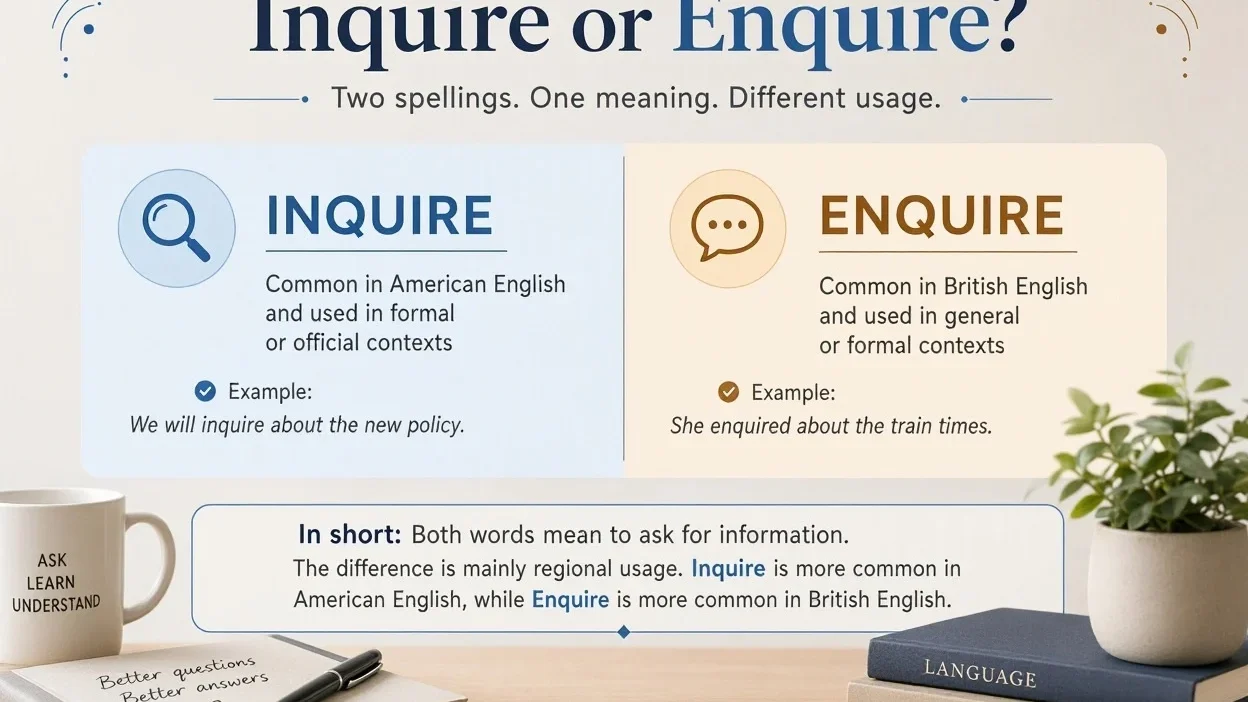
Have you ever wondered whether to write inquire or enquire? Both words are correct, and both mean to ask for information, investigate something, or seek an answer. However, their spelling and usage can depend on where you live and the type of English you are writing.
Understanding the difference will help you choose the right word in emails, school assignments, professional conversations, and everyday writing.
The main difference is that inquire is more common in American English, while enquire is traditionally more common in British English. In British English, some writers also distinguish between the two words based on their meanings.
Although this distinction is not always followed, knowing it can make your writing clearer and more natural. Let’s explore their definitions, origins, examples, and common mistakes so you can confidently use both words.
Quick Answer: Inquire or Enquire
Both inquire and enquire are correct English spellings. They mean to ask for information or investigate something. Inquire is preferred in American English and is widely used internationally, while enquire is traditionally associated with British English. Choose the spelling that matches your audience and remain consistent throughout your writing.
Why Do People Confuse Inquire and Enquire?
People often confuse these words because they have almost identical meanings, pronunciation, and grammatical functions.
Both words are verbs, and both describe the action of asking questions or seeking information.
For example:
- I want to inquire about the job opening.
- I want to enquire about the job opening.
Both sentences are grammatically correct.
The confusion mainly comes from differences between American and British spelling conventions. American English generally prefers inquire, whereas British English accepts both spellings.
Another reason for the confusion is that some British dictionaries and writing traditions distinguish between formal investigations and ordinary questions.
Understanding the regional preferences makes it easier to select the appropriate spelling.
First Word: Inquire
Inquire is a verb that means to ask for information, request details, or investigate a particular subject.
It is the preferred spelling in American English and is also widely recognized in other English-speaking countries.
Meaning of Inquire
The word inquire can have two closely related meanings:
- To ask someone for information about something.
- To investigate or examine a situation to discover the truth.
Examples:
- She called the school to inquire about admission requirements.
- The police will inquire into the incident.
- I would like to inquire about your services.
- The journalist decided to inquire further into the matter.
Origin of Inquire
The word inquire comes through Middle English from Old French and ultimately from Latin inquirere.
The Latin word combines elements meaning “in” and “to seek.” Its historical sense is connected with searching for information or investigating something.
Over time, the word developed into its modern English meaning: asking questions or looking into a subject.
When Should You Use Inquire?
Use inquire when:
- Writing American English.
- Asking for information in a professional email.
- Investigating a problem or situation.
- Requesting details about a service or product.
- Writing formal reports or academic documents.
Example:
“I am writing to inquire about the available scholarship opportunities.”
This sentence is appropriate for a formal email to a university.
Second Word: Enquire
Enquire is also a verb. It means to ask for information, make a request, or investigate something.
It is traditionally associated with British English and is commonly used in British writing.
Meaning of Enquire
The word enquire generally means to ask someone a question or seek information about something.
In traditional British usage, it is often associated with ordinary questions and requests for information.
Examples:
- I called the hotel to enquire about room availability.
- She went to the office to enquire about the meeting.
- Please enquire at the reception desk.
- He wanted to enquire about the course fees.
Origin of Enquire
The word enquire shares the same historical Latin origin as inquire.
Both spellings developed through the history of English and French. Their meanings eventually became very similar, although regional spelling preferences developed over time.
Today, enquire remains particularly familiar in British English.
When Should You Use Enquire?
Use enquire when:
- Writing in British English.
- Asking ordinary questions.
- Requesting information about a service.
- Communicating with British organizations.
- Following a British English spelling style.
Example:
“I would like to enquire about the registration process.”
This is a natural sentence in British English.
Inquire vs Enquire: Comparison Table
The following table explains the main differences between these two words.
| Feature | Inquire | Enquire |
| Part of speech | Verb | Verb |
| Meaning | Ask or investigate | Ask or investigate |
| American English | Preferred | Less common |
| British English | Common | Common |
| Formal writing | Yes | Yes |
| Pronunciation | Usually identical | Usually identical |
| Noun form | Inquiry | Enquiry |
| Example | Inquire about fees | Enquire about fees |
The most important difference is regional preference, not basic meaning. Both words are correct, and neither is inherently more professional or grammatically superior.
When to Use Each: Inquire or Enquire?
Choosing between inquire and enquire becomes easier when you consider your audience and writing style.
1. Use Inquire in American English
American English generally uses inquire in both everyday and formal communication.
Example:
“I am contacting you to inquire about the application deadline.”
2. Use Enquire in British English
British English traditionally uses enquire for ordinary requests for information.
Example:
“Could you please enquire about the availability of tickets?”
3. Use Inquire for Formal Investigations
In traditional British usage, inquire is often preferred when referring to an official investigation.
Example:
“The government will inquire into the causes of the accident.”
4. Use Enquire for General Questions
In traditional British usage, enquire is often used when someone simply wants to ask a question.
Example:
“I would like to enquire about the price of this product.”
Remember that these British distinctions are traditional preferences, not strict rules followed by every writer.
15 Examples of Inquire and Enquire in Sentences
Examples make it easier to understand how these words work in everyday and professional English.
Examples Using Inquire
- I would like to inquire about the admission process.
- She called the company to inquire about the job vacancy.
- The manager decided to inquire into the customer’s complaint.
- We need to inquire about the delivery schedule.
- He went to the office to inquire about his application.
- The journalist wanted to inquire further into the story.
- Parents can inquire about school fees at the reception desk.
Examples Using Enquire
- I called the hotel to enquire about room prices.
- She went to the university to enquire about available courses.
- Please enquire at the information desk.
- He wanted to enquire about the company’s working hours.
- You can enquire about the event by sending an email.
- I would like to enquire whether registration is still open.
- They contacted the travel agency to enquire about holiday packages.
- She decided to enquire about the new job opportunity.
Important: You can replace inquire with enquire in most of these sentences without changing the basic meaning. The best choice depends on your preferred English variety.
Common Mistakes When Using Inquire and Enquire
Although both words are correct, learners sometimes make mistakes when using them.
Here are some common errors to avoid.
Mistake 1: Thinking Enquire Is Incorrect
Incorrect understanding: “Enquire is not a real English word.”
Correct understanding: Both inquire and enquire are accepted English spellings.
Mistake 2: Mixing American and British Spellings
Using inquire in one paragraph and enquire in another may make your writing inconsistent.
Better approach: Choose one spelling style and follow it throughout your document.
Mistake 3: Confusing Inquire With Inquiry
Inquire is a verb, while inquiry is a noun.
- Correct: I want to inquire about the course.
- Correct: I made an inquiry about the course.
Mistake 4: Using the Wrong Word Form
Remember these related forms:
| Verb | Noun | Example |
| Inquire | Inquiry | She made an inquiry. |
| Enquire | Enquiry | He sent an enquiry. |
Mistake 5: Assuming They Have Completely Different Meanings
Both words can describe asking questions and seeking information. The distinction between ordinary questions and formal investigations is mainly a traditional British usage preference.
Memory Trick: How to Remember Inquire vs Enquire
A simple memory trick can help you remember which spelling to choose.
Think of the letter I in Inquire as I for International and American writing.
- Inquire = Preferred in American English.
- Enquire = Traditionally preferred in British English.
Another easy way to remember:
- If you are writing for an American audience, choose inquire.
- If you are writing for a British audience, enquire is a natural choice for ordinary questions.
You can also remember that both words are connected to asking questions and searching for information.
American vs British English: Inquire or Enquire
American and British English sometimes use different spellings for words with the same meaning. Inquire and enquire are examples of this difference.
In American English, inquire is the standard and more widely preferred spelling. It is used for everyday questions, business communication, academic writing, and official investigations.
In British English, both spellings are accepted. Traditionally, enquire is used for general questions, while inquire is associated more closely with formal investigations.
| English Variety | Preferred Usage | Example |
| American English | Inquire | I want to inquire about the course. |
| British English | Enquire | I want to enquire about the course. |
| British formal investigation | Inquire | An inquiry will investigate the incident. |
For international writing, inquire is a widely understood and practical choice.
Similar Words Related to Inquire and Enquire
Several English words have meanings similar to inquire and enquire. Learning these words can improve your vocabulary and help you express yourself more clearly.
1. Ask
Meaning: To request information or an answer.
Example: “I want to ask about the meeting.”
2. Question
Meaning: To ask someone for information or clarification.
Example: “The teacher questioned the student about the assignment.”
3. Investigate
Meaning: To examine something carefully to discover facts.
Example: “The police will investigate the accident.”
4. Request
Meaning: To politely ask for something.
Example: “She requested additional information about the course.”
5. Consult
Meaning: To ask someone for advice or information.
Example: “You should consult your teacher about the examination.”
6. Examine
Meaning: To study or inspect something carefully.
Example: “The committee will examine the available evidence.”
These words are related to asking questions or gathering information, but they are not always interchangeable. Choose the word that best expresses your intended meaning.
Final Verdict: Which Is Correct, Inquire or Enquire?
Both inquire and enquire are correct English words. They have almost identical meanings and can generally be used interchangeably.
However, your choice should depend on your audience:
- Inquire: Best for American English and a widely recognized international spelling.
- Enquire: A natural choice in British English, particularly for ordinary requests for information.
If you are writing for an American audience, use inquire. If you are following traditional British English, enquire is suitable for general questions.
The most important thing is to use your chosen spelling consistently.
(FAQs):
1. Is it inquire or enquire?
Both spellings are correct. Inquire is preferred in American English, while enquire is traditionally more common in British English. Both words mean to ask for information or investigate something.
2. Is enquire British or American?
Enquire is traditionally associated with British English. It is accepted in British writing, especially when someone is asking a general question or requesting information.
3. Is inquire more formal than enquire?
No. Neither spelling is inherently more formal than the other. Both can be used in professional emails, academic writing, and formal communication. Regional spelling preferences determine which one is more suitable.
4. What is the difference between inquiry and enquiry?
Inquiry and enquiry are nouns. Both refer to a question, request for information, or investigation. American English generally prefers inquiry, while British English traditionally uses both forms.
5. Can I use enquire in American English?
Yes, people can understand enquire in American English, but inquire is the standard and more widely preferred spelling in the United States.
6. Which spelling should I use in a formal email?
Choose the spelling that matches your audience. Use inquire for American English and enquire for British English. Both are appropriate for professional emails.
7. Are inquire and enquire pronounced the same?
Yes. In standard English pronunciation, both words are generally pronounced the same way. Their main difference is spelling and regional usage.
8. Which spelling is better for international English?
Inquire is a practical choice for international communication because it is widely recognized and is the standard spelling in American English. However, enquire is also correct.
Remember This
Here are the most important points to remember:
- Both inquire and enquire are correct.
- Both words mean to ask for information or investigate.
- Inquire is preferred in American English.
- Enquire is traditionally associated with British English.
- British English sometimes distinguishes between general enquiries and formal inquiries.
- Inquiry and enquiry are their corresponding noun forms.
- Always maintain consistent spelling throughout your writing.
The difference between inquire and enquire is mainly related to regional spelling preferences. Both words have the same basic meaning and are used when someone wants to ask a question, request information, or investigate a matter. American English generally prefers inquire, while British English traditionally accepts both forms and often uses enquire for everyday questions.
If you are unsure which spelling to choose, consider your readers and follow the appropriate English style. Remember that neither word is wrong. Once you understand their regional preferences and traditional usage, you can confidently use inquire or enquire in emails, academic assignments, business communication, and everyday writing.