
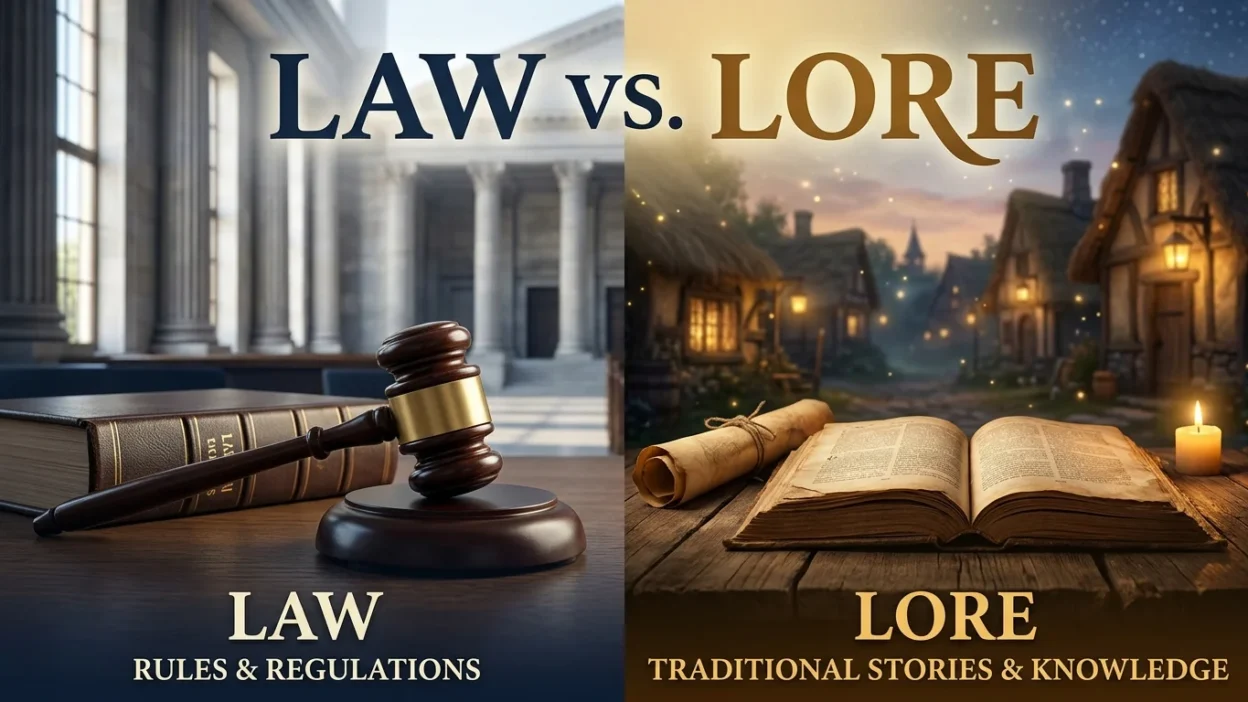
The words law and lore are often used when discussing rules, traditions, culture, and the knowledge people pass from one generation to another. Although they may appear together, they have different meanings.
Both words are important in everyday English, history, literature, religion, and cultural studies. For example, a country has laws that citizens are expected to follow, while a community may preserve local lore through stories, customs, and legends. Learning how these terms work will help you understand their meanings, recognize their differences, and use them naturally in sentences.
Quick Answer: What Does Law and Lore Mean?
Law means an official rule or system of rules established by an authority to guide behavior and maintain order. Lore means traditional knowledge, stories, beliefs, and customs passed from one generation to another. Law is generally formal and enforceable, while lore is usually cultural, historical, or informal. Both influence how people understand and organize society.
Why Do People Confuse Law and Lore?
People sometimes confuse law and lore because both words relate to the rules, beliefs, and traditions that guide human behavior.
However, they serve different purposes:
- Law establishes formal rules that people are legally required to follow.
- Lore preserves traditional knowledge, cultural beliefs, and stories.
- Both can influence how communities behave and understand the world.
- Both can be connected to history, society, and cultural identity.
For example, a law may require drivers to stop at a red traffic light. Local driving lore might include traditional advice about avoiding certain roads during busy hours.
The important difference is that laws have legal authority, while lore generally comes from shared cultural knowledge and experience.
First Word: Law
What Does Law Mean?
The word law refers to a system of official rules established by a government, legal authority, or recognized institution. These rules explain what people can and cannot do.
Laws help maintain peace, protect individual rights, settle disagreements, and create order within society.
For example, traffic laws tell drivers how to use roads safely. Criminal laws explain which actions are considered offenses and what legal consequences may follow.
Origin and History of Law
The word law comes from Old English lagu, which was influenced by Old Norse lag. It developed from an older idea connected with something laid down or established.
Over time, the word became associated with official rules, legal systems, and principles governing society.
Different civilizations developed their own legal systems. Ancient legal traditions, including Roman law and the Code of Hammurabi, helped shape the development of legal thought.
Examples of Law in Sentences
- Everyone must follow the law.
- The government introduced a new environmental law.
- Traffic law helps protect drivers and pedestrians.
- The judge explained the law clearly.
- Breaking the law can lead to legal consequences.
- The school has a law against dangerous behavior.
Different Meanings of Law
The word law can have several meanings depending on its context.
- Legal law: Official rules established by a government.
- Scientific law: A statement describing a consistent pattern in nature, such as the law of gravity.
- Moral law: Principles about right and wrong.
- General principle: A recognized rule or principle that explains how something works.
Second Word: Lore
What Does Lore Mean?
The word lore refers to traditional knowledge, stories, beliefs, customs, and information passed from one generation to another.
Lore is commonly connected with culture, history, folklore, mythology, and community traditions.
Unlike law, lore does not usually come from a government or legal institution. Instead, it develops through shared experiences, storytelling, and cultural practices.
For example, traditional stories about mythical creatures are part of folklore. Similarly, old farming knowledge passed down through generations can be described as agricultural lore.
Origin and History of Lore
The word lore comes from Old English lār, meaning teaching, instruction, or knowledge.
Historically, people passed information through storytelling, songs, oral traditions, and practical experience. This helped communities preserve their history and cultural identity.
Today, lore can describe traditional knowledge, fictional histories, legends, and even the background information of books, movies, and video games.
Examples of Lore in Sentences
- The village is famous for its ancient lore.
- My grandmother shared family lore with us.
- The book contains interesting stories about local lore.
- Ancient Greek mythology is filled with fascinating lore.
- The historian studied the lore of the region.
- The game introduces players to the lore of its fictional world.
Different Types of Lore
Lore appears in many areas of life and culture.
- Folklore: Traditional stories, customs, and beliefs of a community.
- Family lore: Stories and traditions passed down within a family.
- Historical lore: Traditional knowledge connected with historical events and people.
- Religious lore: Traditional stories and beliefs associated with religious communities.
- Fantasy lore: Background stories, characters, and histories of imaginary worlds.
Law vs Lore: What Is the Difference?
Law and lore are different in meaning, purpose, origin, and usage. Law is connected with official rules, while lore is associated with traditional knowledge and stories.
| Feature | Law | Lore |
| Meaning | Official rules or legal principles | Traditional knowledge and stories |
| Origin | Governments and legal authorities | Communities and generations |
| Purpose | Maintain order and regulate behavior | Preserve culture and knowledge |
| Nature | Usually formal | Usually informal |
| Enforcement | May be legally enforced | Generally not legally enforced |
| Examples | Traffic law, criminal law | Family lore, folklore |
| Common context | Courts, government, rights | Culture, history, mythology |
Simple example:
- Law: You must follow the speed limit while driving.
- Lore: Local drivers share traditional knowledge about roads that become dangerous during heavy rain.
When Should You Use Law and Lore?
Choosing the correct word depends on what you want to communicate.
When to Use Law
Use law when discussing official rules, legal systems, government regulations, or established principles.
Examples:
- When discussing legal rights.
- When explaining government regulations.
- When talking about criminal offenses.
- When describing scientific principles.
- When discussing rules that can be legally enforced.
Sentence: The new law protects children from online exploitation.
When to Use Lore
Use lore when discussing traditional stories, cultural knowledge, legends, customs, or information passed between generations.
Examples:
- When describing traditional beliefs.
- When discussing ancient legends.
- When sharing family history.
- When explaining cultural customs.
- When describing fictional worlds.
Sentence: The town’s local lore includes stories about a mysterious old castle.
12 Examples of Law and Lore in Sentences
These examples show how to use both words naturally in everyday English.
- Law: Every citizen should understand their legal rights.
- Lore: The village has fascinating stories about its past.
- Law: The government passed a new law to protect wildlife.
- Lore: Local lore tells stories about hidden treasures.
- Law: The judge carefully considered the law.
- Lore: My grandfather knows a great deal of family lore.
- Law: Driving without a valid license may violate the law.
- Lore: Ancient Egyptian lore includes stories about gods and goddesses.
- Law: The company must follow employment law.
- Lore: The community preserves its cultural lore through storytelling.
- Law: The new law applies to all businesses in the country.
- Lore: The fantasy novel contains detailed lore about its magical kingdom.
Common Mistakes When Using Law and Lore
English learners sometimes use law and lore incorrectly because both words can appear in discussions about society and traditions.
Here are some mistakes to avoid.
Mistake 1: Using lore when you mean an official rule
Incorrect: Everyone must follow the lore of the country.
Correct: Everyone must follow the laws of the country.
Mistake 2: Using law when you mean traditional stories
Incorrect: The village has interesting laws about ancient legends.
Correct: The village has interesting lore about ancient legends.
Mistake 3: Assuming lore is always legally binding
Lore may influence people’s behavior, but it does not automatically create legal obligations.
Mistake 4: Assuming every law is written
Some legal systems recognize customary laws and unwritten legal principles. Therefore, law is not always limited to written rules.
Mistake 5: Confusing folklore with law
Folklore describes traditional stories and cultural beliefs. It is not the same as an official legal system.
Memory Trick: How to Remember Law and Lore
A simple memory trick can help you remember the difference between these words.
- Law = Legal rules. Both begin with the letter L.
- Lore = Legends and learning. Think of traditional stories and knowledge.
Remember these two short sentences:
- Law tells you what rules you must follow.
- Lore tells you what stories and knowledge people pass down.
This simple trick makes it easier to choose the correct word when speaking or writing.
American vs British English: Law and Lore
There is no major spelling or meaning difference between American and British English for the words law and lore.
Both varieties use these words with the same basic meanings.
| Word | American English | British English |
| Law | Law | Law |
| Lore | Lore | Lore |
| Plural of law | Laws | Laws |
| Plural of lore | Usually uncountable | Usually uncountable |
Examples:
- American English: The new law protects public health.
- British English: The new law protects public health.
- American English: The region has fascinating local lore.
- British English: The region has fascinating local lore.
The pronunciation and spelling are generally the same in both varieties.
Similar Words Related to Law and Lore
Learning related vocabulary can help you understand these words more clearly.
Words Similar to Law
- Rule: An instruction that explains what is allowed or required.
- Regulation: An official rule created by an authority.
- Statute: A written law passed by a legislative body.
- Legislation: Laws considered or passed by a government.
- Justice: Fair treatment according to legal or moral principles.
Words Similar to Lore
- Folklore: Traditional stories, beliefs, and customs.
- Myth: A traditional story, often involving supernatural beings or explaining beliefs.
- Legend: A traditional story associated with a person, place, or event.
- Tradition: A custom or belief passed from one generation to another.
- Heritage: Cultural history and traditions inherited from previous generations.
Final Verdict: Law or Lore?
The difference between law and lore is simple once you understand their purposes.
Law refers to official rules, legal principles, and regulations that guide behavior within a society. It is associated with governments, courts, and legal institutions.
Lore refers to traditional knowledge, cultural beliefs, stories, and customs passed down through generations. It is associated with history, folklore, mythology, and community traditions.
Use law when discussing legal rules and lore when discussing traditional knowledge or stories. Remembering this distinction will help you use both words correctly in everyday communication.
(FAQs): About Law and Lore
1. What is the meaning of law and lore?
Law means official rules established by a legal authority, while lore means traditional knowledge, stories, beliefs, and customs passed from one generation to another. Law regulates behavior, whereas lore preserves cultural knowledge.
2. Are law and lore the same thing?
No, law and lore are not the same. Law refers to formal rules that may be legally enforced, while lore refers to traditional knowledge and stories shared within a community.
3. What is an example of law?
A traffic regulation requiring drivers to stop at a red light is an example of law. It establishes a rule that drivers are legally expected to follow.
4. What is an example of lore?
A traditional story about a mysterious creature living in a forest is an example of lore. Such stories are often passed down through generations.
5. Is lore the same as folklore?
Not exactly. Folklore is a specific type of lore that includes traditional stories, beliefs, customs, songs, and practices of a community. Lore is a broader term that can include other forms of traditional knowledge.
6. Can lore become law?
Sometimes, yes. In certain legal systems, long-established customs and traditions can be recognized as customary law. However, not every cultural belief or traditional practice becomes legally binding.
7. Is lore a formal or informal word?
Lore is generally used to describe traditional or accumulated knowledge. It is common in discussions about history, culture, mythology, literature, and fictional worlds. It is not usually a formal legal term.
8. How can I remember the difference between law and lore?
Remember that law means legal rules, while lore means legends and traditional knowledge. Law tells people what rules to follow, and lore preserves stories and information from the past.
Remember This
- Law = Official rules, regulations, and legal principles.
- Lore = Traditional knowledge, stories, beliefs, and customs.
- Law is generally enforceable through legal institutions.
- Lore is usually preserved through storytelling and shared experiences.
- Both words help explain how societies develop rules, traditions, and cultural identities.
Conclusion
Understanding the difference between law and lore helps you communicate more clearly and confidently in English. Although both words relate to society and human behavior, they have different meanings. Law refers to official rules and legal principles, while lore describes traditional knowledge, stories, and cultural beliefs passed from one generation to another.
Whenever you write or speak, remember that laws regulate behavior, while lore preserves knowledge and traditions. Learning these simple differences will improve your vocabulary and help you understand English conversations, books, history, and cultural discussions more easily.