
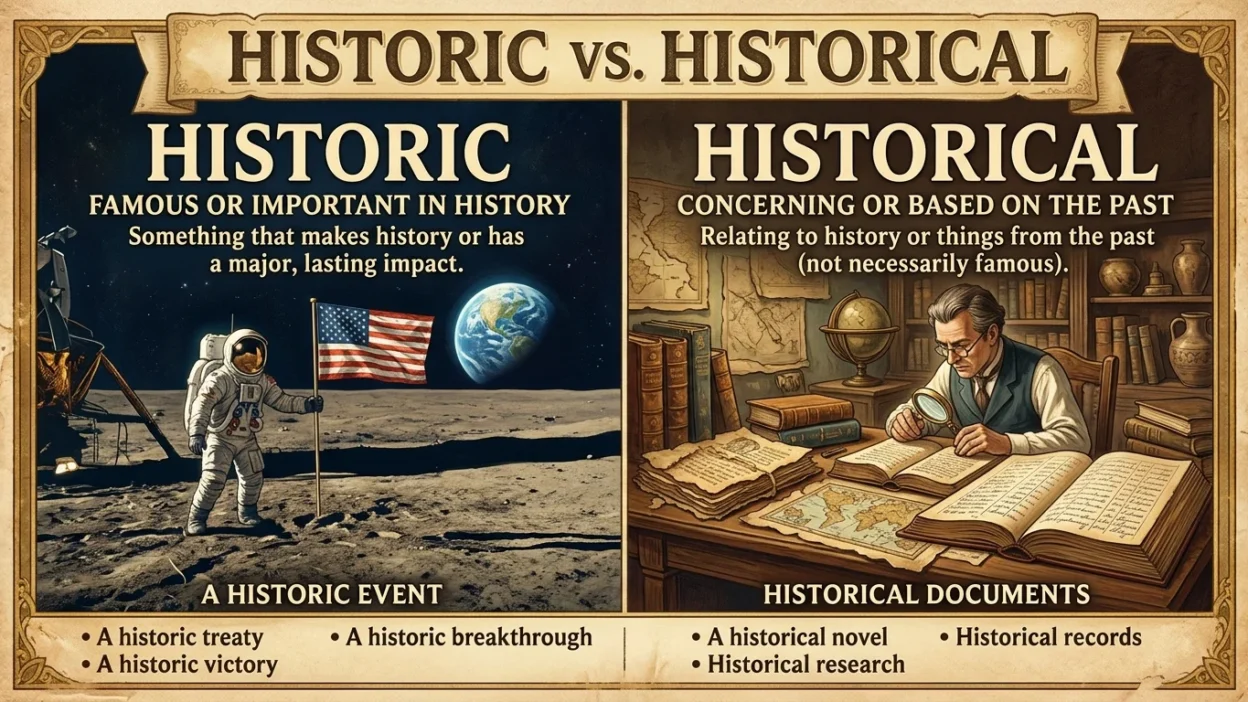
The words historic and historical look and sound similar, but they have different meanings. Both are related to history, past events, and important moments. However, knowing when to use each word can make your English clearer and more accurate. If you are learning English, preparing for an exam, or improving your writing skills, understanding the difference between historic and historical is important.
The main difference is simple: historic describes something important or influential in history, while historical describes something connected to the past or the study of history. For example, the first moon landing was a historic event because it changed human achievement. A historical document, on the other hand, is simply a document from the past or one that provides information about history. In this guide, you will learn their meanings, differences, grammar, common mistakes, and practical examples.
Quick Answer: What Is the Difference Between Historic and Historical?
Historic means important or significant in history. It describes events, achievements, places, or moments that have made a lasting impact. Historical means related to history or belonging to the past. For example, a historic victory changes history, while a historical book explains or describes past events. Both words are adjectives, but they are not interchangeable in every sentence.
Why Do People Confuse Historic and Historical?
People often confuse these words because they share the same root word, history. They also have similar spellings, pronunciations, and meanings connected to the past.
However, their purposes are different.
- Historic: Focuses on importance, influence, or lasting significance.
- Historical: Focuses on a connection to the past, history, or historical records.
Consider these examples:
- The signing of the peace agreement was a historic moment.
- The museum contains many historical documents.
In the first sentence, the agreement is important because it may change the future. In the second sentence, the documents are connected to the past.
Remember that something can be historical without being historic. Not every old object or past event is important enough to be called historic.
What Does Historic Mean?
Historic is an adjective that describes something important, memorable, or influential in history. It is used for events, decisions, discoveries, achievements, and moments that have a lasting impact on society or the world.
A historic event often becomes an important part of history because it changes people’s lives, influences future generations, or marks a major achievement.
Examples of Historic in Sentences
- The first moon landing was a historic achievement.
- The country celebrated a historic victory.
- The president made a historic announcement.
- The peace agreement marked a historic moment.
- It was a historic day for the entire nation.
When Should You Use Historic?
Use historic when you want to highlight the importance of something in history.
Common expressions include:
- Historic achievement
- Historic decision
- Historic victory
- Historic agreement
- Historic moment
- Historic election
- Historic event
- Historic milestone
Simple explanation: If something is important enough to be remembered as a major moment in history, the word historic is usually appropriate.
What Does Historical Mean?
Historical is an adjective that describes something related to history, the past, or the study of past events. It can refer to old documents, buildings, records, photographs, people, traditions, and information about earlier times.
Unlike historic, historical does not necessarily suggest that something is important or influential.
For example, a historical photograph may simply show an ordinary family from 100 years ago. It is connected to the past, but it may not have changed history.
Examples of Historical in Sentences
- She enjoys reading historical novels.
- The museum displays historical photographs.
- Researchers discovered important historical records.
- We visited a historical building.
- The teacher explained the historical background of the war.
When Should You Use Historical?
Use historical when discussing something connected to the past or the study of history.
Common expressions include:
- Historical records
- Historical documents
- Historical research
- Historical facts
- Historical evidence
- Historical background
- Historical fiction
- Historical buildings
Simple explanation: If something belongs to the past, describes the past, or helps people understand history, historical is usually the correct word.
Historic vs. Historical: What Is the Main Difference?
The easiest way to understand these words is to compare their meanings, purposes, and examples.
| Feature | Historic | Historical |
| Part of speech | Adjective | Adjective |
| Main meaning | Important in history | Related to history |
| Main focus | Significance | Connection to the past |
| Importance required? | Usually yes | No |
| Common use | Major events and achievements | Documents, records, and research |
| Example | Historic victory | Historical record |
| Example sentence | It was a historic discovery. | I read a historical book. |
Easy Comparison
- A historic building is a building considered important because of its historical significance.
- A historical building is a building associated with a particular period or the past.
Similarly:
- A historic speech is an important speech that may influence future generations.
- A historical speech is a speech studied or discussed as part of history.
The context determines which word is most suitable.
When Should You Use Historic or Historical?
Choosing the correct word becomes easier when you understand what you want to communicate.
Use Historic for Important Events
Choose historic when describing something that makes a significant contribution to history.
Examples:
- The country achieved a historic victory.
- The discovery was a historic breakthrough.
- The election became a historic event.
Use Historical for Past Information
Choose historical when talking about information, objects, or events connected to earlier times.
Examples:
- The library contains historical books.
- Students studied historical events.
- The researcher examined historical evidence.
Can Something Be Both Historic and Historical?
Yes. Something can be both historic and historical, depending on the meaning.
For example, the first moon landing was a historic achievement because it changed the course of human exploration. It is also a historical event because it happened in the past and is studied by historians.
The difference is the emphasis:
- Historic highlights its importance.
- Historical highlights its connection to the past.
15 Examples of Historic and Historical in Sentences
Here are practical examples to help you understand how to use both words naturally.
Examples Using Historic
- The first flight around the world was a historic achievement.
- The country experienced a historic change in leadership.
- The team celebrated a historic championship victory.
- The new agreement marked a historic step toward peace.
- Her speech became a historic moment in the nation’s history.
- Scientists made a historic breakthrough in medical research.
- The election was considered a historic event.
- The discovery changed the course of scientific history.
Examples Using Historical
- My grandfather collects historical photographs.
- The students visited a historical museum.
- She is writing a historical novel about ancient Rome.
- Researchers studied historical documents.
- The book provides historical information about the city.
- We learned about historical events in school.
- The university offers courses in historical research.
These examples show that historic emphasizes importance, while historical emphasizes a connection to the past.
Common Mistakes When Using Historic and Historical
Even advanced English learners sometimes use these words incorrectly. Here are some common mistakes and their corrections.
| Incorrect Sentence | Correct Sentence | Reason |
| It was a historical victory. | It was a historic victory. | A significant victory is historic. |
| I read a historic novel about ancient Rome. | I read a historical novel about ancient Rome. | The novel relates to the past. |
| The historical decision changed the country. | The historic decision changed the country. | The decision was highly significant. |
| We studied historic documents. | We studied historical documents. | The documents relate to the past. |
| It was a historic record of the family. | It was a historical record of the family. | It describes past information. |
Mistake 1: Thinking Both Words Mean Exactly the Same Thing
Although both words are connected to history, they are not identical. Historic focuses on significance, while historical focuses on the past.
Mistake 2: Using Historic for Every Old Object
An old photograph is not automatically historic. It may simply be historical because it provides information about an earlier time.
Mistake 3: Ignoring Context
Sometimes the same subject can use either word. For example, a building can be historical because of its age and historic because of its importance.
Always consider the meaning you want to express.
Easy Memory Trick: How to Remember Historic vs. Historical
Here is a simple way to remember the difference:
- Historic = Important
- Historical = Related to the past
Think of the word historic as describing something that makes history.
Think of historical as describing something that tells us about history.
Remember These Two Examples
- A historic discovery changes the world.
- A historical book explains the past.
If you remember these two sentences, you will find it much easier to choose the correct word in everyday English.
Historic vs. Historical in American and British English
The meanings of historic and historical are generally the same in American and British English.
Both varieties use:
- Historic event
- Historic achievement
- Historical documents
- Historical research
- Historical records
There is one small difference worth knowing: the pronunciation of historic can vary.
In traditional British English, historic is commonly pronounced with an initial h sound. American English also generally pronounces the h.
A Note About A and An
You may see both “a historic event” and “an historic event” in published English.
- A historic event is the standard choice in modern American English and is widely used in British English.
- An historic event occurs in some British writing and in speech styles where the initial h is weak or silent.
For everyday writing, choose a historic event.
Similar Words: Historic, Historical, History, and Historian
These four words are related, but each has a different grammatical role and meaning.
| Word | Part of Speech | Meaning | Example |
| Historic | Adjective | Important in history | A historic victory |
| Historical | Adjective | Related to the past | Historical evidence |
| History | Noun | Study or record of past events | I study history. |
| Historian | Noun | A person who studies history | She is a historian. |
What Is the Difference Between History and Historian?
History refers to past events or the study of those events.
Example: History teaches us about earlier generations.
Historian refers to a person who researches, studies, or writes about history.
Example: The historian discovered an old manuscript.
Understanding these related words will help you build a stronger English vocabulary.
Final Verdict: Historic vs. Historical
The difference between historic and historical is mainly about significance and connection to the past.
Use historic when describing something important, influential, or memorable in history. Use historical when describing something related to past events, historical information, or the study of history.
For example, a historic victory is an important achievement, while a historical document provides information about the past.
Both words are correct when used in the right context. The best choice depends on whether you want to emphasize importance or simply describe a connection to history.
Frequently Asked Questions (FAQs)
1. What is the main difference between historic and historical?
Historic describes something important or significant in history, while historical describes something related to the past or the study of history. For example, a historic achievement changes history, whereas a historical document provides information about earlier times.
2. Is a historic event the same as a historical event?
Not exactly. A historic event is an important event that has a lasting impact on history. A historical event is any event that happened in the past or is studied as part of history. Some events can be both historic and historical.
3. Should I say historic building or historical building?
Both expressions are correct, but their meanings differ slightly. A historic building is important because of its cultural, architectural, or historical significance. A historical building is associated with a particular period or the past.
4. Is the word historic positive or negative?
Historic is generally neutral. It describes something significant or influential in history, whether the impact is positive or negative. A historic victory may be positive, while a historic disaster may describe a tragic event.
5. What is the difference between historical and history?
History is a noun that refers to past events or their study. Historical is an adjective that describes something connected to history. For example, history is an interesting subject, while historical documents provide information about the past.
6. Can a person be historic or historical?
Yes, both words can describe people, but their meanings differ. A historic person is someone who has made a significant impact on history. A historical person is someone who lived in the past or is connected to a particular historical period.
7. Which is correct: a historic event or an historic event?
“A historic event” is the standard choice in modern English, especially in American English. “An historic event” is also found in some British English writing and speech. For everyday communication, “a historic event” is a safe choice.
Remember This
- Historic = Important in history.
- Historical = Connected to the past.
- A historic event makes history.
- A historical document tells us about history.
- Something can be both historic and historical.
Conclusion
Understanding the difference between historic and historical is easier when you focus on their main meanings. Historic describes something important or influential in history, while historical describes something connected to past events, records, or the study of history. Although the words look similar, they serve different purposes in English sentences.
The best way to remember them is to connect historic with importance and historical with the past. Practice using both words in everyday conversations, school assignments, and writing. With a little practice, you will be able to choose the correct word confidently and communicate your ideas more clearly.