Many English learners and even native speakers get confused by the words inquire and enquire. At first glance, they look very similar. They also have almost the same meaning and are often used in the same situations.
Because both words mean to ask for information, many people wonder if there is any real difference between them. Some people see “inquire” in books, emails, and business writing, while others see “enquire” in newspapers and everyday conversations.
The good news is that the difference is much simpler than many people think. Once you understand where each spelling is commonly used, choosing the right one becomes easy.
Quick Answer
- Inquire and enquire both mean to ask for information.
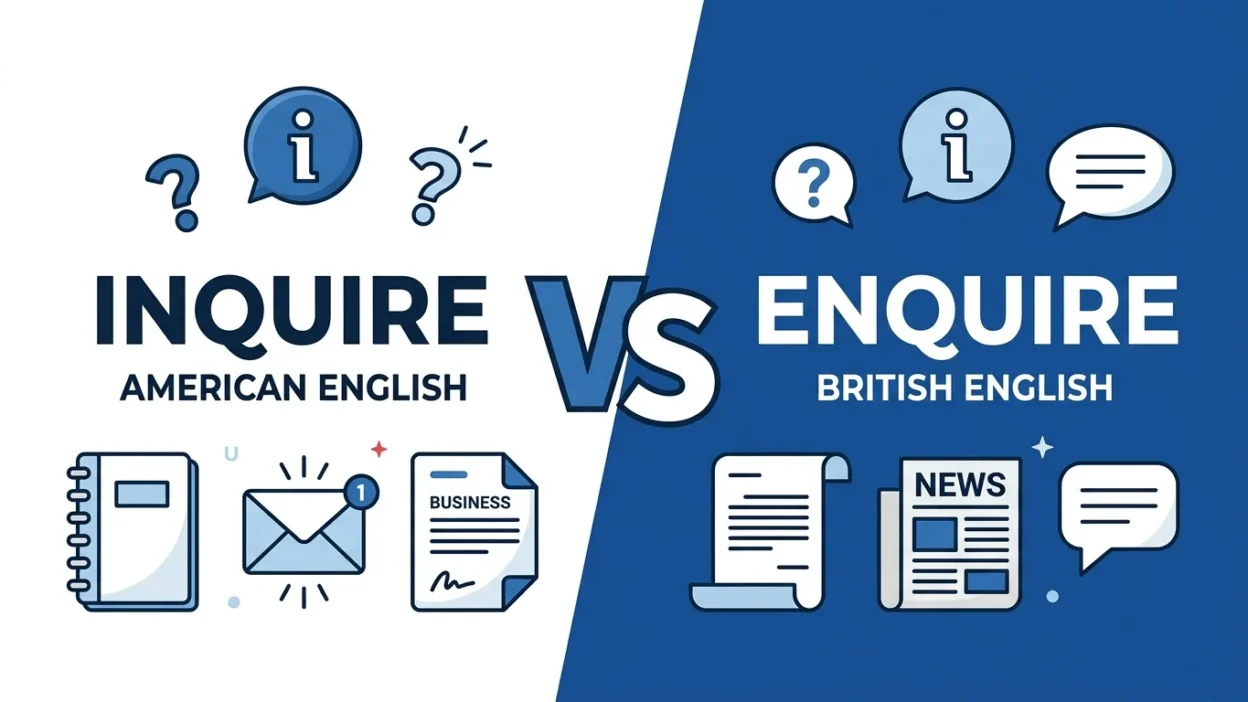
- Inquire is more common in American English.
- Enquire is more common in British English.
- In most situations, they mean the same thing.
- If you write for an American audience, use inquire.
- If you write for a British audience, use enquire.
- Both spellings are correct.
Simple Example
- I would like to inquire about the course fees.
- I would like to enquire about the course fees.
Both sentences are correct.
A Simple Background of the Words
The words inquire and enquire have been around for hundreds of years. They come from the same older word that meant to search for information or ask questions.
Over time, English developed different spelling styles in different countries.
As American English and British English grew apart, certain words began to have different preferred spellings. This is similar to:
| American English | British English |
| Color | Colour |
| Favorite | Favourite |
| Organize | Organise |
| Inquire | Enquire |
Because of this history, both spellings survived and are still used today.
The Difference Between Inquire and Enquire
The biggest difference is where they are commonly used.
Inquire
“Inquire” is the preferred spelling in American English.
People in the United States often use it in:
- Business emails
- Official letters
- Customer service messages
- School and university communication
- Professional writing
Example:
I am writing to inquire about admission requirements.
Enquire
“Enquire” is more common in British English.
People in the United Kingdom often use it in:
- Everyday communication
- Customer support messages
- Newspapers
- General writing
Example:
I am writing to enquire about admission requirements.
Do They Have Different Meanings?
In modern English, not really.
Most dictionaries treat them as having the same meaning.
Some style guides suggest:
- Enquire = ask a simple question.
- Inquire = conduct a formal investigation.
For example:
- She enquired about the train schedule.
- The police inquired into the accident.
However, this distinction is not always followed today. Many writers use the words interchangeably.
Comparison Table
| Feature | Inquire | Enquire |
| Meaning | Ask for information | Ask for information |
| American English | Very common | Rare |
| British English | Used | Very common |
| Formal writing | Common | Less common |
| Business emails | Common | Common in the UK |
| Correct spelling | Yes | Yes |
| Modern meaning | Same as enquire | Same as inquire |
Which One Should You Use and When?
The best choice depends on your audience.
Use “Inquire” When:
- Writing in American English
- Sending business emails
- Writing formal letters
- Communicating with U.S. companies
- Creating academic or professional documents
Example:
I would like to inquire about your training program.
Use “Enquire” When:
- Writing in British English
- Communicating with people in the UK
- Following British spelling rules
- Writing for British publications
Example:
I would like to enquire about ticket availability.
If You Are Unsure
Choose one spelling and stay consistent.
Do not switch between “inquire” and “enquire” in the same document unless there is a specific reason.
Common Mistakes People Make
Using Both Spellings in One Document
Incorrect:
I would like to inquire about the course.
Later, I may enquire about accommodation.
This can look inconsistent.
Better:
I would like to inquire about the course.
Later, I may inquire about accommodation.
Or:
I would like to enquire about the course.
Later, I may enquire about accommodation.
Thinking One Spelling Is Wrong
Many learners believe one spelling must be incorrect.
This is not true.
Both spellings are accepted English words.
Forgetting the Audience
A British reader may naturally expect “enquire.”
An American reader may naturally expect “inquire.”
Choosing the spelling that matches your audience can make your writing feel more natural.
Mixing English Styles
Example:
I would like to enquire about the color options.
This mixes British and American spelling.
A more consistent version would be:
British English:
I would like to enquire about the colour options.
American English:
I would like to inquire about the color options.
Everyday Real Life Examples
Emails
American English:
I am writing to inquire about the status of my application.
British English:
I am writing to enquire about the status of my application.
News
American style:
Reporters inquired about the government’s decision.
British style:
Reporters enquired about the government’s decision.
Social Media
American user:
I just inquired about membership prices.
British user:
I just enquired about membership prices.
Daily Conversations
American English:
I called to inquire about opening hours.
British English:
I called to enquire about opening hours.
Customer Service
American English:
Customers can inquire online for more information.
British English:
Customers can enquire online for more information.
A Short Learning Section for Students and Beginners
A simple way to remember the difference is:
Remember This Rule
- America = Inquire
- Britain = Enquire
That’s usually enough for everyday writing.
Easy Memory Trick
Think of the letter I in Inquire as standing for:
I = International business and American writing
Think of Enquire as the spelling you will often see in:
England and British English
Practice Sentences
Fill in the blank:
- I would like to ______ about the course fees.
- She called to ______ about train times.
- We want to ______ about your services.
Answers:
- inquire/enquire
- inquire/enquire
- inquire/enquire
Both words work because they have the same meaning.
Frequently Asked Questions (FAQ)
Is inquire the same as enquire?
Yes. Both words mean to ask for information. The main difference is regional spelling preference.
Which is correct, inquire or enquire?
Both are correct. Use the spelling that matches your audience and writing style.
Is inquire American English?
Yes. “Inquire” is the preferred spelling in American English.
Is enquire British English?
Yes. “Enquire” is more common in British English.
Can I use inquire and enquire interchangeably?
In most situations, yes. They usually have the same meaning.
Which spelling should students use?
Students should follow the English style they are learning. Use “inquire” for American English and “enquire” for British English.
Is inquire more formal?
Many people consider “inquire” slightly more formal, especially in business and professional writing. However, both words can be used formally.
Do dictionaries accept both spellings?
Yes. Modern dictionaries generally recognize both “inquire” and “enquire” as correct spellings.
Conclusion
The difference between inquire and enquire is much simpler than many people think. Both words mean to ask for information, and both are correct English words.
The main thing to remember is that inquire is more common in American English, while enquire is more common in British English. In everyday writing, the meaning is usually the same.
If you are writing for an American audience, choose inquire. If you are writing for a British audience, choose enquire. Most importantly, stay consistent throughout your writing.
Once you remember this simple rule, you will never have to worry about the difference between inquire and enquire again.