The English words illusion and allusion look and sound similar, but they have completely different meanings. Because both words contain similar letters and pronunciation patterns, students, writers, and English learners often confuse them. However, understanding the difference is simple when you learn what each word means and how it works in a sentence.
An illusion is something that appears real but is not actually real. It can be a misleading appearance, a false belief, or something created to trick the eyes or mind. An allusion, on the other hand, is an indirect reference to a person, place, event, book, or story. Writers often use allusions to connect their ideas with something familiar to readers. In this guide, you will learn the meanings, differences, examples, common mistakes, and easy memory tricks to use both words correctly.
Quick Answer: What Is the Difference Between Illusion and Allusion?
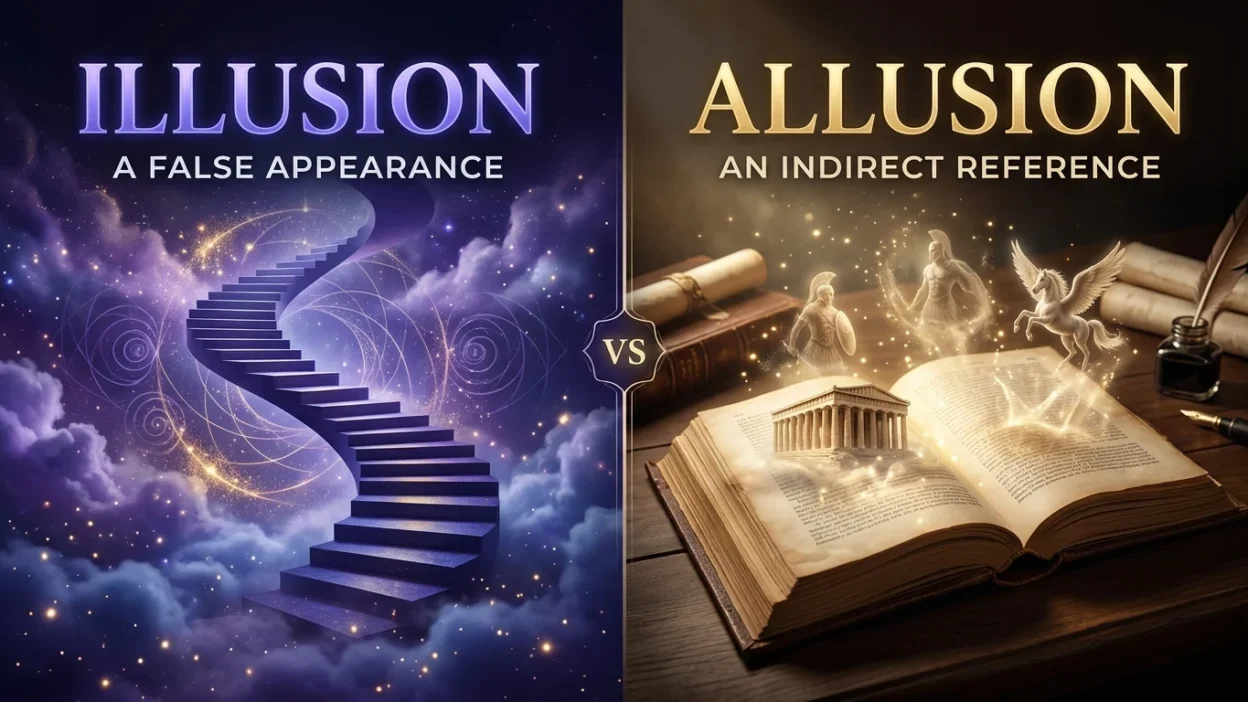
Illusion means a false appearance or something that tricks the mind or senses. For example, a magician creates an illusion during a performance. Allusion means an indirect reference to something well-known, such as a historical event, person, or literary work. For example, calling someone a Romeo is an allusion to Shakespeare’s famous character.
Why Do People Confuse Illusion and Allusion?
People often confuse illusion and allusion because the words have similar spellings and sounds. Both are nouns, and both are commonly used in writing, literature, conversations, and everyday English.
Another reason for the confusion is that both words relate to something beyond their direct meaning.
- Illusion involves something that seems real but is not.
- Allusion involves mentioning something indirectly without explaining it completely.
The main difference is their purpose. An illusion creates a misleading impression, while an allusion helps readers recognize a connection to another subject.
First Word: What Does Illusion Mean?
Illusion is a noun that means a false impression, misleading appearance, or something that seems real but is not.
An illusion can happen when your eyes, ears, or mind misunderstand what is happening. It can also describe a false belief about a situation, person, or experience.
For example, when you look at a road on a very hot day, you might see what appears to be water in the distance. However, there is no actual water there. This is an optical illusion.
Origin and History of Illusion
The word illusion comes from the Latin word illusio, which is connected to the idea of mocking, deceiving, or misleading.
It entered English through Old French and developed into its modern meaning of a false or misleading appearance.
Today, illusion is commonly used in psychology, entertainment, art, literature, and everyday communication.
Different Types of Illusion
Here are some common types of illusions:
- Optical illusion: Something that tricks your eyes or visual perception.
- Auditory illusion: A sound that your brain misunderstands.
- Mental illusion: A false belief or mistaken understanding.
- Magical illusion: A trick performed by a magician to create an impossible appearance.
- Emotional illusion: A false idea or expectation about a relationship or situation.
Illusion Examples in Sentences
- The magician created an amazing illusion on stage.
- The desert heat produced the illusion of water.
- She lived under the illusion that everything was perfect.
- The painting creates an illusion of depth.
- His confidence was only an illusion.
Second Word: What Does Allusion Mean?
Allusion is a noun that means an indirect reference to a famous person, place, historical event, literary work, or cultural idea.
An allusion does not explain everything about the subject. Instead, it gives readers or listeners a hint that connects the current conversation to something they may already know.
For example, if someone says, “He is a real Romeo,” they are making an allusion to Romeo, the romantic character from William Shakespeare’s Romeo and Juliet.
Origin and History of Allusion
The word allusion comes from the Latin word alludere, meaning to play with or refer to something indirectly.
It entered English through French and became an important term in literature, communication, and writing.
Authors often use allusions to make their writing more meaningful without providing long explanations.
Different Types of Allusion
Here are some common types of allusions:
- Literary allusion: A reference to a famous book, poem, or fictional character.
- Biblical allusion: An indirect reference to a person, story, or event from the Bible.
- Historical allusion: A reference to an important historical person or event.
- Mythological allusion: A reference to characters or stories from ancient mythology.
- Cultural allusion: A reference to a popular cultural event, tradition, or personality.
Allusion Examples in Sentences
- His strength made people compare him to Hercules.
- The teacher made an allusion to Shakespeare’s famous play.
- Her kindness reminded me of Mother Teresa.
- The speech included an allusion to the American Revolution.
- Calling someone a Scrooge is an allusion to Charles Dickens’s character.
Illusion vs. Allusion: What Is the Difference?
The easiest way to understand these words is to compare their meanings, purposes, and examples.
| Feature | Illusion | Allusion |
| Meaning | A false appearance or impression | An indirect reference |
| Part of speech | Noun | Noun |
| Main purpose | To create a misleading impression | To suggest a connection |
| Common use | Psychology, magic, art, everyday speech | Literature, writing, speeches |
| Related idea | Deception or misperception | Reference or association |
| Example | The mirror created an illusion. | He made an allusion to Romeo. |
| Memory clue | Illusion = Imaginary appearance | Allusion = A reference |
The main difference: An illusion makes something appear different from reality, while an allusion refers indirectly to something familiar.
When Should You Use Illusion or Allusion?
Choosing the correct word depends on what you want to communicate.
When to Use Illusion
Use illusion when you are talking about:
- Something that looks real but is not.
- A trick that confuses the eyes or mind.
- A false belief or mistaken impression.
- A magical performance or visual effect.
- An unrealistic expectation.
Example: The magician created the illusion of making a person disappear.
Here, illusion is correct because the magician makes something appear to happen even though it does not actually happen.
When to Use Allusion
Use allusion when you are talking about:
- An indirect reference to a famous person.
- A connection to a book, poem, or story.
- A reference to a historical event.
- A mention of a biblical story or character.
- A cultural reference that readers can recognize.
Example: The writer made an allusion to Adam and Eve in the story.
Here, allusion is correct because the writer indirectly refers to a familiar biblical story.
15 Examples of Illusion and Allusion in Sentences
The following examples will help you understand how both words work in everyday English.
10 Examples of Illusion
- The magician created a beautiful illusion during the show.
- The heat made the road look wet, but it was only an illusion.
- She believed that money could bring unlimited happiness, but that was an illusion.
- The artist used shadows to create an illusion of movement.
- The mirror gave the room an illusion of extra space.
- His friendly behavior created the illusion that he was trustworthy.
- The movie used special effects to create realistic illusions.
- The clouds created an illusion of a giant animal in the sky.
- Their perfect lifestyle was nothing more than an illusion.
- The optical illusion made the straight lines look curved.
10 Examples of Allusion
- The teacher made an allusion to Romeo and Juliet.
- His courage reminded everyone of Hercules.
- The politician made an allusion to the American Dream.
- The writer included a biblical allusion in the novel.
- Calling him a Scrooge was an allusion to a famous literary character.
- Her beauty was compared to Helen of Troy through a mythological allusion.
- The speech contained an allusion to Martin Luther King Jr.
- The poem makes an allusion to the Garden of Eden.
- His journey was described as an allusion to Homer’s Odyssey.
- The author used an allusion to Greek mythology to explain the character’s struggle.
Common Mistakes When Using Illusion and Allusion
Even experienced English speakers sometimes mix up these words. Understanding the following mistakes can help you avoid confusion.
1. Using Illusion Instead of Allusion
Incorrect: The author made an illusion to Shakespeare.
Correct: The author made an allusion to Shakespeare.
Why? The author is referring indirectly to Shakespeare, not creating a false appearance.
2. Using Allusion Instead of Illusion
Incorrect: The magician performed an allusion during the show.
Correct: The magician performed an illusion during the show.
Why? A magician creates tricks that make something appear real or possible.
3. Thinking Both Words Have the Same Meaning
These words are not interchangeable. An illusion relates to appearance or perception, while an allusion relates to an indirect reference.
4. Forgetting the Word’s Context
Always consider the meaning of the sentence before choosing a word.
- If the sentence describes something misleading, use illusion.
- If the sentence refers to a famous person, event, or story, use allusion.
Easy Memory Trick to Remember Illusion vs. Allusion
A simple memory trick can help you remember the difference without memorizing complicated definitions.
Illusion = Imaginary appearance
Think of the letter “I” in illusion as something that tricks your eyes or imagination.
Example: A magician creates an illusion.
Allusion = A reference
Think of the letter “A” in allusion as the beginning of “a reference.”
Example: A writer makes an allusion to Shakespeare.
Remember these two simple ideas:
- Illusion = Something that seems real but is not.
- Allusion = A reference to something familiar.
If you remember these meanings, you can easily choose the correct word in your writing and conversations.
American vs. British English: Illusion and Allusion
There is no difference in the basic meaning or standard spelling of illusion and allusion between American and British English.
Both varieties of English use the same spelling, pronunciation, and grammatical rules for these words.
| Word | American English | British English |
| Illusion | Illusion | Illusion |
| Allusion | Allusion | Allusion |
Both words are nouns in American and British English.
Examples:
- American English: The magician created an illusion.
- British English: The magician created an illusion.
- American English: The author made an allusion to history.
- British English: The author made an allusion to history.
The spelling and meaning remain the same in both varieties.
Similar Words Related to Illusion and Allusion
Learning related words can improve your vocabulary and help you understand these terms more clearly.
Words Similar to Illusion
| Word | Meaning |
| Mirage | An optical effect that makes something appear to exist |
| Delusion | A firmly held false belief |
| Hallucination | A perception without an external stimulus |
| Deception | The act of misleading someone |
| Fantasy | Something imagined rather than real |
| Misconception | An incorrect understanding or belief |
Words Similar to Allusion
| Word | Meaning |
| Reference | A mention of something |
| Mention | A brief statement about someone or something |
| Citation | A formal acknowledgment of a source |
| Hint | An indirect suggestion |
| Implication | An indirect meaning or suggestion |
| Innuendo | An indirect remark, often suggesting something negative |
Although these words have related meanings, they are not always interchangeable. Their correct use depends on the context.
Final Verdict: Illusion or Allusion?
Illusion and allusion are two different English words with different meanings and purposes.
Use illusion when describing a false appearance, misleading impression, or trick that affects how someone sees or understands something.
Use allusion when describing an indirect reference to a famous person, historical event, literary work, biblical story, or cultural idea.
The easiest way to remember the difference is:
- Illusion = A false appearance.
- Allusion = An indirect reference.
Once you understand these definitions, you can use both words confidently in conversations, school assignments, essays, and professional writing.
Frequently Asked Questions (FAQs)
1. What is the main difference between illusion and allusion?
The main difference is their meaning. Illusion refers to a false appearance or misleading impression, while allusion refers to an indirect mention of a famous person, place, event, or story.
2. Is an illusion something that is not real?
Yes. An illusion is something that appears real but does not match reality. It can involve a visual trick, a mistaken perception, or a false belief.
3. What is an example of an allusion in a sentence?
An example is: “He is a real Romeo.” This sentence makes an allusion to Romeo, the famous romantic character in Shakespeare’s Romeo and Juliet.
4. How can I easily remember illusion and allusion?
Remember that illusion starts with “I,” which can remind you of an imaginary appearance. Allusion starts with “A,” which can remind you of “a reference.” This simple trick helps you distinguish the words.
5. Can illusion and allusion be used interchangeably?
No. These words have different meanings and cannot replace each other. Illusion describes a misleading appearance, while allusion describes an indirect reference.
6. Is allusion commonly used in literature?
Yes. Writers frequently use allusions in poems, novels, stories, and speeches. They help connect ideas with familiar historical, biblical, mythological, and literary subjects.
7. What is the plural form of illusion and allusion?
The plural forms are illusions and allusions. For example, “The magician performed several illusions” and “The novel contains several biblical allusions.”
8. What is the difference between allusion and illusion in writing?
In writing, an illusion describes something that creates a false impression or appearance. An allusion is a literary device that indirectly refers to another work, person, event, or cultural idea.
Remember This
- Illusion means a false appearance or impression.
- Allusion means an indirect reference.
- A magician creates an illusion.
- A writer makes an allusion to Shakespeare.
- Illusion relates to perception, while allusion relates to reference.
- Neither word should be used as a substitute for the other.
Conclusion
Understanding the difference between illusion and allusion is important for improving your English vocabulary, reading, and writing skills. Although these words look and sound similar, their meanings are completely different. Illusion describes something that appears real but is misleading, while allusion refers indirectly to a familiar person, place, event, or story.
The best way to remember them is to connect illusion with an imaginary appearance and allusion with a reference. Practice using both words in your own sentences, and you will become more confident in choosing the correct word whenever you write or speak English.