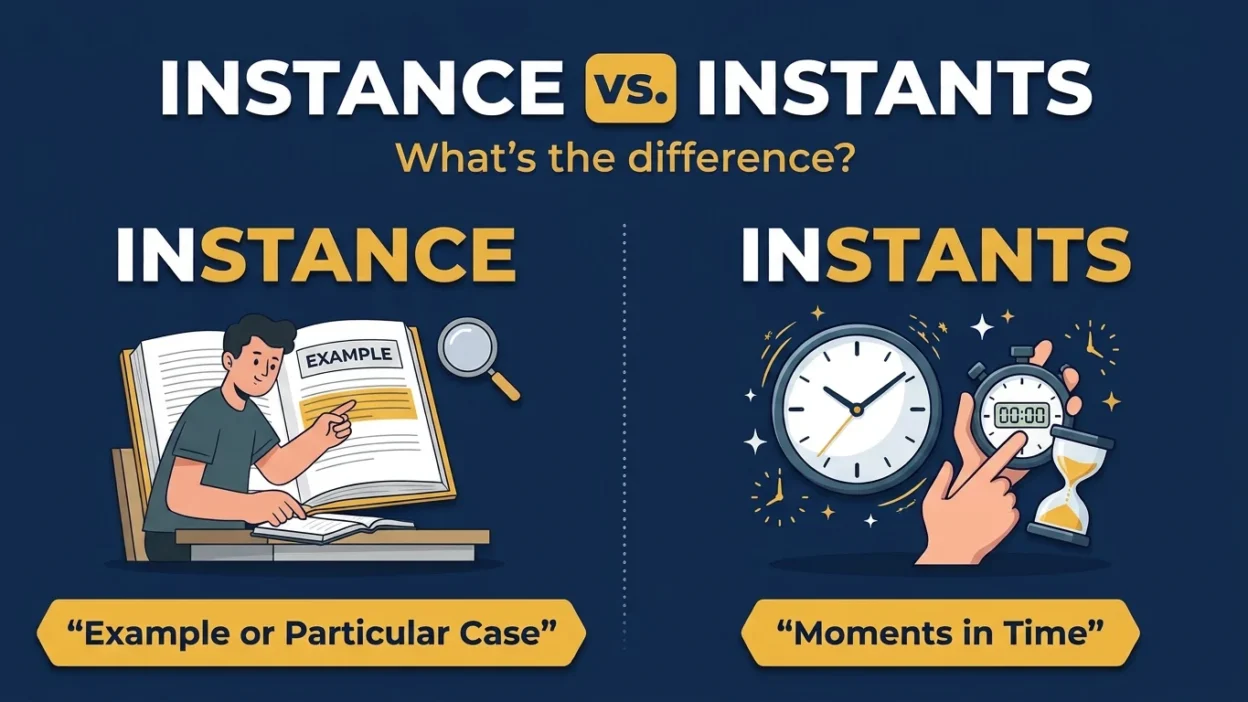
The English words instance and instants look and sound similar, but they have different meanings and grammatical uses.
Both words are commonly used in everyday English, writing, conversations, and formal communication. However, confusing them can change the meaning of a sentence and create grammatical mistakes.
The word instance refers to a particular example, occurrence, or situation. For example, you might say, “This is an instance of excellent teamwork.” On the other hand, instants is the plural form of instant, meaning very short moments or points in time. For example,
Several exciting instants made the match unforgettable.” Understanding the difference between instance and instants will help you choose the correct word, improve your vocabulary, and communicate more clearly. In this guide, you will learn their meanings, pronunciation, examples, common mistakes, and simple memory tricks.
Quick Answer: Instance vs. Instants
Instance means an example, case, or particular occurrence. It is a singular noun used when referring to one situation or example. Instants is the plural form of instant, meaning extremely short moments in time. Use instance when discussing an example and instants when referring to multiple brief moments.
Why Do People Confuse Instance and Instants?
People often confuse instance and instants because their spelling and pronunciation are similar. Both words begin with “inst,” contain similar sounds, and are associated with specific situations or events.
However, their meanings are different:
- Instance: Refers to an example, case, or occurrence.
- Instants: Refers to multiple very short moments in time.
Another reason for confusion is that both words can appear in discussions about events and experiences.
For example:
- Correct: This is an interesting instance of human kindness.
- Correct: Those were unforgettable instants in my life.
The easiest way to avoid confusion is to remember that instance is about an example, while instants is about moments.
What Does Instance Mean?
Instance is a noun that means a particular example, case, occurrence, or situation that demonstrates something.
It is commonly used when explaining an idea, describing an event, or providing evidence to support a statement.
Origin of Instance
The word instance comes from the Latin word instantia, meaning presence, urgency, or something that stands before someone. It entered English through Old French and developed into its modern meaning of an example or particular case.
How to Use Instance in a Sentence
Use instance when referring to one example or occurrence.
Examples:
- This is an instance of great leadership.
- I remember one instance when he helped me.
- The teacher explained the rule using a simple instance.
- In this instance, honesty is the best choice.
Grammatical Forms of Instance
| Word | Part of Speech | Meaning |
| Instance | Singular noun | One example or case |
| Instances | Plural noun | Multiple examples or cases |
| For instance | Phrase | For example |
| Instance-based | Adjective | Based on individual examples or cases |
Important: The plural of instance is instances, not instants.
What Does Instants Mean?
Instants is the plural form of the noun instant. It refers to two or more extremely short moments or brief periods of time.
An instant is a moment that happens very quickly. The plural form, instants, describes multiple such moments.
Origin of Instants
The word instant comes from the Latin word instantem, meaning pressing, urgent, or immediate. Over time, its meaning developed to describe something happening immediately or a very short moment.
How to Use Instants in a Sentence
Use instants when talking about multiple brief moments in time.
Examples:
- The happiest instants of my life were unforgettable.
- Those instants passed very quickly.
- Several important instants changed their relationship.
- We captured beautiful instants during the wedding.
Grammatical Forms of Instant
| Word | Part of Speech | Meaning |
| Instant | Singular noun | A very short moment |
| Instants | Plural noun | Multiple short moments |
| Instantly | Adverb | Immediately |
| Instantaneous | Adjective | Happening almost immediately |
Instance vs. Instants: Comparison Table
The following table highlights the main differences between these two words.
| Feature | Instance | Instants |
| Meaning | Example or case | Brief moments |
| Word form | Singular noun | Plural noun |
| Base word | Instance | Instant |
| Main use | Explaining examples | Describing moments |
| Context | Situations and occurrences | Time and experiences |
| Example | One instance of kindness | Beautiful instants of joy |
Key difference: Instance refers to an example or case, whereas instants refers to multiple short moments.
When Should You Use Instance and Instants?
Choosing the correct word becomes easier when you understand the situation in which each word is used.
When to Use Instance
Use instance when:
- Giving an example to explain something.
- Describing a particular situation.
- Discussing a specific occurrence.
- Providing evidence for an argument.
- Referring to one particular case.
Examples:
- For instance, you can improve your English by reading daily.
- This instance shows the importance of patience.
- In this instance, the decision was correct.
When to Use Instants
Use instants when:
- Describing multiple short moments.
- Talking about memorable experiences.
- Discussing brief periods of time.
- Describing moments that happen quickly.
- Writing about emotional or exciting experiences.
Examples:
- The best instants of childhood stay in our memories.
- Those instants of happiness were precious.
- The exciting instants of the game thrilled everyone.
15 Examples of Instance vs. Instants in Sentences
Learning through examples is one of the easiest ways to understand the difference between similar English words.
Examples Using Instance
- This is an instance of excellent teamwork.
- The teacher gave an instance to explain the lesson.
- In this instance, everyone agreed with the decision.
- This particular instance changed my opinion.
- For instance, reading books improves vocabulary.
- The report describes an instance of unusual behavior.
- I remember an instance when my friend helped me.
- This instance demonstrates the importance of honesty.
Examples Using Instants
- The happiest instants of my childhood remain unforgettable.
- Those instants passed before we could react.
- We captured beautiful instants during the celebration.
- Several exciting instants made the match memorable.
- Life is made up of countless precious instants.
- The camera recorded every important instant.
- Those brief instants of silence felt peaceful.
Notice: In sentence 14, instant is singular because it refers to one moment. If there were multiple moments, you could use instants.
Common Mistakes When Using Instance and Instants
Even experienced English learners sometimes confuse similar-looking words. Here are common mistakes and their corrections.
Mistake 1: Using Instants Instead of Instance
Incorrect: This is an instants of kindness.
Correct: This is an instance of kindness.
Why? The sentence refers to one example, so the singular noun instance is correct.
Mistake 2: Using Instance Instead of Instants
Incorrect: Those beautiful instance will remain in my memory.
Correct: Those beautiful instants will remain in my memory.
Why? The sentence describes multiple moments, so instants is appropriate.
Mistake 3: Confusing Instances with Instants
Incorrect: There were several instants of poor customer service.
Correct: There were several instances of poor customer service.
Why? The sentence refers to multiple cases of poor service, not brief moments.
Mistake 4: Forgetting the Meaning of For Instance
Incorrect: For instants, exercise improves health.
Correct: For instance, exercise improves health.
Why? The expression for instance means “for example.” It does not refer to moments in time.
Easy Memory Trick to Remember Instance vs. Instants
You can remember these words using two simple associations:
- Instance = Example: Think of the phrase “For instance,” which means “For example.”
- Instants = Moments: Think of an instant as a very short moment in time.
Here is another helpful trick:
Instance has an E for Example.
Instants has an S for Several moments.
Remembering these associations will help you choose the correct word when writing sentences or speaking English.
American vs. British English: Instance and Instants
There is no meaningful difference between American and British English in the meanings or standard spelling of instance and instants.
Both varieties of English use these words in the same way.
| Word | American English | British English |
| Instance | Same spelling and meaning | Same spelling and meaning |
| Instants | Same spelling and meaning | Same spelling and meaning |
| Instances | Same spelling and meaning | Same spelling and meaning |
| Instant | Same spelling and meaning | Same spelling and meaning |
The pronunciation may vary slightly depending on the speaker’s accent, but the meanings remain unchanged.
You can confidently use both words in American and British English writing.
Similar Words You Should Know
Several English words have meanings related to instance and instants. Understanding them can improve your vocabulary.
| Word | Meaning | Example |
| Example | Something that explains an idea | Give me an example. |
| Case | A particular situation | This is a special case. |
| Occurrence | Something that happens | It was a rare occurrence. |
| Moment | A short period of time | Wait a moment. |
| Second | A unit of time | Give me a second. |
| Episode | An event or experience | It was a strange episode. |
| Occasion | A particular event or time | It was a special occasion. |
| Instance | A particular example or case | This is one instance. |
| Instant | A very short moment | Wait just an instant. |
These words are related in meaning, but they are not always interchangeable. Choose the word that best expresses your intended meaning.
Final Verdict: Instance or Instants?
The difference between instance and instants is simple once you understand their meanings.
- Use instance when referring to one example, case, or particular occurrence.
- Use instants when referring to multiple brief moments in time.
- Use instances when referring to multiple examples or cases.
- Use instant when referring to one very short moment.
For example, “This is an instance of kindness” describes an example, while “Those were beautiful instants” describes memorable moments.
Always consider whether you are talking about an example or a moment before choosing the correct word.
(FAQs):
1. What is the main difference between instance and instants?
Instance means an example, case, or particular occurrence. Instants is the plural form of instant and refers to multiple very short moments in time. The main difference is that one describes examples, while the other describes moments.
2. Is instants the plural of instance?
No, instants is not the plural of instance. It is the plural form of instant. The correct plural of instance is instances.
3. What is the plural form of instance?
The plural form of instance is instances. It refers to multiple examples, cases, or particular occurrences.
Example: The report contains several instances of incorrect information.
4. What does for instance mean?
For instance” is a common English expression that means “for example.” It introduces a specific example to explain or support an idea.
Example: Many activities improve health. For instance, walking and swimming are beneficial exercises.
5. Can instants be used in everyday English?
Yes, instants is a correct English word. It is used when referring to multiple brief moments, especially in descriptions of memories, experiences, and events.
Example: Those were the happiest instants of my life.
6. Is instance a noun or a verb?
Instance is primarily used as a noun in modern everyday English. It describes an example, case, or occurrence.
Example: This instance proves that teamwork matters.
7. What is the difference between instances and instants?
Instances means multiple examples or cases, while instants means multiple brief moments in time.
Examples:
- Instances: Several instances of kindness were reported.
- Instants: Several instants of happiness made the day special.
Remember This
- Instance = One example or case.
- Instances = Multiple examples or cases.
- Instant = One brief moment.
- Instants = Multiple brief moments.
- For instance = For example.
The most important thing to remember is that instance relates to examples, while instants relates to time.
Conclusion
Understanding the difference between instance and instants can make your English writing clearer and more accurate. Although these words look similar, they have different meanings and uses.
Instance refers to a particular example, case, or occurrence, while instants describes multiple very short moments. Learning their meanings and grammatical forms will help you avoid common spelling and vocabulary mistakes.
The easiest way to remember the difference is to connect instance with examples and instants with moments. Practice using both words in everyday sentences, pay attention to their context, and remember that the plural of instance is instances.
With regular practice, you will be able to use these words confidently in conversations, schoolwork, and professional writing.