Many people get confused by “win” and “loose” because they sound a little similar in fast speech and are often mixed up online. You may see sentences like:
- “You win or loose.”
- “Don’t loose the game.”
- “We can still loose.”
But in correct English, these words do not mean the same thing.
The confusion usually happens because people actually mean “lose”, not “loose.”
This article will explain everything in very simple English so you can clearly understand the difference between:
- win
- lose
- loose
By the end, you will know exactly which word to use and when.
Quick Answer
Here is the simple answer first:
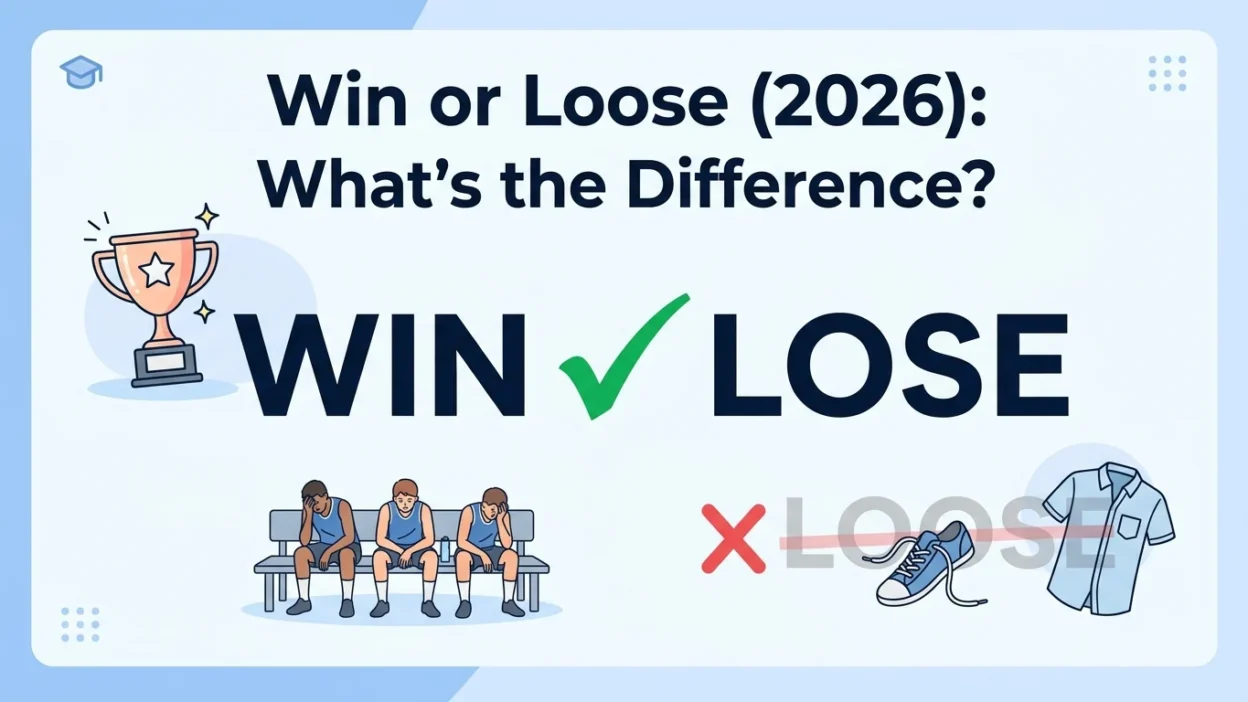
- Win = to succeed or get victory
- Lose = to fail or not keep something
- Loose = not tight
Correct Examples
- We want to win the match.
- I do not want to lose my phone.
- My shoes are too loose.
Incorrect Example
- ❌ “Did your team loose?”
- ✅ “Did your team lose?”
Remember this easy rule:
If you are talking about games, success, failure, or missing something, the word is usually lose, not loose.
Simple Background of the Words
English has many words that look alike but have different meanings. “Lose” and “loose” are one of the most common examples.
Win
The word win is about success, victory, or getting something good.
Examples:
- win a game
- win a prize
- win an election
- win a competition
Lose
The word lose means:
- not winning
- missing something
- no longer having something
Examples:
- lose a game
- lose your keys
- lose money
- lose interest
Loose
The word loose is usually an adjective. It describes something that is not tight or not fixed strongly.
Examples:
- loose clothes
- loose hair
- loose screw
- loose rope
The Main Difference Explained Simply
This is the easiest way to understand the difference.
Win = Success
You use win when someone succeeds.
Examples:
- Our school team will win.
- She worked hard and won the contest.
- I hope you win first place.
Lose = Opposite of Win
You use lose when someone does not succeed.
Examples:
- We lost the game yesterday.
- Do not lose hope.
- He lost his wallet.
Loose = Not Tight
You use loose when something is free, open, or not tight.
Examples:
- My shirt feels loose.
- The dog got loose from the yard.
- This nail is loose.
Easy Comparison
| Word | Meaning | Part of Speech | Example |
| Win | To succeed or get victory | Verb | We want to win the game. |
| Lose | To fail or no longer have something | Verb | I do not want to lose my bag. |
| Loose | Not tight | Adjective | These pants are loose. |
Which One Should You Use?
This section makes it very simple.
Use “Win” When Talking About Success
Use win when someone:
- succeeds
- gets victory
- earns a prize
- achieves something
Examples:
- She can win the race.
- They won the championship.
- I hope you win the award.
Use “Lose” When Talking About Failure or Missing Something
Use lose when someone:
- fails
- cannot find something
- no longer has something
Examples:
- Do not lose your passport.
- Our team may lose tonight.
- He lost his job last year.
Use “Loose” When Talking About Something Not Tight
Use loose for clothing, objects, animals, ropes, screws, and similar things.
Examples:
- My tooth feels loose.
- The door handle is loose.
- Wear loose clothing in hot weather.
Common Mistakes People Make
Many English learners make these mistakes because the spelling is similar.
Mistake 1: Writing “Loose” Instead of “Lose”
❌ I do not want to loose the game.
✅ I do not want to lose the game.
Why?
Because “lose” is the verb connected to winning and failing.
Mistake 2: Using “Loose” for Sports
❌ Our team loose yesterday.
✅ Our team lost yesterday.
Correct forms of “lose”:
- lose
- loses
- lost
- losing
Mistake 3: Forgetting That “Loose” Means Not Tight
❌ I loose my phone every week.
✅ I lose my phone every week.
But:
✅ My phone case is loose.
Mistake 4: Confusing Pronunciation
These words sound different:
- Lose sounds like “looz”
- Loose sounds like “looss”
Even native speakers sometimes type the wrong one online.
Everyday Real Life Examples
Here are simple real world examples to help you remember.
In Emails
Correct:
- “We do not want to lose this customer.”
- “Congratulations! You win the prize.”
Correct use of loose:
- “The wire is loose.”
On Social Media
People often write:
❌ “You win or loose.”
Correct version:
✅ “You win or lose.”
In News Headlines
Examples:
- “Local Team Wins Final Match”
- “Company Could Lose Millions”
- “Loose Cable Causes Problem”
In Daily Conversations
Examples:
- “I always lose my keys.”
- “Your jacket looks loose.”
- “Who will win tonight?”
In School
Examples:
- “Do not lose your homework.”
- “Our class won the competition.”
- “The paper inside the folder is loose.”
Easy Trick to Remember the Difference
Here are three memory tricks.
Trick 1: Win and Lose Are Opposites
Think:
- win ↔ lose
These two words belong together.
Example:
- One team wins.
- One team loses.
Trick 2: Loose Has Extra “O”
The extra “o” can help you remember extra space.
Loose things have more space because they are not tight.
Example:
- loose shirt
- loose shoes
Trick 3: Ask Yourself a Simple Question
Ask:
“Am I talking about success/failure or about tightness?”
- Success/failure → win or lose
- Tightness → loose
Short Learning Section for Students and Beginners
Here is a quick study lesson.
Sentence Practice
Fill in the blanks.
- I hope we ______ the match.
- Do not ______ your ticket.
- My sweater feels too ______.
Answers:
- win
- lose
- loose
Mini Quiz
Choose the correct word.
1. She does not want to ___ her phone.
- win
- lose
- loose
✅ Correct answer: lose
2. These shoes are too ___.
- loose
- lose
- win
✅ Correct answer: loose
3. Which team will ___ tonight?
- loose
- lose
- win
✅ Correct answer: win
Frequently Asked Questions (FAQ)
Is “win or loose” correct?
No. The correct phrase is:
✅ “win or lose”
“Loose” does not mean failing.
What is the difference between lose and loose?
- Lose = fail or no longer have something
- Loose = not tight
Why do people confuse lose and loose?
Because the spellings are very similar, and many people type quickly online.
Is “loose” ever used as a verb?
Sometimes, but not in the same way as “lose.”
Example:
- “Loose the dogs.”
This use is much less common in everyday English.
What is the past tense of lose?
The past tense is:
✅ lost
Example:
- We lost the game yesterday.
Can “win” and “lose” be used together?
Yes. They are often opposites.
Example:
- Some people win and some people lose.
How do I remember the correct spelling?
Remember:
- win ↔ lose
- loose = not tight
Is “loose” positive or negative?
It depends on the situation.
Examples:
- Loose clothes can feel comfortable.
- A loose screw can be a problem.
Final Thoughts
The difference between win, lose, and loose is actually very simple once you understand the meanings clearly.
- Win means success or victory.
- Lose means fail or no longer have something.
- Loose means not tight.
The biggest mistake people make is writing “loose” when they really mean “lose.”
So the next time you write about games, sports, competitions, or failure, remember:
✅ “win or lose”
❌ “win or loose”
With a little practice, you will start using these words correctly and naturally in everyday English.