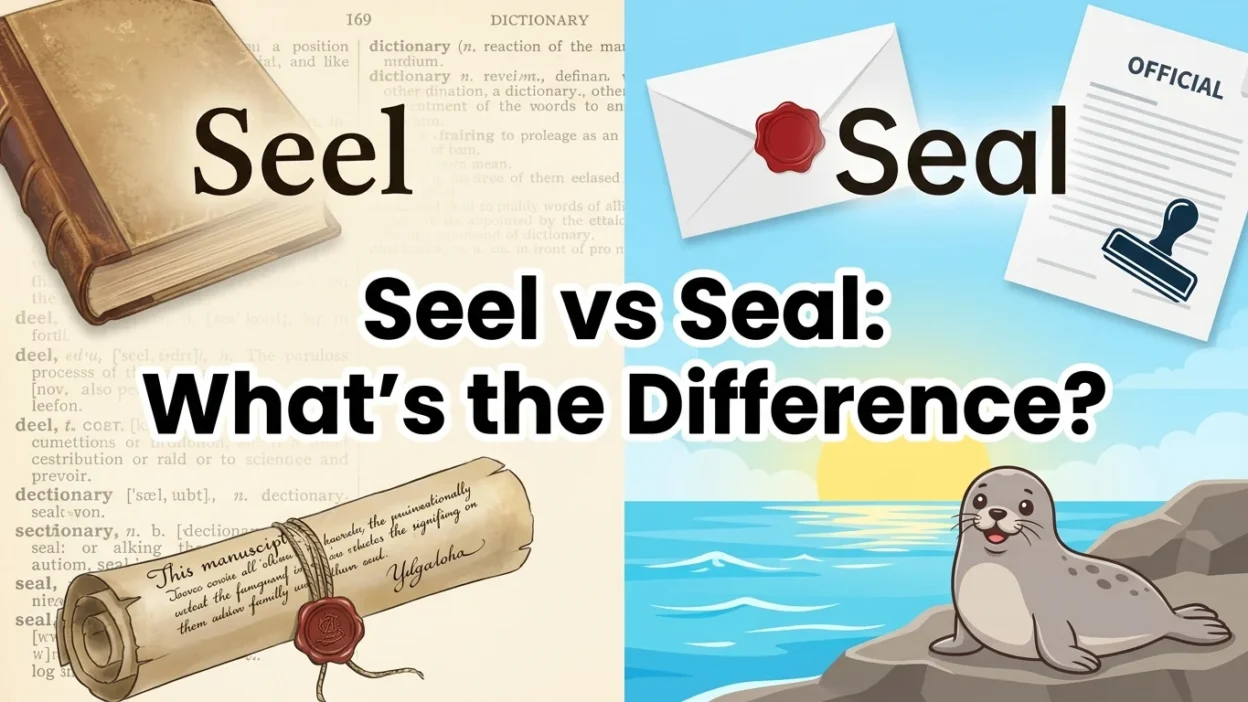
Many English learners and even native speakers sometimes get confused between seel and seal because the two words look very similar. They differ by only one letter, and when spoken quickly, they can sound alike to some learners.
The confusion becomes even greater because seal is a common English word that appears in everyday conversations, while seel is a very rare word that most people never use.
If you have ever wondered whether to write seel or seal, this guide will make the difference easy to understand.
Quick Answer
- Seal is the correct word in almost all modern English situations.
- Seal can mean:
- To close something tightly
- An official stamp or mark
- A marine animal
- To finalize an agreement
- Seel is a very old and uncommon word.
- Most people never use seel in daily writing or speaking.
- If you are unsure, you almost certainly need seal.
Simple Origin and Background
Understanding where these words came from can help clear up the confusion.
The Word “Seal”
The word seal has been used in English for hundreds of years. Over time, it developed several meanings.
People used seals to:
- Close letters
- Mark official documents
- Show ownership
- Confirm agreements
Later, the same spelling was also used for the sea animal known as a seal.
Today, seal remains a common and useful English word.
The Word “Seel”
The word seel comes from very old English usage.
Historically, it referred to a practice involving birds, especially hunting birds. The meaning is rarely needed today, and most modern dictionaries label it as old fashioned or uncommon.
Because it is so rare, many people have never seen the word before.
Clear Explanation of the Difference
The easiest way to remember the difference is this:
Seal = Common Modern Word
You use seal when talking about:
- Closing something
- Making something official
- A sea animal
- Finishing an agreement
Examples:
- Please seal the envelope.
- The company put its seal on the document.
- We saw a seal at the beach.
- They sealed the deal yesterday.
Seel = Rare Old Word
You use seel only when discussing historical language, old literature, or very specialized topics.
Examples:
- The old text used the word seel.
- Students studying historical English may encounter seel.
In normal writing, seel is almost never the correct choice.
Comparison
| Feature | Seel | Seal |
| Common today? | No | Yes |
| Used in everyday English? | Almost never | Very often |
| Found in modern conversations? | Rarely | Frequently |
| Meaning related to closing something? | No | Yes |
| Meaning related to an animal? | No | Yes |
| Seen in emails and business writing? | No | Yes |
| Recommended for learners? | Usually avoid | Learn and use |
Which One to Use and When
Use “Seal” When Talking About Closing Something
Examples:
- Seal the package before shipping.
- Seal the bottle tightly.
- The workers sealed the container.
Use “Seal” for Official Approval
Examples:
- The document carries the official seal.
- The certificate has a government seal.
- The organization placed its seal on the letter.
Use “Seal” for Agreements
Examples:
- They sealed the partnership.
- The two companies sealed the deal.
- A handshake sealed the agreement.
Use “Seal” for the Animal
Examples:
- The seal swam near the shore.
- We watched seals playing in the water.
- A baby seal rested on the rocks.
Use “Seel” Only in Special Historical Contexts
You may see seel in:
- Old books
- Historical studies
- Literature classes
- Language research
For everyday English, you almost never need it.
Common Mistakes People Make
Mistake 1: Writing “Seel” Instead of “Seal”
Incorrect:
- Please seel the envelope.
Correct:
- Please seal the envelope.
Mistake 2: Using “Seel” for the Animal
Incorrect:
- We saw a seel at the zoo.
Correct:
- We saw a seal at the zoo.
Mistake 3: Assuming Both Words Mean the Same Thing
Some learners think they are simply spelling variations.
They are not.
- Seal is a common modern word.
- Seel is an uncommon historical word.
Mistake 4: Auto Correct Errors
Sometimes people type quickly and accidentally write:
- seel
- seeling
- seeled
Instead of:
- seal
- sealing
- sealed
Always double check your spelling.
Everyday Real Life Examples
Emails
Correct:
- Please seal the package before sending it.
- Make sure the envelope is sealed properly.
Incorrect:
- Please seel the package before sending it.
News
Correct:
- Leaders sealed an important agreement.
- Officials placed a seal on the document.
Incorrect:
- Leaders seeled an important agreement.
Social Media
Correct:
- We finally sealed the deal!
- Look at this cute seal at the aquarium!
Incorrect:
- We finally seeled the deal!
Daily Conversations
Correct:
- Can you seal this bag?
- The lid does not seal properly.
- We saw a seal during our trip.
Incorrect:
- Can you seel this bag?
Short Learning Section for Students and Beginners
Here is a simple memory trick.
Remember This Sentence
“Seal is the word you will use almost every day.”
Think of these examples:
- Seal an envelope.
- Seal a bottle.
- Seal a deal.
- Seal a document.
- Seal the container.
Now think about seel.
Most students may go years without ever needing to write it.
Easy Rule
If you are writing modern English:
Choose “seal.”
Only use seel when discussing old language or historical texts.
Quick Practice
Which word is correct?
- Please _____ the envelope.
- Answer: seal
- We saw a _____ at the aquarium.
- Answer: seal
- The company _____ the agreement.
- Answer: sealed
- Which word is rare and old fashioned?
- Answer: seel
FAQ
Is “seel” a real English word?
Yes. It is a real English word, but it is very old and rarely used today.
Which word is more common, seel or seal?
Seal is far more common and appears in everyday English.
Can I use “seel” instead of “seal”?
No. In most situations, using seel would be considered incorrect.
Is a seal an animal?
Yes. A seal is a marine mammal that lives in oceans and coastal areas.
What does it mean to seal a document?
It means to officially approve, close, or authenticate the document.
Why do people misspell seal as seel?
The words look similar, and some people accidentally replace the letter “a” with “e” while typing.
Will I see “seel” in modern writing?
Very rarely. Most people never encounter it outside historical or literary materials.
How can I remember the correct spelling?
Remember that seal is the everyday word used for closing, approving, or referring to the animal.
Conclusion
The difference between seel and seal is actually very simple. Seal is the common modern English word used for closing things, making agreements official, marking documents, and naming the marine animal. Seel, on the other hand, is an old and uncommon word that most people rarely use.
For students, ESL learners, and general readers, the safest rule is easy: if you are writing normal modern English, you almost always need seal, not seel. Once you remember that, the confusion disappears.