If you have ever typed messege instead of message, you are not alone. In my experience helping students, professionals, and even a content creator, this common confusion appears because of phonetic confusion, similar vowels, sound confusion, fast typing, hurried typing mistakes, visual memory errors, and overreliance on autocorrect.
In the English language, message is the correct spelling, while messege, mesage, messej, and masssage are forms of misspelling that are not recognized by dictionaries, grammar sources, or an official English dictionary. This small typing mistake may seem harmless, but in professional writing, academic writing, job applications, emails, texts, and social media posts, a single one letter difference can affect credibility, professionalism, trust, clarity, and even personal dignity.
The meaning of message is simple: a piece of information, news, or communication sent from someone, a person, or another recipient through written communication, spoken communication, digital communication, verbal communication, recorded communication, electronic means, an email, text, letter, voice note, WhatsApp, Instagram DM, app, answerphone, conversation, signals, gestures, or other non-verbal methods. As both a noun and verb, it appears in messaging, messaged, and past tense verb forms.
The word has a rich history linked to Latin, French, and Germanic roots, and its hidden structure can be remembered as mess + age, a root idea and ending structure that create a balanced word. This guide offers practical examples, memory hacks, sound chunks, repetition, muscle memory, daily writing, spelling checks, spell-check, grammar-check tools, and foolproof ways to choose the right word every time, whether you are a student, casual texter, native speakers, a marketing intern, or a Californian contact handling important document tasks in the digital world.
Quick Answer
Simple explanation:
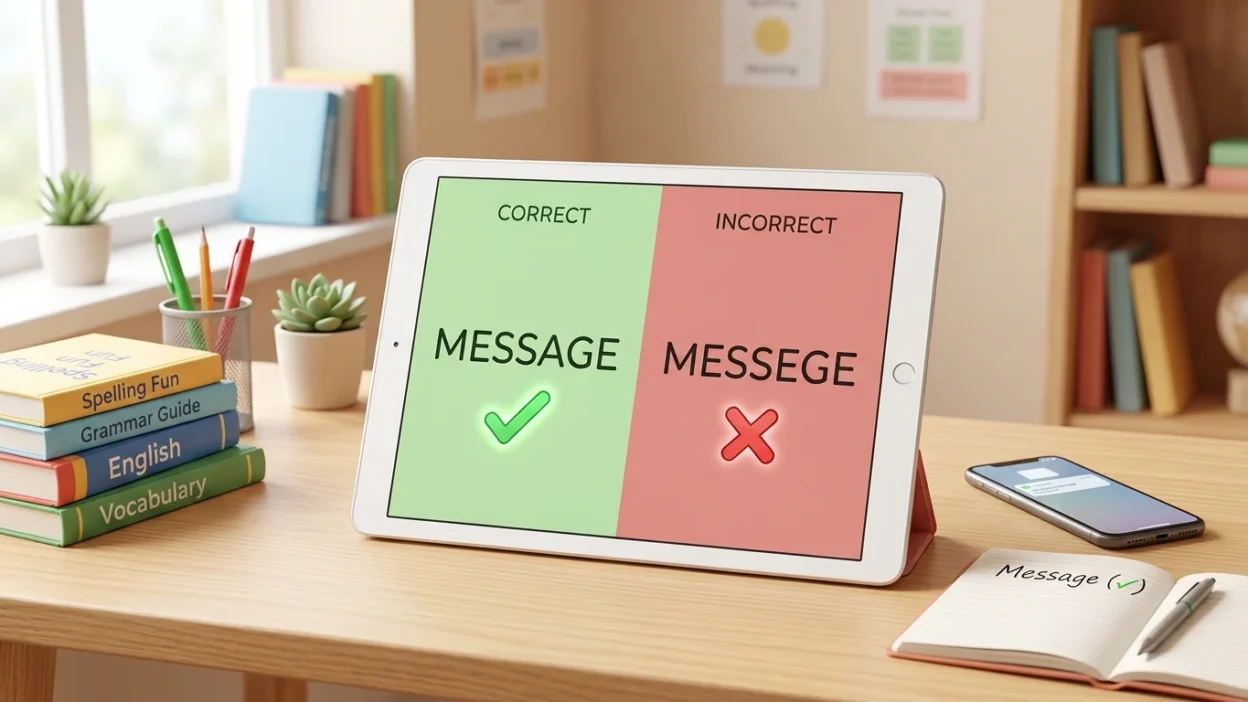
- ✔ Message = correct word
- ❌ Messege = wrong spelling
What it means:
- A message is information you send or receive
- It can be text, voice, email, or note
Example:
- ✔ I sent you a message
- ❌ I sent you a messege
Simple Origin or Background
The word message comes from old French and Latin languages. It originally meant:
- “Something sent from one person to another”
Over time, English kept the word but made the spelling simpler.
The correct spelling became:
- message (M-E-S-S-A-G-E)
But many learners accidentally write:
- messege (wrong)
This mistake usually happens because:
- “a” and “e” sound similar in fast speech
- People copy wrong spellings from social media
- Auto correct sometimes guesses incorrectly
Clear Explanation of the Difference
There is no real difference in meaning because “messege” is not a real word.
So the real comparison is:
✔ Message (Correct Word)
- Used in English
- Means information sent to someone
- Can be written, spoken, or digital
❌ Messege (Incorrect Word)
- Not found in English dictionary
- Wrong spelling
- Should never be used in formal or informal writing
Simple way to remember:
Think like this:
- “A” is always important in message
- Without “a,” the word becomes wrong
Comparison Table
| Feature | Message (Correct) | Messege (Wrong) |
| Spelling | M-E-S-S-A-G-E | M-E-S-S-E-G-E |
| Meaning | Information sent to someone | No meaning |
| Dictionary use | Yes | No |
| Acceptable in English | Yes | No |
| Usage | Emails, chats, letters | Never use |
Which One to Use and When
You should always use message in every situation.
Use “message” when:
- Sending a text on phone
- Writing an email
- Leaving a note for someone
- Talking about online chat
- Reporting communication
Examples:
- I will send you a message later
- Did you receive my message?
- She left a message on your phone
Never use “messege”:
- In exams
- In assignments
- In messages
- In emails
- In social media posts
Even in casual writing, it is always wrong.
Common Mistakes People Make
Many learners repeat the same spelling errors. Here are the most common ones:
1. Missing the letter “a”
People often write:
- messege ❌
Instead of:
- message ✔
2. Typing too fast
Fast typing causes wrong spelling because fingers skip letters.
3. Copying wrong spelling from others
If someone else writes it wrong online, others may copy it.
4. Confusion with pronunciation
The word sounds like:
- “mes-ij”
So learners guess the spelling incorrectly.
5. Auto correct mistakes
Sometimes devices suggest wrong words, especially if settings are not updated.
Everyday Real Life Examples
Email example
- ✔ Correct: I sent you a message about the meeting
- ❌ Wrong: I sent you a messege about the meeting
Social media example
- ✔ Correct: Check my message on WhatsApp
- ❌ Wrong: Check my messege on WhatsApp
School example
- ✔ Correct: The teacher left a message on the board
- ❌ Wrong: The teacher left a messege on the board
Daily life example
- ✔ Correct: I got your message yesterday
- ❌ Wrong: I got your messege yesterday
Short Learning Section for Students and Beginners
Here is a very simple way to learn and remember:
Step 1: Remember the correct spelling
- M-E-S-S-A-G-E
Step 2: Break it into parts
- mes + sage (like “sage” meaning wise person)
Step 3: Practice daily
Write it 5 times:
- message message message message message
Step 4: Use it in sentences
- I sent a message
- She received a message
- They read the message
Easy memory trick:
👉 “A good message always has an ‘A’ in it.”
FAQ Section
What is the correct spelling, message or messege?
The correct spelling is message.
Is messege a real English word?
No, messege is not a real word in English.
Why do people write messege?
People write it by mistake due to fast typing or confusion.
Does messege have any meaning?
No, it has no meaning at all.
Can I use messege in exams?
No, it is wrong and should not be used anywhere.
What does message mean?
It means information sent from one person to another.
How can I stop spelling it wrong?
Practice writing message daily and remember it has an “a.”
Is message used in formal writing?
Yes, it is used in emails, letters, exams, and official communication.
Conclusion
The confusion between message and messege is very common, but the answer is very simple.
- ✔ Message is correct
- ❌ Messege is incorrect and should never be used
If you remember just one thing, remember this:
👉 A real English word always has the correct spelling, and in this case it is message.
With a little practice, you will never make this mistake again.