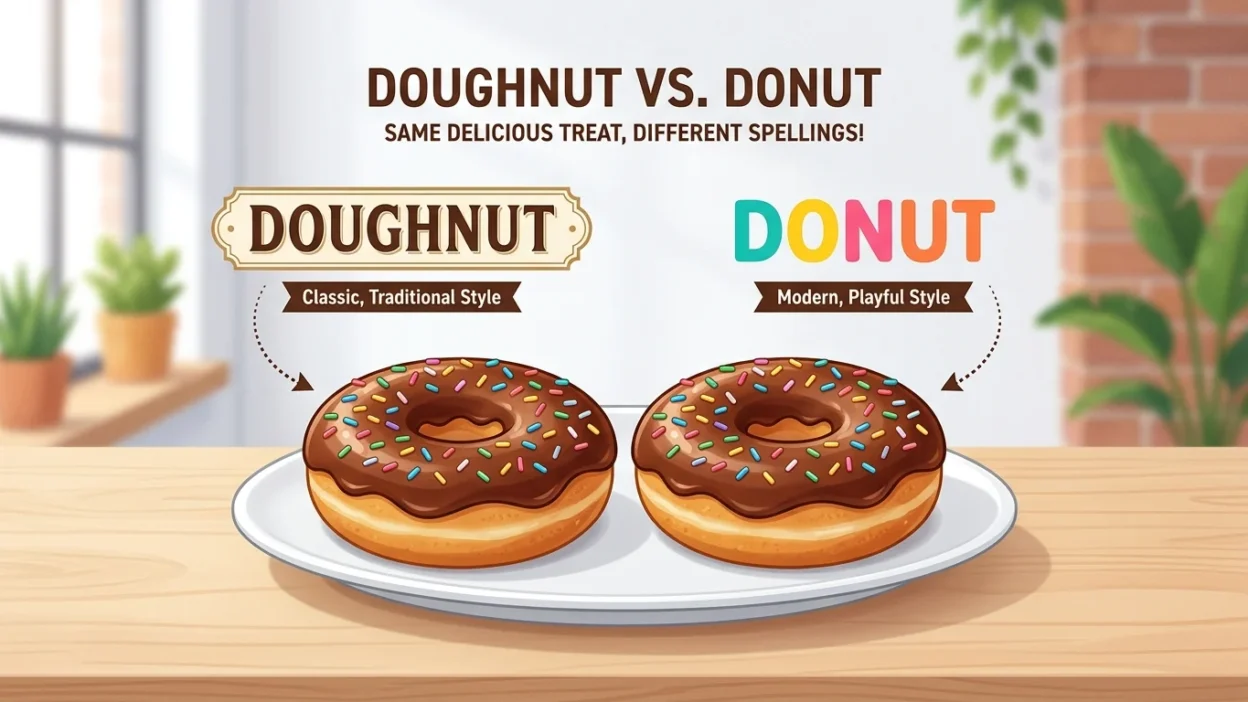
Many people see two spellings of the same sweet food: “doughnut” and “donut.” This often creates confusion, especially for students and English learners. Some people think they are two different foods. Others are not sure which spelling is correct.
The truth is simple, but the confusion happens because both words are used in real life. You may see “doughnut” in books and older writing, but “donut” in shops, social media, and everyday talk.
In this article, you will learn the clear and simple truth. By the end, you will fully understand that there is no real difference in meaning, only in spelling and usage style.
Quick Answer: Doughnut vs Donut
Here is the simplest explanation:
- “Doughnut” and “donut” mean the same sweet fried food.
- There is no difference in taste, shape, or recipe.
- “Doughnut” is the older and more traditional spelling.
- “Donut” is the shorter, modern, and more popular spelling in daily life.
- Both words are correct in English.
So, you can use either one without changing the meaning.
Simple Origin or Background Explanation
To understand why there are two spellings, we need to look at the history.
The word originally comes from “dough nut,” which describes a small piece of fried dough shaped like a nut or small ball. Over time, the two words joined together and became “doughnut.”
This is the older form and is still used in formal writing, dictionaries, and traditional English.
Later, in everyday American English, people started shortening many words to make them faster and easier to write. That is how “doughnut” slowly became “donut.”
The shorter form became very popular, especially in shops and branding. Many food companies and cafés use “donut” because it looks simple and modern.
So, the difference is not about meaning. It is only about language style and spelling change over time.
Clear Explanation of the Difference
Even though both words mean the same thing, there are small differences in how people use them.
1. Spelling style
- Doughnut: traditional spelling
- Donut: modern short spelling
2. Usage in writing
- Doughnut is often used in:
- dictionaries
- formal writing
- educational material
- Donut is often used in:
- shop names
- menus
- social media posts
- casual writing
3. Feeling or tone
- Doughnut feels more formal and classic
- Donut feels more friendly and modern
4. Popularity
Today, “donut” is more commonly seen in daily life, especially in advertising and branding.
But again, both mean the same sweet snack.
Comparison Table
| Feature | Doughnut | Donut |
| Meaning | Same sweet fried food | Same sweet fried food |
| Spelling | Traditional spelling | Modern shortened spelling |
| Usage style | Formal, educational | Casual, everyday language |
| Common use | Books, dictionaries | Shops, menus, branding |
| Popularity | Less common in daily use | More common today |
| Tone | Classic, traditional | Simple, modern |
Which One to Use and When
Both spellings are correct, so your choice depends on the situation.
Use “doughnut” when:
- You are writing school essays
- You are writing formal English
- You want a traditional or classic style
Use “donut” when:
- You are chatting with friends
- You are writing on social media
- You are naming a food shop or menu item
- You want simple and modern writing
If you are not sure, “donut” is usually safe because it is widely understood and commonly used.
Common Mistakes People Make
Many learners get confused and make small mistakes. Here are the most common ones:
- Thinking they are two different foods
- Believing one spelling is wrong
- Mixing both spellings in one sentence without reason
- Overthinking which one is “better”
- Assuming “donut” is slang or incorrect English
The truth is simple: both are correct, and neither is wrong.
Everyday Real Life Examples
In emails
- “I bought a box of doughnuts for the meeting.”
- “I bought a box of donuts for the meeting.”
Both sentences are correct and mean the same thing.
In social media
- “Morning coffee and donuts 🍩”
- “Best doughnuts in town!”
People often use “donut” on social media because it looks short and friendly.
In news or articles
- “The bakery introduced new doughnut flavors.”
Here, “doughnut” is used because news writing is often more formal.
In daily speech
- “Do you want a donut?”
- “I feel like eating a doughnut.”
In speaking, both are natural and commonly used.
Short Learning Section for Students and Beginners
If you are learning English, here is a simple way to remember:
- Doughnut = long, traditional spelling
- Donut = short, modern spelling
- Meaning = exactly the same
Easy memory trick:
Think of “donut” as the “fast version” of “doughnut.”
Just like:
- photograph → photo
- advertisement → ad
English often shortens words in daily use, and “donut” is one example.
FAQ: Common Questions Answered
1. Are doughnut and donut different foods?
No, they are the same food. Only the spelling is different.
2. Which spelling is correct?
Both are correct in English.
3. Why do people use donut instead of doughnut?
Because it is shorter, easier to write, and more modern.
4. Is doughnut more formal?
Yes, “doughnut” is usually used in formal writing and education.
5. Is donut slang?
No, it is not slang. It is an accepted spelling.
6. Which spelling is more popular today?
“Donut” is more common in everyday life and branding.
7. Can I use both in one article?
Yes, but it is better to stay consistent in formal writing.
8. Do they taste different?
No, the taste is exactly the same.
Conclusion
The confusion between “doughnut” and “donut” is very common, but the answer is actually very simple. Both words mean the same sweet fried food. There is no difference in taste, shape, or meaning.
The only difference is spelling and style. “Doughnut” is the traditional form, while “donut” is the modern and shorter version used in everyday life.
If you are a beginner or student, remember this easy idea: both are correct, and you can use either one depending on the situation. Once you understand this, the confusion disappears completely, and you can confidently use both spellings in your writing and speaking.