
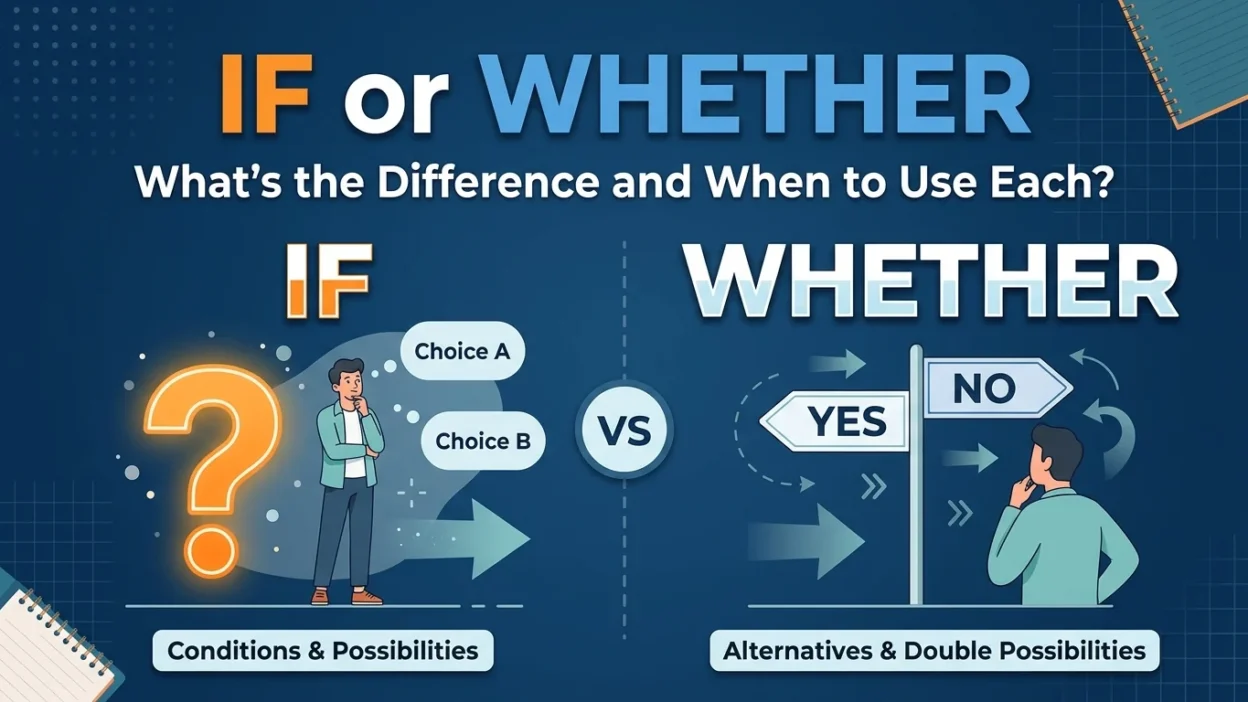
The words “if” and “whether” are often confusing because both can introduce clauses about possibilities, choices, and uncertainty. In many sentences, they seem to have the same meaning, but they are not always interchangeable. Understanding the difference between if or whether can help you write clearer sentences and speak more confidently in English.
Both words are commonly used when discussing uncertain situations or asking indirect questions. However, each has specific grammar rules that determine when it is appropriate. For example, “I don’t know if he will come” and “I don’t know whether he will come” are both correct. But when presenting two alternatives, such as “whether to stay or leave,” whether is the better choice. Learning these differences will help students, ESL learners, and everyday English users avoid common grammar mistakes.
Quick Answer: If or Whether
If and whether can both introduce indirect yes-or-no questions. However, if is more common in everyday conditional sentences, while whether is preferred when expressing alternatives, choices, or possibilities. Use whether before an infinitive, such as “whether to go,” and before “or not” when the alternatives are clearly emphasized.
Why Do People Confuse If and Whether?
People often confuse if and whether because both words can introduce indirect questions that expect a yes-or-no answer.
For example:
- I don’t know if she is coming.
- I don’t know whether she is coming.
Both sentences are grammatically correct and communicate the same basic idea.
The confusion happens because English uses if in two different ways:
- Conditional if: It introduces a condition that must be met for something to happen.
- Question if: It introduces an indirect yes-or-no question.
Whether, on the other hand, mainly introduces alternatives or indirect questions involving uncertainty.
Understanding these two uses of if makes it easier to choose the correct word.
First Word: If
What Does If Mean?
If is a conjunction used to introduce a condition or an indirect yes-or-no question. It explains that something may happen depending on a particular situation.
It is especially common in everyday conversations and conditional sentences.
Examples of If in Sentences
- If it rains, we will stay home.
- I will call you if I have time.
- She asked if I was ready.
- I don’t know if he understands.
- If you study regularly, you will improve.
When Should You Use If?
Use if in the following situations:
1. To express a condition
Use if when one action depends on another.
Example: If you work hard, you can achieve your goals.
2. To introduce an indirect yes-or-no question
Use if when you are unsure about something.
Example: I wonder if they are coming.
3. In everyday conversations
If sounds natural in many informal and neutral situations.
Example: Let me know if you need help.
Second Word: Whether
What Does Whether Mean?
Whether is a conjunction used to introduce alternatives, choices, or indirect questions involving uncertainty.
It is especially useful when discussing two or more possibilities.
For example:
- I don’t know whether he is coming.
- She cannot decide whether to stay or leave.
- We must determine whether the information is correct.
Examples of Whether in Sentences
- I wonder whether she knows the answer.
- He asked whether I wanted tea or coffee.
- We haven’t decided whether to travel.
- Tell me whether you agree or disagree.
- She is thinking about whether to accept the offer.
When Should You Use Whether?
1. When presenting two alternatives
Use whether when comparing choices.
Example: I cannot decide whether to study English or French.
2. Before an infinitive
Use whether + to + base verb.
Example: He doesn’t know whether to accept the invitation.
3. Before or not
Use whether when expressing two possible outcomes.
Example: We need to find out whether or not the shop is open.
4. After a preposition
Use whether after prepositions such as about, on, and in.
Example: We talked about whether we should move.
5. In formal writing
Whether is often preferred when expressing uncertainty or alternatives in academic and professional writing.
If vs Whether: Comparison Table
| Feature | If | Whether |
| Main meaning | Condition or uncertainty | Alternatives or uncertainty |
| Conditional sentences | Yes | No, not normally |
| Indirect questions | Yes | Yes |
| Two alternatives | Sometimes | Preferred |
| Before to + verb | No | Yes |
| After a preposition | Generally no | Yes |
| Everyday conversation | Very common | Common |
| Formal writing | Common | Often preferred |
When Should You Use If or Whether?
Choosing between if and whether depends on the meaning and structure of your sentence.
Use If for Conditions
When something depends on another event or situation, use if.
Examples:
- If you hurry, you will catch the bus.
- If I have money, I will buy a new phone.
- If she calls, tell her I am busy.
In these sentences, if introduces a condition.
Use If or Whether for Indirect Questions
When you want to express uncertainty about a yes-or-no question, both words can work.
Examples:
- I don’t know if he is at home.
- I don’t know whether he is at home.
- She asked if I liked the movie.
- She asked whether I liked the movie.
Use Whether for Two Choices
When you clearly mention alternatives, whether is generally the better choice.
Examples:
- I don’t know whether to laugh or cry.
- She must decide whether to stay or leave.
- We are discussing whether to buy or rent a house.
Use Whether After a Preposition
Whether is the standard choice after a preposition.
Examples:
- We talked about whether the plan would work.
- It depends on whether he agrees.
- They argued about whether the decision was fair.
15+ Examples of If and Whether in Sentences
The following examples show how to use both words correctly in everyday English.
Examples Using If
- If you study every day, your English will improve.
- I will visit you if I have enough time.
- She asked if I was feeling better.
- Let me know if you need anything.
- If the weather is nice, we will go outside.
- He doesn’t know if the answer is correct.
- If you practice speaking, you will become more confident.
- I wonder if they have arrived.
Examples Using Whether
- I don’t know whether she will attend the meeting.
- He cannot decide whether to travel or stay home.
- She asked whether I wanted coffee or tea.
- We need to determine whether the information is accurate.
- It depends on whether you agree.
- I am unsure whether to accept the invitation.
- They discussed whether the project should continue.
- Tell me whether you are ready or not.
Examples Where Both Are Correct
- I don’t know if he is busy.
- I don’t know whether he is busy.
- She asked if I could help her.
- She asked whether I could help her.
In examples 17–20, both words introduce indirect yes-or-no questions, so either choice is acceptable.
Common Mistakes When Using If and Whether
Even experienced English learners sometimes use these words incorrectly. Here are some common mistakes and their corrections.
Mistake 1: Using If Before an Infinitive
Incorrect: I don’t know if to go.
Correct: I don’t know whether to go.
Explanation: Use whether before an infinitive construction.
Mistake 2: Using If After a Preposition
Incorrect: It depends on if he agrees.
Better: It depends on whether he agrees.
Explanation: Whether is the standard choice after a preposition.
Mistake 3: Confusing Conditional If With Question If
Incorrect: I will call you whether I have time.
Correct: I will call you if I have time.
Explanation: The sentence expresses a condition, so if is appropriate.
Mistake 4: Forgetting the Alternative
Less clear: She doesn’t know if to stay.
Correct: She doesn’t know whether to stay or leave.
Explanation: Whether is used to introduce a choice.
Mistake 5: Thinking If and Whether Are Always Interchangeable
Incorrect: I am worried about if he will arrive.
Better: I am worried about whether he will arrive.
Explanation: After a preposition, whether is the appropriate choice.
Easy Memory Trick: How to Remember If vs Whether
You can remember the difference between these two words with a simple trick.
Think of IF as a condition and WHETHER as a choice.
- IF = Something depends on something else.
- WHETHER = Two or more possibilities are being considered.
Remember these examples:
- If it rains, I will stay home. (Condition)
- I don’t know whether to stay home or go outside. (Choice)
Another helpful tip is to remember that whether can come before to + verb, while if cannot.
For example:
- Whether to eat or sleep.
- Whether to go or stay.
This simple rule can help you make the correct choice in many sentences.
American vs British English: Is There a Difference?
The basic grammar rules for if and whether are the same in American and British English.
Both varieties use if for conditional sentences and indirect yes-or-no questions. Both also use whether when expressing alternatives, choices, or uncertainty.
For example:
American English:
- I don’t know if he is coming.
- I haven’t decided whether to go.
British English:
- I don’t know if he is coming.
- I haven’t decided whether to go.
There is no important regional difference in these examples. The choice depends on grammar and meaning rather than nationality.
Similar Words Related to If and Whether
Several English words and expressions are related to if and whether. However, they do not always have the same meaning.
1. Unless
Unless means except if. It introduces a negative condition.
Example: I will not go unless you come with me.
2. Provided That
Provided that means only if a particular condition is satisfied.
Example: You can join us provided that you arrive on time.
3. Whether or Not
This expression emphasizes that something is true or happens regardless of the circumstances.
Example: I will support you whether or not you win.
4. In Case
In case introduces something done as a precaution against a possible event.
Example: Take an umbrella in case it rains.
5. Even If
Even if introduces a condition that will not change the main result.
Example: I will continue even if the work is difficult.
Final Verdict: If or Whether?
Both if and whether are correct English words, but they serve different grammatical purposes.
Use if when introducing a condition or an indirect yes-or-no question. Use whether when discussing alternatives, expressing choices, writing whether + to + verb constructions, or placing an indirect question after a preposition.
For example:
- If you study, you will pass. (Condition)
- I don’t know if you will pass. (Indirect question)
- I don’t know whether to study or rest. (Choice)
The most important thing is to understand the meaning of your sentence before choosing either word.
Frequently Asked Questions (FAQs)
1. What is the main difference between if and whether?
The main difference is that if commonly introduces conditions, while whether introduces alternatives or indirect yes-or-no questions. Both can be used in indirect questions, but whether is more suitable when choices are involved.
2. Can I use if and whether interchangeably?
Sometimes, yes. Both are correct in many indirect yes-or-no questions.
For example:
- I wonder if she is home.
- I wonder whether she is home.
However, they cannot be exchanged in every situation. Use if for conditional sentences and whether before an infinitive.
3. Is it correct to say whether or not?
Yes, whether or not is grammatically correct. It emphasizes that something will happen regardless of the outcome.
Example: I will finish the project whether or not you help me.
4. Should I use if or whether in formal writing?
Whether is often preferred in formal writing when discussing alternatives or uncertainty. However, if is also correct for conditional statements and many indirect questions.
Example: The researchers examined whether the results were accurate.
5. Can whether be used without or not?
Yes. Whether does not need to be followed by or not.
Example: I don’t know whether he will attend the event.
Both whether and whether or not can be correct, depending on the intended meaning.
6. Why do we say whether to go instead of if to go?
Because whether can introduce an infinitive phrase with to, while if cannot normally be used in this structure.
Correct: I cannot decide whether to go.
Incorrect: I cannot decide if to go.
7. Which is better: I don’t know if or I don’t know whether?
Both expressions are grammatically correct when introducing an indirect yes-or-no question.
For everyday conversation, if is very common. Whether can sound slightly more formal or emphasize uncertainty between possibilities.
Remember This
- If introduces a condition: If it rains, I will stay home.
- Whether introduces alternatives: I don’t know whether to stay or leave.
- Both can introduce indirect yes-or-no questions.
- Use whether before to + verb.
- Prefer whether after a preposition.
- Use whether or not to emphasize two possible outcomes.
Conclusion
Understanding the difference between if and whether makes English grammar easier and helps you communicate more clearly. Although both words can introduce indirect yes-or-no questions, if is especially useful for conditional sentences, while whether is preferred when discussing choices, alternatives, and uncertainty. Learning their individual uses will help you avoid common mistakes.
The easiest way to remember the difference is to think of if as a condition and whether as a choice. Practice using both words in everyday sentences, pay attention to their grammatical structures, and you will become more confident in choosing the right word. With regular practice, using if or whether will feel natural.