
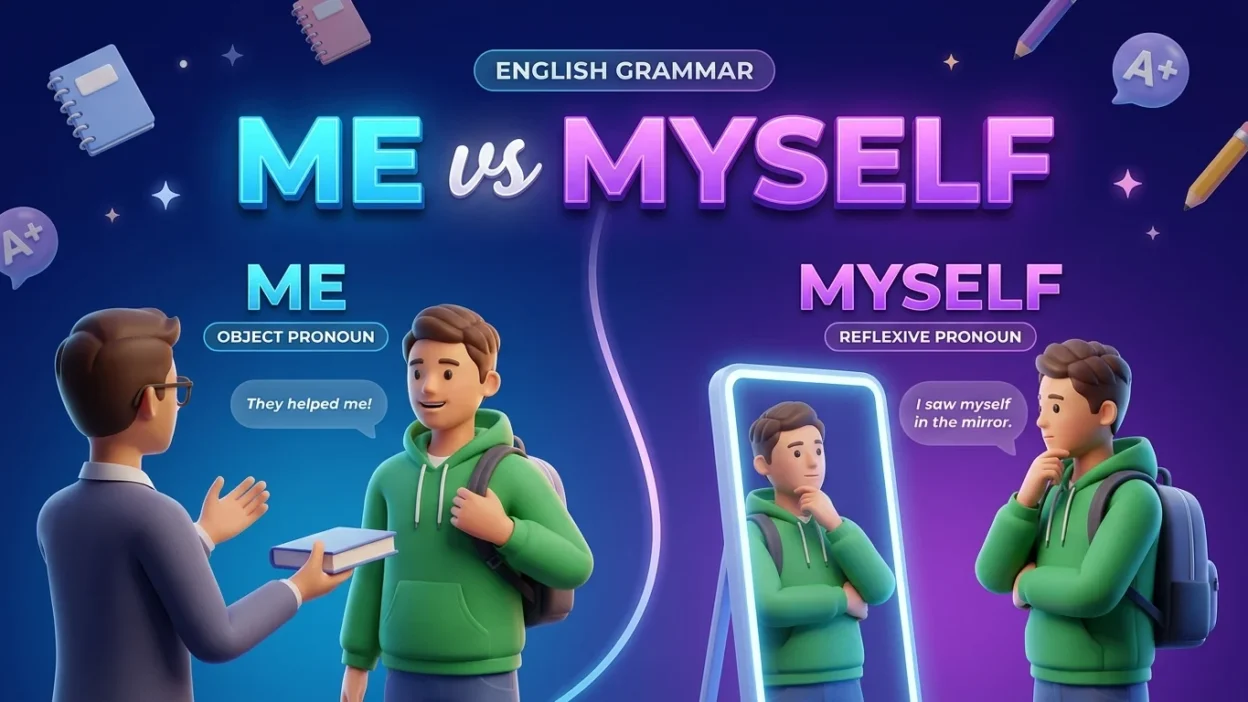
English has many words that seem similar but have different meanings and grammatical uses. “Me” and “myself” are two commonly confused words. Both refer to the person speaking, but they are not interchangeable in every sentence. Understanding when to use me and myself can help you speak naturally, write correctly, and avoid common grammar mistakes.
Many English learners use “myself” when they want to sound formal or professional. Others use “me” in situations where a reflexive pronoun is necessary. However, the correct choice depends on the sentence structure and the role each word plays. Whether you are writing an email, having a conversation, or completing an English grammar exercise, knowing the difference between me and myself will make your communication clearer.
Quick Answer: Me vs. Myself
Me is an object pronoun used when someone performs an action toward the speaker or when the speaker receives an action. Myself is a reflexive or intensive pronoun used when the subject and object refer to the same person or when emphasizing the speaker. For example, “She called me” and “I called myself.”
Why Do People Confuse Me and Myself?
People often confuse these words because both refer to the person speaking. They can also appear in similar sentence structures, which makes it difficult for beginners to identify the correct choice.
Another reason is that some people believe “myself” sounds more professional or polite than “me.” This is not always true. Using “myself” incorrectly can make a sentence grammatically awkward.
For example:
- Correct: Please contact me tomorrow.
- Incorrect: Please contact myself tomorrow.
- Correct: I introduced myself to the teacher.
The main difference is their grammatical function. “Me” receives an action, while “myself” refers back to the subject or adds emphasis.
First Word: What Does “Me” Mean?
Me is an object pronoun in English. It refers to the person speaking and is commonly used as the object of a verb or preposition.
When another person or thing performs an action toward you, you can use “me.”
Meaning of Me
The word “me” means the person who is speaking or writing. It is the object form of the subject pronoun “I.”
For example:
- She invited me to dinner.
- My brother helped me.
- Please listen to me.
- They gave me a beautiful gift.
In these sentences, “me” receives the action or follows a preposition.
When Should You Use Me?
Use “me” in these situations:
1. After an action verb
Use “me” when someone performs an action toward you.
Examples:
- He called me yesterday.
- My teacher praised me.
- She helped me with my homework.
2. After a preposition
Use “me” after words such as to, for, with, between, and about.
Examples:
- This letter is for me.
- Come with me.
- They were talking about me.
- Keep this secret between you and me.
3. As part of a compound object
Use “me” when you are one of two or more people receiving an action.
Examples:
- Sarah and me went shopping. (Incorrect as a subject.)
- The teacher called Sarah and me. (Correct.)
- My parents invited my brother and me.
Remember that “me” is an object pronoun, not a subject pronoun.
Second Word: What Does “Myself” Mean?
Myself is a reflexive and intensive pronoun. It refers to the speaker and is used when the subject and object of a sentence refer to the same person or when the speaker wants to add emphasis.
It is made from “my” and “self.”
Meaning of Myself
The word “myself” means me personally or the same person who is performing the action.
For example:
- I taught myself English.
- I prepared the meal myself.
- I looked at myself in the mirror.
- I completed the project myself.
In these examples, “myself” either refers back to “I” or emphasizes that the speaker personally performed an action.
When Should You Use Myself?
There are two main uses of “myself.”
1. As a reflexive pronoun
Use “myself” when the action performed by the subject comes back to the same person.
Examples:
- I hurt myself while playing.
- I introduced myself to the manager.
- I blamed myself for the mistake.
- I looked at myself in the mirror.
2. As an intensive pronoun
Use “myself” to emphasize that you personally performed an action.
Examples:
- I myself checked the report.
- I made this cake myself.
- I will speak to the principal myself.
In these sentences, “myself” adds emphasis. Removing it does not change the basic meaning of the sentence.
Me vs. Myself: Comparison Table
The following table explains the main differences between me and myself.
| Feature | Me | Myself |
| Pronoun type | Object pronoun | Reflexive and intensive pronoun |
| Refers to | The speaker | The speaker |
| Main purpose | Receives an action | Reflects or emphasizes an action |
| Common position | After verbs and prepositions | After reflexive verbs or for emphasis |
| Subject form | I | I |
| Example | She called me. | I called myself. |
| Correct use | Give it to me. | I did it myself. |
The easiest way to remember the difference is that “me” usually receives an action, while “myself” refers back to “I” or adds personal emphasis.
When to Use Me and When to Use Myself
Choosing between these pronouns becomes easier when you understand the purpose of your sentence.
Use Me When You Receive an Action
If someone else performs an action toward you, use “me.”
Examples:
- My friend invited me.
- The teacher asked me a question.
- My parents supported me.
Use Myself When the Action Reflects Back on You
If you perform an action on yourself, use “myself.”
Examples:
- I taught myself to cook.
- I accidentally cut myself.
- I reminded myself to study.
Use Myself for Personal Emphasis
When you want to show that you personally completed something, use “myself.”
Examples:
- I wrote the article myself.
- I will handle this matter myself.
- I myself believe in hard work.
Use Me After Prepositions
When a sentence contains a preposition followed by the speaker, use “me” in ordinary object constructions.
Examples:
- She sat beside me.
- He came with me.
- This present is from me.
15 Examples of Me and Myself in Sentences
Here are practical examples to help you understand how these words work in everyday English.
Examples Using Me
- My mother loves me very much.
- Please send me the details.
- She gave me a new notebook.
- My friends invited me to the party.
- The manager asked me to wait.
- Can you help me with this question?
- He was standing next to me.
- Nobody told me about the meeting.
Examples Using Myself
- I taught myself how to swim.
- I introduced myself to the new students.
- I looked at myself in the mirror.
- I prepared breakfast myself.
- I blamed myself for the mistake.
- I will complete the assignment myself.
- I reminded myself to stay positive.
These examples show that the correct pronoun depends on the grammatical role it plays in the sentence.
Common Mistakes When Using Me and Myself
Even experienced English speakers sometimes misuse these pronouns. Here are some common mistakes and their corrections.
Mistake 1: Using Myself Instead of Me
Incorrect: Please email myself the document.
Correct: Please email me the document.
Explanation: “Me” is the correct object pronoun because the speaker receives the document.
Mistake 2: Using Myself as a Subject
Incorrect: Myself and John went to school.
Correct: John and I went to school.
Explanation: Use “I” as the subject of a sentence, not “myself.”
Mistake 3: Using Myself to Sound Formal
Incorrect: The manager contacted myself.
Correct: The manager contacted me.
Explanation: “Myself” is not a more professional replacement for “me.”
Mistake 4: Using Me Instead of Myself in a Reflexive Sentence
Incorrect: I blamed me for the mistake.
Correct: I blamed myself for the mistake.
Explanation: The subject and object refer to the same person, so the reflexive pronoun is required.
Mistake 5: Using Me After Between
Incorrect: Keep this information between you and I.
Correct: Keep this information between you and me.
Explanation: “Between” is a preposition, so it takes the object pronoun “me.”
Easy Memory Trick: How to Remember Me vs. Myself
A simple memory trick can help you choose the correct word without thinking too much about grammar rules.
Remember these three rules:
- Me = Object: Someone does something to me.
- Myself = Reflexive: I do something to myself.
- Myself = Emphasis: I personally do something.
Try these examples:
- She helped me. (Someone helped the speaker.)
- I helped myself. (The speaker helped the same person.)
- I did it myself. (The speaker emphasizes personal involvement.)
You can also remember that “myself” usually needs “I” as its subject or refers back to an established first-person subject.
Me vs. Myself in American and British English
There is no important grammatical difference between American and British English when using “me” and “myself.”
Both varieties follow the same basic rules:
- Use “me” as an object pronoun.
- Use “myself” as a reflexive pronoun.
- Use “myself” for emphasis.
Examples in American English:
- She invited me to her birthday party.
- I made the dinner myself.
Examples in British English:
- She invited me to her birthday party.
- I made the dinner myself.
The spelling and grammatical use remain the same in both varieties. Differences in pronunciation or accent do not change which pronoun is correct.
Similar Words Related to Me and Myself
Understanding other first-person pronouns can make English grammar easier.
I
“I” is a subject pronoun used when the speaker performs an action.
Example: I love reading books.
My
“My” is a possessive adjective used to show ownership.
Example: This is my book.
Mine
“Mine” is a possessive pronoun that shows ownership without repeating the noun.
Example: This book is mine.
Myself
“Myself” is a reflexive or intensive pronoun.
Example: I wrote this book myself.
Me
“Me” is an object pronoun.
Example: She gave me a book.
These words are connected because they all refer to the first-person speaker, but they have different grammatical functions.
Final Verdict: Me or Myself?
The difference between “me” and “myself” is mainly about grammar and sentence structure.
Use me when you are the object of a verb or preposition. Use myself when the action refers back to you or when you want to emphasize that you personally performed something.
For example:
- She called me. (Correct object pronoun.)
- I called myself. (Correct reflexive pronoun.)
- I completed the work myself. (Correct emphasis.)
Never use “myself” simply because you think it sounds more formal. Choosing the right pronoun will make your English clearer and more natural.
Frequently Asked Questions (FAQs)
1. What is the difference between me and myself?
“Me” is an object pronoun, while “myself” is a reflexive or intensive pronoun. Use “me” when someone performs an action toward you. Use “myself” when an action refers back to you or when emphasizing your personal involvement.
2. Is it correct to say me and myself?
It depends on the sentence. The phrase “me and myself” is generally not correct as a replacement for “I and me.” Use “I” as a subject and “me” as an object. Use “myself” only when the reflexive or emphatic meaning is appropriate.
3. Should I say please contact me or please contact myself?
The correct phrase is “Please contact me.” The verb “contact” takes an object pronoun, so “me” is grammatically correct. “Please contact myself” is incorrect in standard English.
4. Can I use myself instead of I?
No. “Myself” cannot normally replace “I” as the subject of a sentence. For example, say “I went to the market,” not “Myself went to the market.”
5. Is myself a reflexive pronoun?
Yes. “Myself” is a reflexive pronoun when the subject and object refer to the same person. For example, “I taught myself English.” It can also work as an intensive pronoun to add emphasis.
6. Is it correct to say between you and me?
Yes. “Between you and me” is grammatically correct because “between” is a preposition that requires object pronouns. Saying “between you and I” is incorrect in standard English.
7. Can I use myself in formal writing?
Yes, but only when the sentence requires a reflexive or intensive pronoun. For example, “I prepared the report myself” is correct. However, “Please send the report to myself” should be “Please send the report to me.”
Remember This
- Me is an object pronoun: She helped me.
- Myself is a reflexive pronoun: I helped myself.
- Myself can add emphasis: I completed it myself.
- I is a subject pronoun: I completed the work.
- Never use “myself” just to make a sentence sound formal.
Conclusion
Understanding the difference between me and myself is an important part of learning correct English grammar. Although both words refer to the speaker, they serve different purposes. “Me” is used as an object pronoun, while “myself” is used when an action reflects back on the speaker or when adding emphasis. Learning these simple rules can help you avoid common mistakes.
The best way to improve is to practice using both words in everyday sentences. Remember to use “me” after verbs and prepositions when it functions as an object, and choose “myself” when referring back to “I” or emphasizing personal involvement. With regular practice, you will find it much easier to use these words naturally and confidently.