Understanding the difference between immoral and amoral can make your English clearer and help you choose the correct word in everyday conversations and writing.
Although these two words look and sound similar, they have different meanings. Both are connected to morality, but they describe different attitudes toward right and wrong.
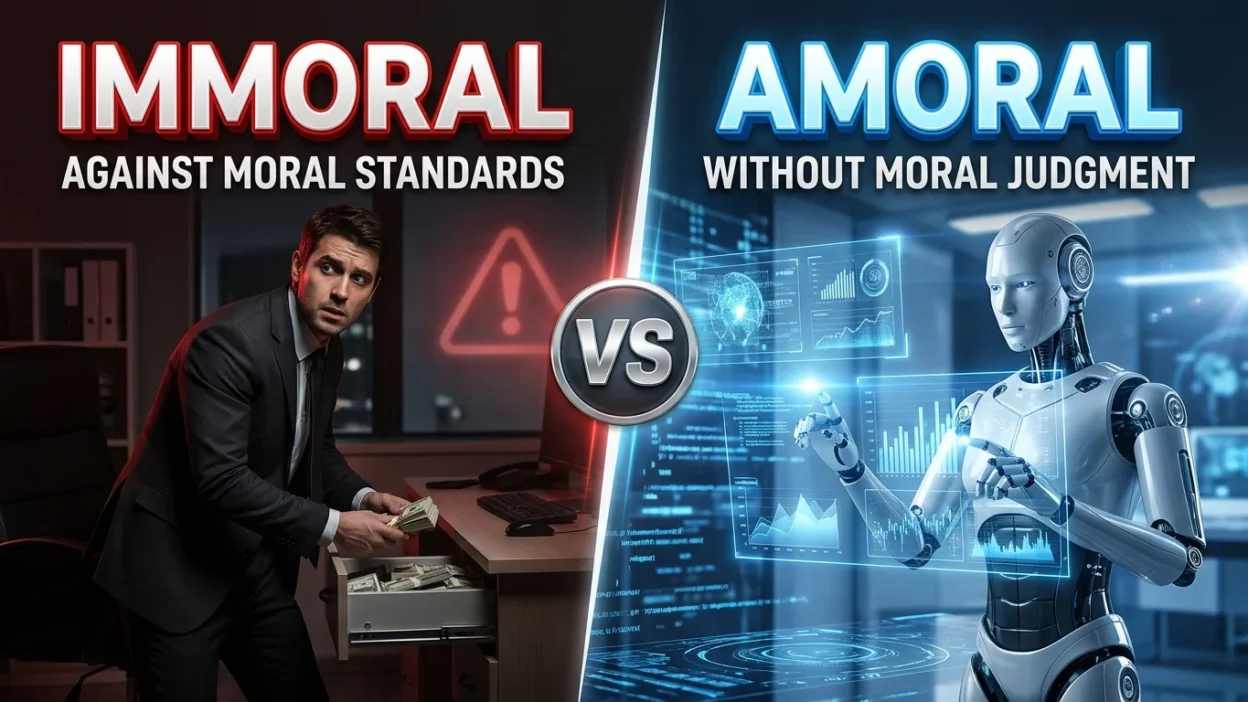
The word immoral describes something that goes against accepted moral principles. It is commonly used for dishonest, unethical, harmful, or unacceptable behavior. In contrast, amoral describes someone or something that does not consider morality or is not concerned with whether an action is right or wrong. For example, cheating on an exam is immoral because it involves dishonesty.
A machine, however, is amoral because it does not have personal moral beliefs or intentions. Learning these differences will help you avoid common vocabulary mistakes and use both words naturally.
Quick Answer: What Is the Difference Between Immoral and Amoral?
Immoral means behaving in a way that is wrong or against moral principles. Amoral means having no sense of morality or not considering right and wrong. For example, stealing is immoral, while a computer is amoral because it cannot make moral decisions independently.
Why Do People Confuse Immoral and Amoral?
People often confuse immoral and amoral because both words contain the word moral. They also have similar spelling and pronunciation.
However, their prefixes create different meanings:
- Im- means not or opposite of something.
- A- means without or lacking something.
The main difference is that immoral behavior goes against moral standards, while amoral behavior does not involve moral judgment or concern.
For example:
- A person who knowingly lies to hurt someone is acting immorally.
- A computer program that processes information without understanding right and wrong is amoral.
Remember that these words are not interchangeable. Using the wrong one can change the meaning of your sentence.
First Word: What Does Immoral Mean?
Immoral is an adjective that describes behavior, actions, decisions, or people that go against accepted standards of right and wrong.
An immoral action is generally considered unethical, dishonest, unfair, or harmful. It involves breaking moral principles or doing something that society or a particular ethical system considers wrong.
Simple Definition of Immoral
Immoral means morally wrong or contrary to accepted principles of right and wrong.
Origin of Immoral
The word immoral comes from the Latin word moralis, which relates to manners, customs, and proper behavior. The prefix im- adds a negative meaning.
Together, the word describes something that is not morally right.
Examples of Immoral Behavior
Some common examples of immoral behavior include:
- Cheating on an examination.
- Stealing money from another person.
- Lying to gain an unfair advantage.
- Betraying someone’s trust.
- Exploiting vulnerable people.
- Deliberately hurting innocent individuals.
Immoral in a Sentence
- Stealing from poor people is an immoral act.
- The company was criticized for its immoral business practices.
- Lying to your friends can damage relationships.
- He refused to participate in the immoral activity.
- Cheating in a competition is considered immoral.
Second Word: What Does Amoral Mean?
Amoral is an adjective that describes someone or something that does not recognize, consider, or follow moral principles.
An amoral person may not think about whether an action is right or wrong. The word can also describe things that have no capacity for moral judgment, such as machines, natural processes, or certain systems.
Simple Definition of Amoral
Amoral means having no concern for morality or being outside the concepts of right and wrong.
Origin of Amoral
The word amoral is formed by combining the prefix a-, meaning without or lacking, with moral.
It describes something that lacks a moral perspective or does not operate according to moral judgments.
Examples of Amoral Behavior
Here are some examples that help explain the word:
- A computer program that follows instructions without understanding ethics.
- A natural disaster that has no intention or moral purpose.
- An animal acting according to instinct rather than human moral rules.
- A person who makes decisions without considering whether they are right or wrong.
Amoral in a Sentence
- A computer is amoral because it does not understand human morality.
- Some philosophers describe nature as amoral.
- The machine follows instructions without making moral judgments.
- He took an amoral approach to business decisions.
- Artificial intelligence systems do not automatically possess human moral understanding.
Immoral vs. Amoral: What Is the Main Difference?
The main difference between immoral and amoral is their relationship with morality. Immoral refers to something that is morally wrong, while amoral describes something that lacks moral concern or judgment.
| Feature | Immoral | Amoral |
| Meaning | Morally wrong | Without moral concern or judgment |
| Prefix | Im- | A- |
| Main idea | Against morality | Lacking morality |
| Moral awareness | Involves a violation of moral standards | May involve no moral consideration |
| Common use | Dishonest or harmful actions | Machines, systems, or people without moral concern |
| Example | Stealing is immoral. | A calculator is amoral. |
| Related idea | Unethical | Nonmoral or lacking moral awareness |
Easy way to understand: An immoral person knows or recognizes moral standards but acts against them. An amoral person does not consider those standards when making decisions.
However, the exact meaning of amoral depends on context. It does not always mean that someone is incapable of understanding morality.
When Should You Use Immoral and Amoral?
Choosing between these words becomes easier when you understand what you want to describe.
When to Use Immoral
Use immoral when discussing actions, decisions, or behavior that violate moral principles.
Common situations include:
- Dishonesty: Lying to deceive someone is immoral.
- Unfairness: Taking advantage of innocent people is immoral.
- Crime: Stealing from another person is immoral.
- Betrayal: Breaking someone’s trust intentionally can be immoral.
- Unethical business: Misleading customers for profit is immoral.
Example: The manager was fired because of his immoral business decisions.
When to Use Amoral
Use amoral when describing something that does not consider morality or cannot make moral judgments.
Common situations include:
- Technology: A calculator is amoral because it cannot understand right and wrong.
- Nature: A storm is amoral because it does not intentionally cause destruction.
- Systems: A system may be amoral if it operates without ethical considerations.
- Decision-making: A person may take an amoral approach by ignoring moral questions.
Example: The machine is amoral because it simply follows programmed instructions.
15 Examples of Immoral and Amoral in Sentences
Examples make it easier to understand how these words work in everyday English.
Examples of Immoral
- Cheating during an examination is an immoral way to achieve success.
- Stealing someone’s money is considered immoral behavior.
- The politician was criticized for his immoral decisions.
- Lying to your parents can be an immoral action.
- The company used immoral methods to increase its profits.
- Taking advantage of poor people is morally wrong.
- She refused to support the immoral business practice.
- Betraying a close friend is an immoral act.
Examples of Amoral
- A calculator is amoral because it cannot understand ethical values.
- Nature is often described as amoral because it does not judge human actions.
- The computer follows instructions in an amoral way.
- An amoral person may ignore the difference between right and wrong.
- The scientist studied the amoral behavior of natural processes.
- The machine does not make moral decisions because it is amoral.
- Some people consider the character amoral because he shows no concern for ethical principles.
Common Mistakes When Using Immoral and Amoral
Even advanced English learners sometimes use these words incorrectly. Here are some mistakes to avoid.
Mistake 1: Using Immoral Instead of Amoral
Incorrect: A computer is immoral because it cannot understand right and wrong.
Correct: A computer is amoral because it cannot independently understand moral principles.
Why? A computer does not intentionally break moral rules. It simply processes information according to its programming.
Mistake 2: Using Amoral to Describe Dishonesty
Incorrect: Stealing money from someone is amoral.
Correct: Stealing money from someone is immoral.
Why? Stealing is generally considered a violation of moral principles.
Mistake 3: Thinking Amoral Always Means Evil
Incorrect: An amoral person is always an evil person.
Correct: An amoral person does not consider morality when making decisions.
Why? Amoral does not automatically mean evil. It describes a lack of moral concern or judgment.
Mistake 4: Confusing Immoral With Illegal
Incorrect: Everything illegal is automatically immoral.
Correct: Illegal and immoral have different meanings.
Why? Illegal refers to breaking the law, while immoral refers to violating moral principles. Something can be immoral without being illegal, and laws and moral standards do not always match.
Easy Memory Trick to Remember Immoral vs. Amoral
A simple memory trick can help you remember the difference between these two words.
- Immoral = In the wrong: Think of someone doing something against moral rules.
- Amoral = Absent morality: Think of something that does not consider right and wrong.
Remember these two simple examples:
- Stealing is immoral because it is morally wrong.
- A calculator is amoral because it cannot make moral decisions.
Quick tip: If something breaks moral rules, use immoral. If something lacks moral awareness or concern, use amoral.
American vs. British English: Is There Any Difference?
There is no major difference between American and British English when using immoral and amoral.
Both varieties of English use these words with the same meanings, spelling, and general pronunciation.
| Word | American English | British English |
| Immoral | Immoral | Immoral |
| Amoral | Amoral | Amoral |
For example:
- American English: Cheating is considered immoral.
- British English: Cheating is considered immoral.
- American English: The machine is amoral.
- British English: The machine is amoral.
Both forms are correct in everyday conversations, academic writing, and professional communication.
Similar Words Related to Immoral and Amoral
Several English words are related to morality. Understanding them can help you expand your vocabulary and express ideas more accurately.
| Word | Meaning | Example |
| Moral | Related to right and wrong | She made a moral decision. |
| Immoral | Against moral principles | Cheating is immoral. |
| Amoral | Without moral concern or judgment | A calculator is amoral. |
| Unethical | Not following accepted ethical standards | The company used unethical practices. |
| Unmoral | Not concerned with morality | The discussion focused on unmoral matters. |
| Nonmoral | Not related to moral questions | The color of a chair is a nonmoral matter. |
| Virtuous | Having good moral qualities | She is known for her virtuous behavior. |
| Ethical | Following principles of right conduct | The doctor followed ethical guidelines. |
Immoral vs. Unethical
Immoral and unethical are closely related. Both describe behavior that violates accepted standards of right conduct.
Example: Cheating customers is both immoral and unethical.
Amoral vs. Nonmoral
These words are related but not always interchangeable.
Amoral generally describes a lack of moral awareness or concern. Nonmoral describes something that is outside the scope of moral judgment.
For example, a calculator is amoral because it cannot make ethical decisions. The color of a wall is nonmoral because color itself is not a moral issue.
Final Verdict: Immoral vs. Amoral
The difference between immoral and amoral is simple once you understand their meanings.
- Immoral describes something that is morally wrong or goes against accepted principles.
- Amoral describes someone or something that does not consider morality or lacks moral judgment.
Use immoral when discussing dishonest, harmful, or unethical actions. Use amoral when describing something that has no moral awareness or does not consider right and wrong.
FAQs:
1. What is the main difference between immoral and amoral?
The main difference is that immoral means morally wrong, while amoral means lacking moral concern or judgment. Stealing is immoral, whereas a calculator is amoral because it cannot understand morality.
2. Is being amoral the same as being evil?
No, being amoral is not necessarily the same as being evil. Amoral describes someone or something that does not consider moral principles. Evil generally refers to extremely harmful or wicked behavior.
3. Can a person be both immoral and amoral?
A person can be described differently in different situations, but the words express distinct ideas. Someone who knowingly breaks moral rules is immoral, while someone who consistently ignores moral considerations may be described as amoral.
4. Is lying immoral or amoral?
Lying to deceive or harm someone is generally considered immoral because it violates honesty and trust. It is not normally described as amoral.
5. Is nature amoral or immoral?
Nature is generally described as amoral because natural events do not have moral intentions. A hurricane, earthquake, or storm does not deliberately choose to hurt people.
6. What is an example of an amoral person?
An amoral person is someone who does not consider right and wrong when making decisions. For example, someone who focuses entirely on personal profit without considering ethical consequences may be described as amoral.
7. Is immoral the opposite of moral?
Yes. Immoral is generally the opposite of moral. Moral describes behavior that follows principles of right and wrong, while immoral describes behavior that violates those principles.
8. What is the opposite of amoral?
There is no single perfect opposite in every context. Depending on the intended meaning, words such as moral, ethical, or principled may express the opposite of amoral.
Remember This
Keep these simple definitions in mind:
- Moral: Following principles of right and wrong.
- Immoral: Going against principles of right and wrong.
- Amoral: Having no moral concern or judgment.
The easiest way to remember the difference is that immoral means doing something morally wrong, while amoral means not considering morality.
Conclusion:
Understanding the difference between immoral and amoral helps you communicate more accurately in English. Although these words look similar, they describe two different relationships with morality. Immoral refers to actions that violate moral standards, while amoral describes someone or something that lacks moral awareness or does not consider ethical questions.
When writing or speaking, remember the simple distinction: stealing, cheating, and intentional dishonesty are generally immoral, while machines and natural events are commonly described as amoral. With these definitions and examples, you can use both words confidently in conversations, academic assignments, and everyday writing.