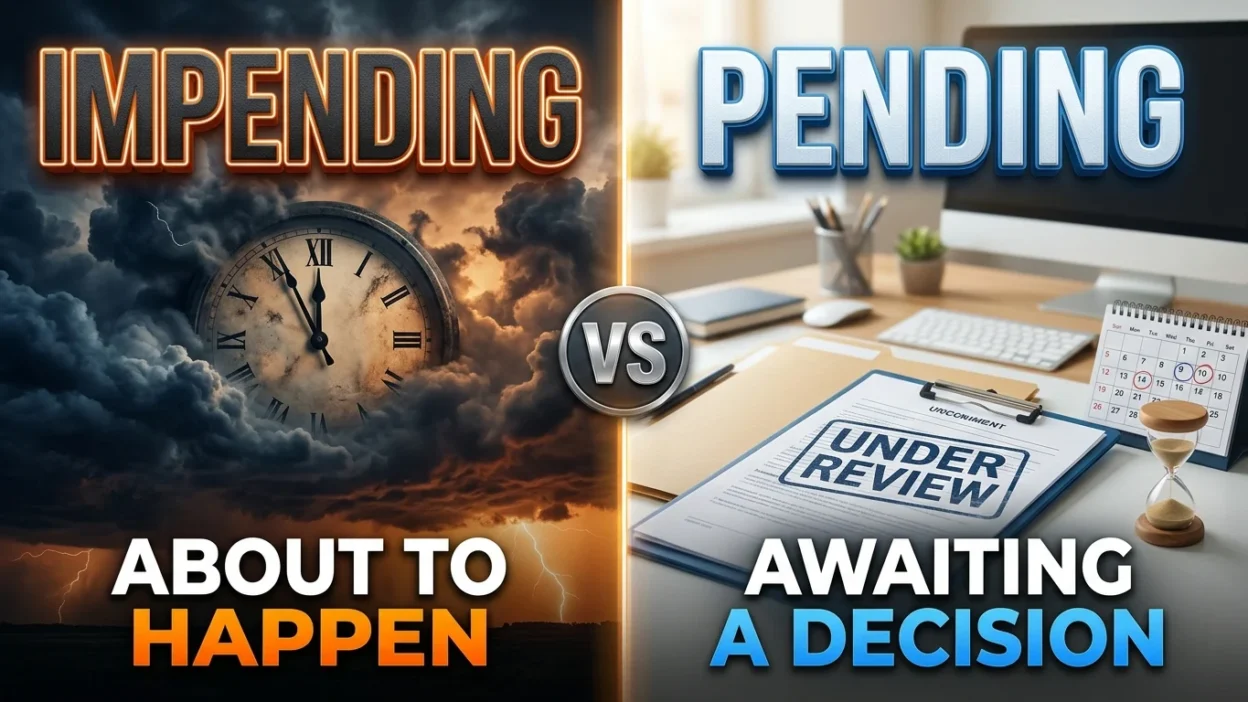
The words impending and pending are often confused because both describe something that has not happened yet. However, they have different meanings and are used in different situations.
Understanding the difference between impending and pending can help you communicate more clearly in everyday conversations, academic writing, and professional settings.
Impending describes something that is expected to happen soon, often suggesting that an important, serious, or unpleasant event is approaching. For example, an impending storm means a storm is likely to arrive soon.
In contrast, pending describes something that is waiting for a decision, approval, completion, or further action. A pending application, for instance, has been submitted but has not yet received a final decision.
Although these words are related to future events or unfinished situations, they are not interchangeable. Learning their meanings, differences, and practical examples will help you use each word correctly.
Quick Answer: What Is the Difference Between Impending and Pending?
Impending means something is approaching or expected to happen soon, usually referring to an upcoming event. Pending means something is awaiting a decision, approval, or completion.
For example, an impending storm is approaching, while a pending application is waiting for a decision. The main difference is approaching versus awaiting action.
Why Do People Confuse Impending and Pending?
People often confuse impending and pending because both words describe situations that are not yet complete or have not happened.
They also appear in contexts involving future events, decisions, and expectations. However, their meanings are different.
Here are three main reasons for the confusion:
- Similar spelling: Both words contain similar letters and have related grammatical uses.
- Future connection: Both can describe something that has not happened or been completed.
- Overlapping contexts: Both words sometimes appear in discussions about upcoming events, official decisions, and unfinished matters.
The easiest way to understand the difference is to remember that impending describes something approaching, while pending describes something waiting.
First Word: Impending – Meaning, Definition, and Examples
Impending is an adjective that means something is about to happen or is approaching soon. It is commonly used when talking about important, unexpected, serious, or unpleasant events.
The word often creates a sense of expectation because something significant may happen in the near future.
Meaning of Impending
According to its common English usage, impending refers to an event that is approaching or expected to occur shortly.
Simple definition: Something that is likely to happen very soon.
Examples:
- The impending storm forced people to stay indoors.
- Everyone was worried about the impending deadline.
- The villagers prepared for the impending flood.
- She felt nervous about her impending examination.
In these sentences, impending describes events that are approaching.
Origin of Impending
The word impending comes from the Latin word impendēre, meaning to hang over or threaten.
This historical meaning helps explain its modern usage. Something impending seems to be hanging over a person or situation because it is expected to happen soon.
When Is Impending Used?
Use impending when describing:
- An approaching storm or natural disaster.
- An upcoming deadline.
- A major change or important event.
- An expected problem or danger.
- An approaching examination or announcement.
More examples:
- The impending hurricane caused widespread concern.
- They discussed the impending changes to the company.
- She was anxious about her impending surgery.
- The impending deadline encouraged everyone to work faster.
Second Word: Pending – Meaning, Definition, and Examples
Pending is an adjective and can also function as a preposition in certain expressions. It generally means waiting for a decision, approval, completion, or resolution.
Unlike impending, pending does not necessarily suggest that something is about to happen. It simply indicates that a process or matter has not been finalized.
Meaning of Pending
Simple definition: Something that has not yet been decided, completed, or resolved.
Examples:
- My job application is still pending.
- The court case remains pending.
- Your payment is pending confirmation.
- The company is waiting for a pending approval.
In these examples, pending describes situations that are unfinished or awaiting further action.
Origin of Pending
The word pending comes from the Latin word pendere, meaning to hang or depend.
Over time, it developed the meaning of something remaining undecided or unfinished.
When Is Pending Used?
Use pending when describing:
- Job applications awaiting a decision.
- Payments waiting for confirmation.
- Court cases awaiting resolution.
- Requests awaiting approval.
- Orders that have not been completed.
- Decisions that have not yet been made.
More examples:
- Her admission application is pending review.
- The payment is still pending.
- The court postponed the hearing because the case was pending.
- We cannot announce the results while the decision is pending.
Impending vs. Pending: Comparison Table
The following table explains the main differences between impending and pending.
| Feature | Impending | Pending |
| Meaning | Approaching soon | Awaiting action or decision |
| Part of speech | Adjective | Adjective; also preposition |
| Main idea | Something is coming | Something is unfinished |
| Time connection | Near future | Unresolved period |
| Common use | Events and situations | Applications, payments, cases |
| Tone | Often serious or concerning | Usually neutral |
| Example | Impending storm | Pending payment |
| Synonyms | Approaching, forthcoming | Awaiting, unresolved |
Remember: Impending focuses on what is about to happen, whereas pending focuses on what is waiting to be completed or decided.
When Should You Use Impending or Pending?
Choosing the correct word becomes easier when you understand the situation.
Use Impending for Approaching Events
Use impending when an event is expected to happen soon.
Examples:
- The impending storm may damage houses.
- We are preparing for the impending arrival of our guests.
- The impending examination made students nervous.
- Everyone discussed the impending announcement.
In each sentence, something is approaching.
Use Pending for Unfinished Matters
Use pending when a matter is waiting for a decision, approval, or completion.
Examples:
- My visa application is pending.
- The payment is pending verification.
- The manager has several pending requests.
- The court has not resolved the pending case.
In each sentence, something remains unfinished.
Can Both Words Be Used in Similar Situations?
Yes, both words can describe situations connected to the future, but they communicate different ideas.
Consider these examples:
- Impending decision: A decision expected to happen soon.
- Pending decision: A decision that has not yet been made.
The first emphasizes that the decision is approaching, while the second emphasizes that it remains unresolved.
12 Examples of Impending vs. Pending in Sentences
Here are practical examples to help you understand how both words work in everyday English.
| Impending | Pending |
| The impending storm frightened the children. | The insurance claim is pending. |
| She worried about her impending surgery. | His application is pending approval. |
| The impending deadline created pressure. | Several requests are still pending. |
| We prepared for the impending arrival of winter. | The payment is pending confirmation. |
| The impending flood threatened nearby villages. | The court case remains pending. |
| Everyone discussed the impending changes. | The order is pending delivery. |
| The impending announcement excited the students. | The final decision is pending. |
| They feared an impending economic crisis. | The investigation is still pending. |
| The impending examination made him nervous. | My admission status is pending review. |
| The impending wedding kept the family busy. | The refund is pending processing. |
| Dark clouds suggested an impending storm. | The request is pending approval. |
| The impending launch attracted attention. | The project is pending authorization. |
Additional Examples in Everyday Conversations
Using impending:
- “I can feel the impending arrival of winter.”
- “There is an impending change in our schedule.”
- “The government warned people about the impending danger.”
Using pending:
- “My bank transfer is still pending.”
- “We cannot proceed because approval is pending.”
- “The results of the examination are pending.”
Common Mistakes When Using Impending and Pending
Even experienced English speakers sometimes confuse these words. Here are common mistakes and their corrections.
Mistake 1: Using Pending for an Approaching Event
Incorrect: The pending storm will arrive tonight.
Correct: The impending storm will arrive tonight.
Why? Impending is more appropriate because the storm is approaching.
Mistake 2: Using Impending for an Unfinished Application
Incorrect: My job application is impending.
Correct: My job application is pending.
Why? The application is waiting for a decision, not approaching as an event.
Mistake 3: Confusing an Impending Decision With a Pending Decision
Both expressions are grammatically correct, but their meanings differ.
- Impending decision: A decision expected soon.
- Pending decision: A decision that has not yet been made.
Mistake 4: Assuming Pending Always Means Something Will Happen Soon
Incorrect understanding: A pending payment will definitely be completed today.
Correct understanding: A pending payment is awaiting processing or confirmation, but there is no guarantee it will be completed today.
Why? Pending does not specify exactly when something will be completed.
Easy Memory Trick: How to Remember Impending vs. Pending
A simple memory trick can help you remember the difference between these two words.
Impending = Incoming
Both words begin with a similar sound, and impending describes something coming or approaching.
Think of:
- Impending storm.
- Impending deadline.
- Impending danger.
Pending = Waiting
Think of pending as something waiting for action or a decision.
Remember:
- Pending payment.
- Pending application.
- Pending approval.
Quick memory rule:
If something is coming soon, use impending. If something is waiting for approval or completion, use pending.
Impending vs. Pending in American and British English
There is no major difference between American and British English when using impending and pending.
Both varieties use these words with essentially the same meanings and grammatical rules.
| Expression | American English | British English |
| Impending storm | Correct | Correct |
| Impending deadline | Correct | Correct |
| Pending application | Correct | Correct |
| Pending payment | Correct | Correct |
| Pending approval | Correct | Correct |
For example:
- American English: My application is still pending.
- British English: My application is still pending.
Both sentences are correct and natural.
Similarly, both American and British speakers use impending to describe approaching events, such as an impending storm or an impending change.
Similar Words Related to Impending and Pending
Learning synonyms can improve your vocabulary and help you understand these words more clearly.
Synonyms of Impending
These words describe something approaching or expected to happen.
- Approaching: Coming closer in time or distance.
- Forthcoming: Expected to happen or appear soon.
- Upcoming: Scheduled or expected in the near future.
- Imminent: About to happen very soon.
- Near: Close in time or distance.
Example: An approaching storm may indicate an impending weather event.
Synonyms of Pending
These words describe something waiting for action or resolution.
- Awaiting: Waiting for something to happen.
- Unresolved: Not yet settled or solved.
- Undecided: Not yet determined.
- Unsettled: Not yet resolved or finalized.
- Outstanding: Still remaining to be completed or paid.
Example: An unresolved application may remain pending until someone makes a decision.
Final Verdict: Impending vs. Pending
The difference between impending and pending is simple but important.
Impending describes something that is approaching and expected to happen soon. It is commonly used for events, changes, deadlines, and possible dangers.
Pending describes something that is waiting for a decision, approval, action, or completion. It is frequently used for applications, payments, requests, and legal matters.
Although both words relate to situations that are not yet complete, they cannot always replace each other.
Choose impending when something is coming, and choose pending when something is waiting.
(FAQs)
1. What is the main difference between impending and pending?
Impending means something is approaching or expected to happen soon. Pending means something is waiting for a decision, approval, or completion. For example, an impending storm is approaching, while a pending application is awaiting a decision.
2. Does impending mean the same as pending?
No, impending and pending have different meanings. Impending describes an approaching event, while pending describes an unfinished or unresolved matter. Both relate to situations that have not fully happened, but they are used in different contexts.
3. Is impending positive or negative?
Impending is often associated with negative or serious situations, such as impending danger, an impending storm, or an impending crisis. However, it can also describe neutral or positive events, such as an impending celebration or an impending wedding.
4. Does pending mean waiting for approval?
Yes, pending often means waiting for approval or a decision. For example, a pending job application means the employer has not yet made a final decision about the application.
5. What is another word for impending?
Common synonyms for impending include approaching, imminent, forthcoming, upcoming, and near. The best alternative depends on the context of the sentence.
6. What is another word for pending?
Common synonyms for pending include awaiting, unresolved, undecided, outstanding, and unsettled. These words describe situations that are waiting for action or completion.
7. Can I use impending and pending in the same sentence?
Yes, you can use both words in one sentence when they describe different situations.
Example: “The impending deadline is creating pressure while several applications remain pending.”
Here, impending describes an approaching deadline, while pending describes applications awaiting decisions or completion.
8. Is a pending decision different from an impending decision?
Yes. A pending decision has not yet been made, while an impending decision is expected to happen soon. A decision can be pending without having a known completion date, but impending emphasizes that it is approaching.
Remember This
- Impending: Something is approaching or expected soon.
- Pending: Something is waiting for a decision or completion.
- Impending storm: A storm is approaching.
- Pending application: An application is awaiting a decision.
- Impending danger: A possible danger is approaching.
- Pending payment: A payment is awaiting processing or confirmation.
The easiest way to remember the difference is: Impending means coming; pending means waiting.
Conclusion
Understanding the difference between impending and pending can make your English writing and speaking more accurate. Although both words describe situations connected to the future, impending refers to something approaching soon, while pending refers to something that remains unfinished or awaits a decision. Learning their meanings and common uses will help you avoid confusion.
Whenever you write about an upcoming event, deadline, or possible danger, choose impending. When discussing an application, payment, request, or unresolved matter, choose pending. With regular practice and the examples in this guide, you can use both words confidently in everyday conversations and professional writing.