Have you ever wondered whether to use imply or infer in a sentence? These two English words are closely related, but they have different meanings.
People often confuse them because both describe how information is communicated, understood, or suggested. However, knowing the difference between imply and infer can make your speaking and writing clearer.
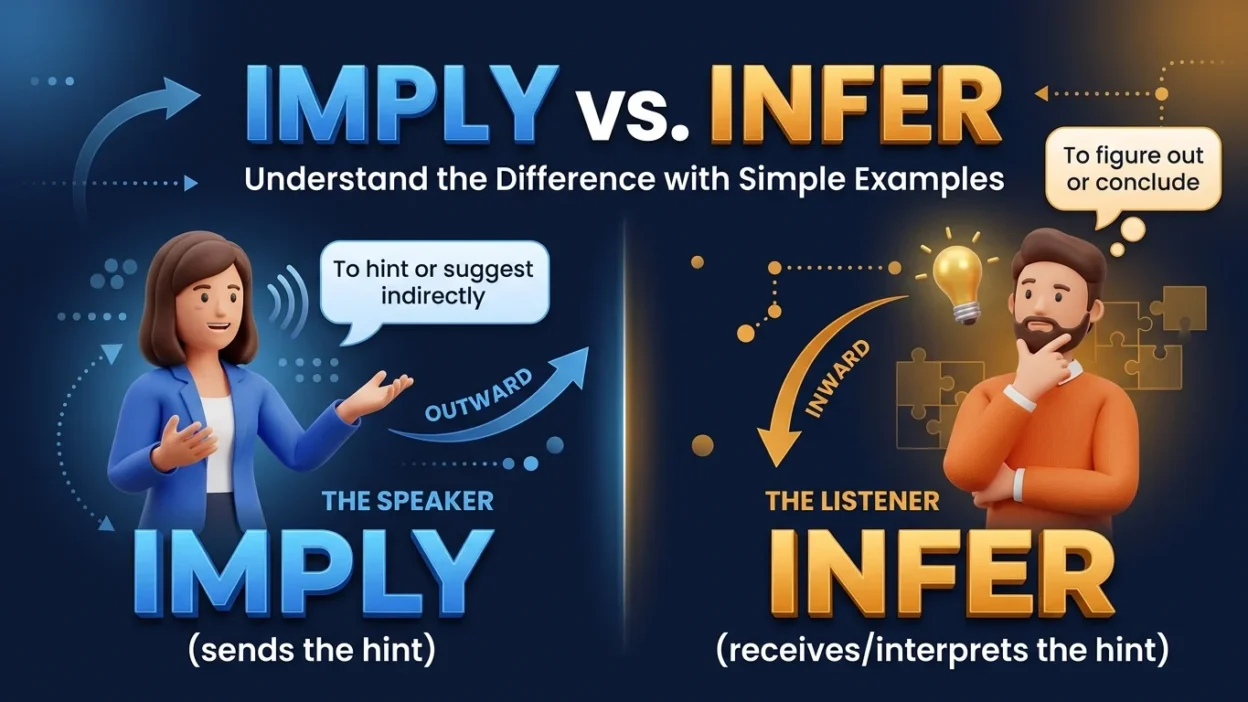
The main difference is simple: to imply means to suggest something indirectly, while to infer means to understand or conclude something from the information you receive. The speaker or writer implies an idea, and the listener or reader infers its meaning.
For example, if a teacher says, “Some students need to work harder,” the teacher may imply that certain students are not studying enough. A student may infer that the teacher is talking about them. Understanding this distinction will help you use both words correctly in everyday conversations, academic writing, and professional communication.
Quick Answer: What Is the Difference Between Imply and Infer?
Imply means to suggest something without saying it directly. It describes what a speaker or writer communicates indirectly. Infer means to reach a conclusion based on clues, evidence, or information. It describes what a listener or reader understands from what is communicated. In short, speakers imply, while listeners infer.
Why Do People Confuse Imply and Infer?
People often confuse imply and infer because both words are connected to indirect communication and hidden meanings.
When someone does not express an idea clearly, another person may need to understand what they really mean. This creates a connection between the two words.
However, they describe two different sides of communication:
- Imply: The person giving the message suggests an idea.
- Infer: The person receiving the message understands or concludes something.
For example:
- Sarah says, “You are always late to meetings.” She implies that her colleague is irresponsible.
- Her colleague infers that Sarah is unhappy with their punctuality.
The same situation involves both words, but each describes a different action.
First Word: Imply (Meaning, Definition, and Examples)
Imply is a verb that means to suggest something indirectly rather than expressing it clearly or directly.
When you imply something, you communicate an idea through your words, tone, behavior, or context. You expect another person to understand your intended meaning without explaining everything.
Simple Definition of Imply
To imply means to suggest, indicate, or communicate an idea without stating it openly.
Part of speech: Verb
Pronunciation: im-PLY
Synonyms: Suggest, indicate, hint, insinuate, intimate.
Examples of Imply in Sentences
- Her smile seemed to imply that she already knew the secret.
- The manager’s comments implied that changes were coming.
- Are you implying that I made a mistake?
- His silence implied disappointment.
- The teacher’s words implied that the examination would be difficult.
- She implied that she was unhappy with the decision.
- The advertisement implies that this product saves time.
- His message seemed to imply that he would not attend.
- The evidence may imply a connection between the two events.
- I did not mean to imply that you were wrong.
How Is Imply Used in Everyday English?
You can use imply when discussing indirect messages, suggestions, or meanings that are not openly expressed.
For example:
- In conversations: “Are you implying that I cannot do this job?”
- At work: “The director implied that promotions might be delayed.”
- In writing: “The author implies that honesty is important.”
- In relationships: “Her expression implied that something was bothering her.”
Remember that imply focuses on the person or thing communicating the indirect message.
Second Word: Infer (Meaning, Definition, and Examples)
Infer is a verb that means to reach a conclusion or understand something based on available information, clues, evidence, or observations.
When you infer something, you use your understanding and reasoning to discover what is probably true, even when the information is not directly stated.
Simple Definition of Infer
To infer means to conclude or understand something from clues, facts, evidence, or indirect information.
Part of speech: Verb
Pronunciation: in-FUR
Synonyms: Conclude, deduce, determine, gather, reason.
Examples of Infer in Sentences
- From her expression, I inferred that she was upset.
- We can infer that the weather will change soon.
- The detective inferred that the suspect had left early.
- I inferred from his silence that he disagreed.
- Readers can infer the character’s feelings from the story.
- She inferred that the meeting had been canceled.
- From the dark clouds, we can infer that rain is coming.
- The scientist inferred a possible connection from the results.
- I could infer from his voice that he was tired.
- Students should infer the meaning of unfamiliar words from context.
How Is Infer Used in Everyday English?
Infer is useful when you explain how someone understands information or reaches a conclusion.
For example:
- In conversations: “I inferred from your tone that you were upset.”
- At school: “Students must infer the meaning of the passage.”
- At work: “We can infer that customers prefer simpler designs.”
- In investigations: “The detective inferred that the suspect knew the victim.”
Remember that infer focuses on the person receiving information and interpreting its meaning.
Imply vs. Infer: Comparison Table
The easiest way to understand these words is to compare their meanings, purposes, and uses.
| Feature | Imply | Infer |
| Meaning | To suggest indirectly | To reach a conclusion |
| Main action | Giving a message | Understanding a message |
| Person involved | Speaker or writer | Listener or reader |
| Focus | What is suggested | What is understood |
| Synonyms | Suggest, hint, indicate | Conclude, deduce, gather |
| Example | She implied that he was wrong. | I inferred that he was wrong. |
| Communication | Sending an indirect idea | Interpreting an indirect idea |
Easy rule: The speaker implies, and the listener infers.
When Should You Use Imply or Infer?
Choosing between imply and infer becomes easier when you identify who is communicating and who is interpreting the message.
When to Use Imply
Use imply when someone suggests an idea without saying it directly.
Common situations include:
- When someone gives an indirect suggestion.
- When a person’s words communicate a hidden meaning.
- When an author suggests an idea through a story.
- When someone’s actions indicate a particular feeling.
- When discussing what a statement appears to mean.
Example: The politician implied that the current policy was unsuccessful.
Here, the politician is communicating an indirect message.
When to Use Infer
Use infer when someone reaches a conclusion based on available information.
Common situations include:
- When understanding someone’s indirect message.
- When drawing conclusions from evidence.
- When reading between the lines.
- When interpreting someone’s behavior.
- When making a logical judgment from clues.
Example: From the politician’s statement, voters inferred that a new policy was coming.
Here, voters are interpreting the politician’s message.
12 Examples of Imply vs. Infer in Sentences
These examples show how both words work in everyday English.
| Imply (Suggest) | Infer (Conclude) |
| She implied that she was tired. | I inferred that she needed rest. |
| He implied that the plan was risky. | We inferred that the plan needed changes. |
| The teacher implied that the test was difficult. | Students inferred that they should study more. |
| Her silence implied disappointment. | I inferred that she was unhappy. |
| The manager implied that jobs might change. | Employees inferred that changes were coming. |
| His smile implied satisfaction. | I inferred that he liked the result. |
| The author implied that friendship was valuable. | Readers inferred the story’s deeper message. |
| The message implied that dinner was canceled. | We inferred that we should stay home. |
| She implied that he was dishonest. | I inferred that she did not trust him. |
| The advertisement implied excellent quality. | Customers inferred that the product was reliable. |
| His words implied a warning. | They inferred that they should be careful. |
| The report implied a possible connection. | Researchers inferred a relationship from the evidence. |
Example in a Short Conversation
Ali: “You haven’t finished your assignment yet.”
Ahmed: “Are you implying that I am lazy?”
Ali: “I didn’t say that.”
Ahmed: “I inferred it from your comment.”
In this conversation:
- Ali’s comment may imply criticism.
- Ahmed infers that Ali thinks he is lazy.
This example shows how both words can describe different parts of the same conversation.
Common Mistakes When Using Imply and Infer
Even fluent English speakers sometimes use these words incorrectly. Here are some common mistakes and their corrections.
Mistake 1: Using Infer Instead of Imply
Incorrect: “Are you inferring that I am dishonest?”
Correct: “Are you implying that I am dishonest?”
Why? The speaker is suggesting an idea, so imply is the correct word.
Mistake 2: Using Imply Instead of Infer
Incorrect: “I implied from his expression that he was angry.”
Correct: “I inferred from his expression that he was angry.”
Why? You are interpreting someone’s expression, so infer is correct.
Mistake 3: Thinking Both Words Have the Same Meaning
Incorrect understanding: Imply and infer both mean to suggest something indirectly.
Correct understanding: Imply means to suggest, while infer means to conclude from information.
Mistake 4: Confusing the Speaker and Listener
Incorrect: “The listener implies the message.”
Correct: “The speaker implies the message, and the listener infers its meaning.”
Mistake 5: Using Infer Without Supporting Information
Incorrect: “I inferred that he was unhappy,” when there are no clues or evidence.
Better: “I inferred that he was unhappy from his disappointed expression.”
Tip: Infer usually involves some kind of evidence, observation, or contextual clue.
Easy Memory Trick to Remember Imply vs. Infer
If you regularly forget which word to use, try this simple memory trick.
- Imply = Indirect Message: A speaker suggests something.
- Infer = Interpret: A listener understands something from clues.
Another easy way to remember:
I imply something to you. You infer something from me.
Think about a teacher saying, “Some students did not prepare properly.”
- The teacher implies that certain students were unprepared.
- The students infer that the teacher may be referring to them.
This simple connection can help you remember the difference whenever you write or speak English.
American vs. British English: Imply and Infer
There is no significant difference between American and British English when it comes to the meanings or standard uses of imply and infer.
Both varieties use these words in the same way:
| Word | American English | British English |
| Imply | To suggest indirectly | To suggest indirectly |
| Infer | To conclude from evidence | To conclude from evidence |
For example:
- American English: “I inferred from her comments that she was unhappy.”
- British English: “I inferred from her comments that she was unhappy.”
Both sentences are correct.
The spelling, meaning, and basic grammatical use of these words remain the same in both varieties of English.
Similar Words Related to Imply and Infer
Several English words have meanings related to imply and infer. Understanding them can help you choose more accurate vocabulary.
1. Suggest
Suggest means to present an idea or possibility for someone to consider.
Example: “Her expression suggested that she was worried.”
2. Hint
Hint means to communicate something indirectly or give a small clue.
Example: “He hinted that he might leave the company.”
3. Deduce
Deduce means to reach a conclusion through logical reasoning and available facts.
Example: “The detective deduced the answer from the evidence.”
4. Conclude
Conclude means to reach a final decision or judgment after considering information.
Example: “We concluded that the experiment was successful.”
5. Indicate
Indicate means to show, point out, or provide information about something.
Example: “The results indicate that the treatment was effective.”
6. Assume
Assume means to accept something as true without having complete proof.
Example: “I assumed that he was busy because he did not answer.”
Although these words are related, they are not always interchangeable. Choose the word that best expresses your intended meaning.
Final Verdict: Imply vs. Infer
The difference between imply and infer depends on the direction of communication.
Imply describes the person who gives an indirect message or suggests an idea without saying it openly. Infer describes the person who receives that information and reaches a conclusion based on the available clues.
For example, when a mother says, “Your room could use some cleaning,” she implies that the room is messy. Her child may infer that it is time to clean the room.
Both words are useful in everyday conversations, academic writing, reading comprehension, and professional communication. Remember that speakers imply, while listeners infer.
(FAQs):
1. What is the main difference between imply and infer?
Imply means to suggest something indirectly, while infer means to reach a conclusion from information or clues. A speaker or writer implies an idea, and a listener or reader infers its meaning.
2. Does a speaker imply or infer?
A speaker implies. When someone communicates an idea indirectly without stating it clearly, they are implying something.
Example: “She implied that she was unhappy with the decision.”
3. Does a listener imply or infer?
A listener infers. When someone understands an indirect message or reaches a conclusion based on what another person says, they are inferring.
Example: “I inferred from his voice that he was angry.”
4. Can imply and infer be used in the same sentence?
Yes, imply and infer can be used together because they describe two related actions.
Example: “The teacher implied that the test would be difficult, so the students inferred that they needed to study harder.”
5. What is an easy trick to remember imply and infer?
Remember this simple rule: Imply = Suggest, Infer = Conclude. The speaker implies an idea, while the listener infers what the speaker means.
6. Are imply and infer synonyms?
No, imply and infer are not synonyms. They are related words, but their meanings are different. Imply describes suggesting something indirectly, while infer describes understanding or concluding something from available information.
7. What is the difference between infer and assume?
Infer means to reach a conclusion based on clues, evidence, or information. Assume means to accept something as true without necessarily having enough evidence.
Example:
- Infer: “I inferred from the dark clouds that it might rain.”
- Assume: “I assumed it would rain without checking the weather.”
Remember This
- Imply: To suggest something indirectly.
- Infer: To understand or conclude something from clues.
- Speaker: Implies.
- Listener: Infers.
- Easy memory trick: Imply = Suggest; Infer = Conclude.
If you remember these five points, you can confidently use both words in your everyday English.
Understanding the difference between imply and infer is important for clear and accurate English communication. Although these words are closely connected, they describe two different actions.
Imply means to suggest something without expressing it directly, while infer means to understand or conclude something from the information available. Recognizing who is giving the message and who is interpreting it makes choosing the correct word much easier.
The easiest way to remember the difference is that speakers imply and listeners infer. Practice using both words in conversations, reading, and writing to improve your vocabulary. With a little practice, you will be able to use imply and infer correctly and confidently in everyday English.