Many English learners get confused about seen and saw because both words come from the verb see. Since they have similar meanings, people often think they can use them in the same way.
However, seen and saw are used in different grammar situations. Using the wrong one can make a sentence sound incorrect, even if the meaning is clear.
The good news is that the difference is simple. Once you understand one basic rule, choosing the correct word becomes much easier.
Quick Answer
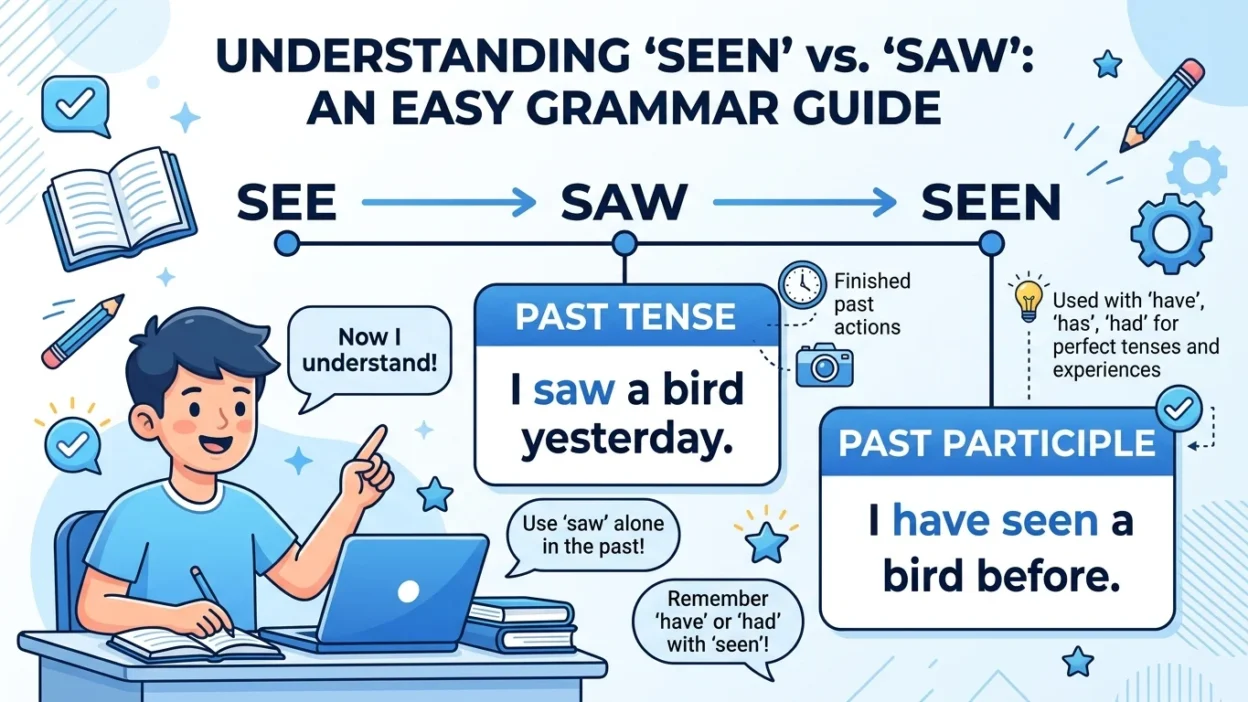
- Saw is the simple past tense of see.
- Seen is the past participle of see.
- Use saw by itself when talking about something in the past.
- Use seen with helping verbs such as:
- have
- has
- had
- was
- were
- be
- been
Examples
✅ I saw a movie yesterday.
✅ I have seen that movie before.
❌ I seen a movie yesterday.
❌ I have saw that movie before.
Origin and Background of the Words
The verb see is one of the oldest words in the English language. People have used it for hundreds of years to talk about looking at something with their eyes or noticing something.
Like many common English verbs, see changes its form depending on the tense.
Here are its main forms:
| Verb Form | Word |
| Base Form | see |
| Present Form | see/sees |
| Past Form | saw |
| Past Participle | seen |
| -ing Form | seeing |
Because English uses different verb forms for different situations, both saw and seen are needed.
The Difference Between Seen and Saw
The easiest way to remember the difference is this:
Use “Saw” for Simple Past
Use saw when talking about something that happened in the past.
Examples
- I saw a bird this morning.
- She saw her friend at the store.
- We saw the game last night.
- They saw a rainbow after the rain.
In each sentence, saw works alone. No helping verb is needed.
Use “Seen” With a Helping Verb
Use seen when it follows a helping verb.
Common helping verbs include:
- have
- has
- had
- be
- been
- was
- were
Examples
- I have seen that movie.
- She has seen the report.
- We had seen the problem before.
- They were seen leaving the building.
Notice that seen never stands alone in these examples.
A Simple Rule
Ask yourself:
Is there a helping verb before the word?
- Yes → use seen
- No → use saw
Comparison Table
| Feature | Saw | Seen |
| Verb type | Past tense | Past participle |
| Can stand alone? | Yes | No |
| Needs a helping verb? | No | Yes |
| Used for simple past actions? | Yes | No |
| Used with have/has/had? | No | Yes |
| Example | I saw a dog. | I have seen a dog. |
Side by Side Examples
| Correct Use of Saw | Correct Use of Seen |
| I saw him yesterday. | I have seen him before. |
| She saw the message. | She has seen the message. |
| We saw the accident. | We had seen the accident. |
| They saw the stars. | They have seen the stars. |
Which One Should You Use and When?
Use “Saw” When Talking About a Finished Past Action
Choose saw when something happened at a specific time in the past.
Examples
- I saw him yesterday.
- She saw the announcement last week.
- We saw a beautiful sunset last evening.
Words such as yesterday, last week, last year, and earlier today often appear with saw.
Use “Seen” After Helping Verbs
Choose seen when using perfect tenses or passive structures.
Examples
- I have seen that photo.
- She has seen the results.
- We had seen similar problems before.
- He was seen entering the room.
Memory Trick
Think of this simple sentence:
Have = Seen
If you see have, has, or had, the correct word is usually seen.
- Have seen ✅
- Has seen ✅
- Had seen ✅
Never write:
- Have saw ❌
- Has saw ❌
- Had saw ❌
Common Mistakes People Make
Many learners make the same errors when using these words.
Mistake 1: Using Seen Without a Helping Verb
❌ I seen your message.
✅ I saw your message.
✅ I have seen your message.
Mistake 2: Using Saw After Have, Has, or Had
❌ I have saw that movie.
✅ I have seen that movie.
❌ She has saw the report.
✅ She has seen the report.
Mistake 3: Mixing Past Tenses
❌ We had saw the problem before.
✅ We had seen the problem before.
Mistake 4: Copying Informal Speech
Sometimes people hear incorrect grammar in conversations and repeat it.
For example:
❌ I seen him yesterday.
This may be heard in some informal speech, but standard English uses:
✅ I saw him yesterday.
Everyday Real Life Examples
In Emails
- I saw your email this morning.
- I have seen your request and will reply soon.
- We have seen the attached document.
In News Reports
- Witnesses saw the event happen.
- The suspect was seen near the area.
- Officials have seen positive results.
On Social Media
- I saw your post today.
- Have you seen this video?
- I have seen this trend before.
In Daily Conversations
- I saw Sarah at the mall.
- Have you seen my keys?
- We saw a great restaurant.
- I have never seen snow before.
At School
- I saw the teacher after class.
- Have you seen the homework instructions?
- She has seen the new timetable.
Learning Section for Students and Beginners
A helpful way to learn is to practice with the forms of the verb see.
Remember This Pattern
| Tense | Example |
| Present | I see |
| Past | I saw |
| Perfect | I have seen |
| Past Perfect | I had seen |
Fill in the Blank Practice
- I _____ a cat yesterday.
- She has _____ that book.
- We _____ the game last night.
- They had _____ the problem before.
Answers
- saw
- seen
- saw
- seen
Easy Formula
- Yesterday = saw
- Last week = saw
- Have = seen
- Has = seen
- Had = seen
This formula helps many learners avoid mistakes.
Frequently Asked Questions (FAQ)
Is “I seen” correct?
Usually, no. In standard English, you should say:
- I saw it yesterday.
- I have seen it before.
Is “I have saw” correct?
No.
The correct sentence is:
- I have seen it.
Why can’t I use seen by itself?
Because seen is a past participle and normally needs a helping verb.
Which is correct: “Have you saw?” or “Have you seen?”
The correct form is:
- Have you seen?
Is “saw” present tense?
No.
Saw is the past tense of see.
What is the past participle of see?
The past participle is seen.
Which word is used with “had”?
Use seen.
Example:
- I had seen that movie before.
How can I remember the difference easily?
Remember this rule:
- No helping verb = saw
- Helping verb present = seen
Conclusion
The difference between seen and saw is much easier than many learners think. Saw is the simple past form and is used by itself to describe something that happened in the past. Seen is the past participle and must usually be used with a helping verb such as have, has, or had.
A quick way to remember is:
- I saw it yesterday.
- I have seen it before.
If there is no helping verb, use saw. If there is a helping verb, use seen. Following this simple rule will help you use both words correctly and confidently in everyday English.