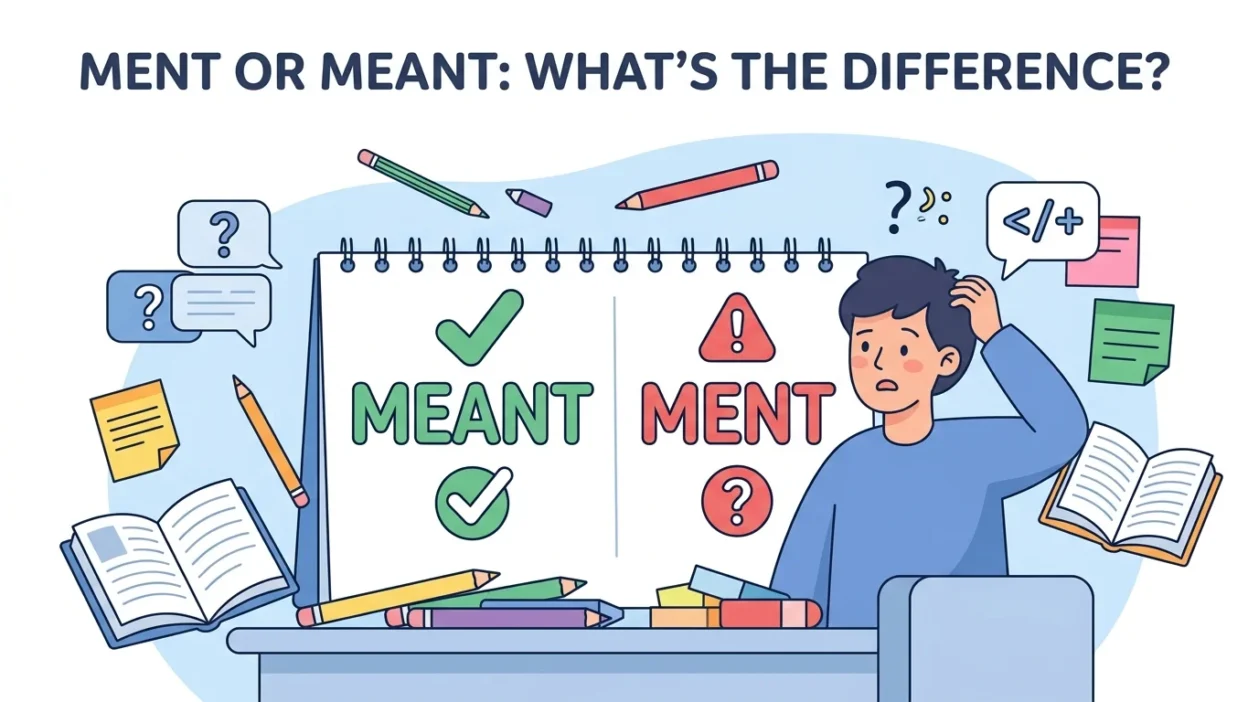
Many English learners get confused between “ment” and “meant” because the two words sound very similar. When people speak quickly, they can almost sound the same.
Another reason is that one of them is a real word, while the other is usually just a word ending used in English. This makes learners wonder:
- Is “ment” a word?
- Is “meant” correct?
- When should I use each one?
- Why do they sound alike but mean different things?
The good news is that the difference is actually very simple once you understand it clearly.
Quick Answer
- Meant is a real English word.
- Meant is the past tense of “mean.”
- Example:
- “I meant to call you yesterday.”
- Ment by itself is usually not used as a normal English word.
- -ment is mostly a suffix added to other words.
- Examples:
- enjoyment
- movement
- agreement
Easy way to remember:
- Meant = action word (verb)
- -ment = ending added to words
Simple Origin or Background Explanation
To understand the difference better, it helps to know where these forms come from.
What is “meant”?
“meant” comes from the verb mean.
The verb “mean” can have different uses:
- to intend something
- to explain something
- to represent something
Examples:
When we talk about the past, “mean” changes to meant.
Example:
- Present: “I mean it.”
- Past: “I meant it.”
What is “-ment”?
“-ment” is not usually a standalone word.
It is a suffix, which means it is added to the end of other words to create nouns.
Examples:
| Verb | Word with -ment |
| enjoy | enjoyment |
| develop | development |
| move | movement |
| agree | agreement |
These new words usually describe:
- an action
- a result
- a condition
Clear Explanation of the Difference
The biggest difference is this:
“Meant” is a complete word
You can use it alone in a sentence.
Example:
- “I meant to help you.”
Here, “meant” shows an action in the past.
“-ment” is only a word ending
You normally cannot use “ment” by itself.
Wrong:
- “I got a ment.”
Correct:
- “I got an agreement.”
The “-ment” part only helps build another word.
Think of it this way
Meant
- works like a verb
- shows past meaning or intention
- can stand alone
Example:
- “She meant every word.”
-ment
- helps create nouns
- cannot usually stand alone
- appears at the end of words
Example:
- “Her achievement made everyone proud.”
Comparison
| Feature | Meant | -ment |
| Type | Verb | Suffix |
| Complete word? | Yes | Usually no |
| Used alone? | Yes | No |
| Main use | Past form of “mean” | Creates nouns |
| Example | “I meant to text you.” | “improvement” |
| Shows | Intention or meaning | Action or result |
| Common in speaking? | Yes | Seen inside many words |
Which One to Use and When
Use “meant” when talking about the past
Use it when someone intended something or wanted to say something.
Examples:
- “I meant to study last night.”
- “She meant well.”
- “What did you mean?”
- “I meant every word.”
Use “-ment” inside nouns
Use it when the word naturally ends in “-ment.”
Examples:
- payment
- movement
- treatment
- excitement
Notice that “-ment” is only one part of the full word.
Quick test
Ask yourself:
Can the word stand alone?
If yes, it may be meant.
Example:
- “I meant that.”
If no, it is probably the suffix -ment.
Example:
- “development” → only part of the word
Common Mistakes People Make
Mistake 1: Writing “ment” instead of “meant”
Wrong:
- “I ment to call you.”
Correct:
- “I meant to call you.”
This is one of the most common spelling mistakes in English.
Why does it happen?
Because “meant” sounds unusual when spelled.
Mistake 2: Thinking “ment” is a normal word
Some learners believe “ment” works like “went” or “sent.”
But in normal English, it usually does not.
Wrong:
- “He gave me a ment.”
Correct:
- “He gave me a comment.”
- “He gave me an assignment.”
Mistake 3: Forgetting that “meant” is past tense
Wrong:
- “I meant this right now.”
Better:
- “I mean this right now.”
Use “meant” only for the past.
Mistake 4: Confusing pronunciation with spelling
English spelling is not always simple.
These words sound similar:
- meant
- ment
But only “meant” is the correct verb spelling.
Everyday Real Life Examples
Emails
- “I meant to reply earlier.”
- “Sorry, I meant Friday, not Thursday.”
News
- “The president meant that the rule would change next year.”
- “The statement meant a lot to the public.”
Social Media
- “I meant this as a joke.”
- “She meant no disrespect.”
Daily Conversations
- “What did you mean?”
- “I never meant to hurt you.”
- “He meant well.”
School and Study
Words with “-ment” are very common in school English.
Examples:
- assignment
- improvement
- achievement
- encouragement
Sentence examples:
- “My teacher praised my improvement.”
- “Finishing the project was a big achievement.”
Short Learning Section for Students and Beginners
Easy Memory Trick
Remember this:
MEANT = Mean + Past
If something already happened, use “meant.”
Example:
- “I meant to help.”
-MENT = Word Ending
If it is attached to another word, it is probably the suffix.
Examples:
- enjoyment
- treatment
- movement
Small Practice
Choose the correct word.
- “I ___ to send the file.”
- meant ✅
- “Her improve___ was amazing.”
- improvement ✅
- “They ___ no harm.”
- meant ✅
- “The agree___ was signed.”
- agreement ✅
Beginner Tip
If you see:
- intention
- apology
- explanation
You probably need meant.
If you see:
- nouns
- results
- actions turned into things
You probably need a word ending in -ment.
FAQ
Is “ment” a real English word?
Usually no. It is mostly a suffix added to other words.
Is “meant” correct English?
Yes. “Meant” is the past tense of “mean.”
Example:
- “I meant what I said.”
Why do people write “ment” instead of “meant”?
Because the pronunciation sounds similar in fast speech.
What does “meant” mean?
It usually shows:
- intention
- purpose
- meaning in the past
Example:
- “I meant to help.”
Can “ment” stand alone?
Normally no.
It is usually attached to another word:
- development
- movement
- agreement
Is “I ment to call you” correct?
No.
Correct sentence:
- “I meant to call you.”
What part of speech is “meant”?
It is a verb.
More specifically, it is the past tense of “mean.”
What part of speech is “-ment”?
It is a suffix used to create nouns.
Conclusion
The difference between “ment” and “meant” becomes very easy once you know their roles in English.
- Meant is a real word and the past form of “mean.”
- -ment is usually just a suffix added to other words.
Remember:
- “I meant to help.” ✅
- “I ment to help.” ❌
And:
- agreement
- enjoyment
- movement
all use the suffix -ment.
If you keep this simple idea in mind, you will avoid one of the most common English spelling mistakes and feel much more confident when writing and speaking English.