Many English learners feel confused when they see both “realized” and “realised.” One spelling appears in American books and websites, while the other is common in British writing. This makes people wonder:
- Which one is correct?
- Is one wrong?
- Which spelling should students use in school or exams?
The good news is simple: both words are correct. The difference is mainly about the type of English being used.
This guide explains everything in very easy English so you can understand the difference clearly and use the correct spelling with confidence.
Quick Answer
Here is the simple answer:
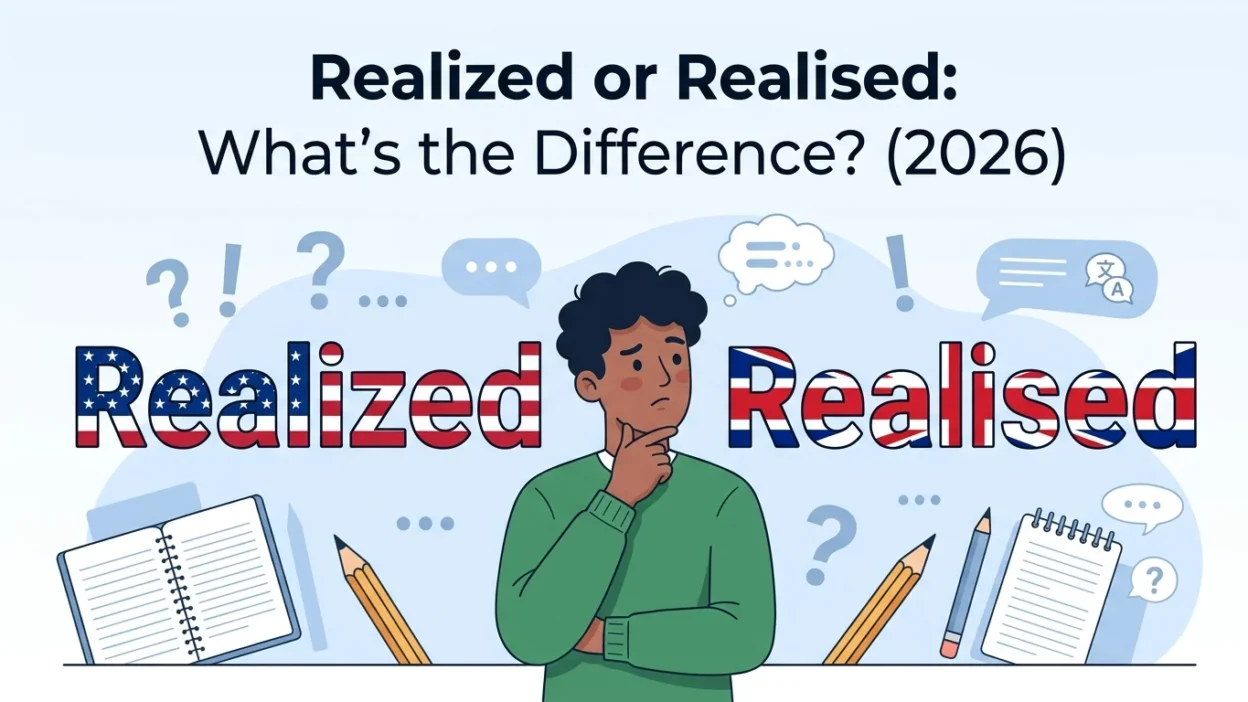
- Realized = American English spelling
- Realised = British English spelling
- Both words have the same meaning
- Both are grammatically correct
- You should choose one style and stay consistent
Example
- American English: I realized I forgot my keys.
- British English: I realised I forgot my keys.
Both sentences mean exactly the same thing.
Simple Background of the Word
The word comes from the verb “realize” or “realise,” which means:
- to understand something
- to become aware of something
- to notice something clearly
Examples
- She realized the answer was wrong.
- He realised he was late.
English has different spelling styles in different countries. This is why some words use -ize and others use -ise.
This happens with many words, not only “realize.”
Other Examples
| American English | British English |
| organize | organise |
| recognize | recognise |
| apologize | apologise |
So, “realized” and “realised” follow the same spelling pattern.
What Is the Difference Between Realized and Realised?
The main difference is the type of English.
Realized
“Realized” is mainly used in:
- the United States
- American schools
- American newspapers
- American websites
It uses the -ized ending.
Realised
“Realised” is mainly used in:
- the United Kingdom
- some British schools
- British newspapers
- countries that follow British English
It uses the -ised ending.
Important Point
Only the spelling changes.
Comparison
Here is an easy table to understand the difference quickly.
| Feature | Realized | Realised |
| English style | American English | British English |
| Meaning | Same | Same |
| Grammar | Correct | Correct |
| Pronunciation | Same | Same |
| Used in the US | Very common | Rare |
| Used in the UK | Less common | Very common |
| Changes the meaning? | No | No |
Which One Should You Use?
The answer depends on where you are writing and who will read your work.
Use “Realized” If:
- you are using American English
- your school follows American spelling
- you are writing for US readers
- you are using American textbooks
Use “Realised” If:
- you are using British English
- your school follows British spelling
- you are writing for UK readers
- your exam uses British English
Most Important Rule
Be consistent.
Do not mix both styles in the same piece of writing.
Incorrect Example
- She realised the truth and apologized later.
This mixes British and American spelling.
Better Examples
British style:
- She realised the truth and apologised later.
American style:
- She realized the truth and apologized later.
Why Do People Get Confused?
There are several reasons.
1. Internet Content Comes From Many Countries
People read articles, videos, and posts from around the world. One website may use American English, while another uses British English.
2. Schools Teach Different Styles
Some schools teach British English, while others teach American English.
3. Both Spellings Are Correct
Usually, learners expect only one correct spelling. Seeing two correct versions feels confusing.
4. Spell Checkers Change the Word
Phones and computers often change spelling automatically based on language settings.
For example:
- US keyboard → realized
- UK keyboard → realised
Common Mistakes People Make
Here are mistakes learners often make.
Mixing Both Styles
This is the most common mistake.
Example
- I realised my mistake and apologized.
One word is British and the other is American.
Try to keep the same style throughout your writing.
Thinking One Spelling Is Wrong
Some learners think “realised” is incorrect because they mostly see “realized” online.
Others think the opposite.
Remember:
- Both are correct
- The difference is regional
Using the Wrong Style in Exams
Some students switch styles during tests or assignments.
Teachers may mark this as inconsistent writing.
Choose one style before you begin writing.
Pronouncing Them Differently
The pronunciation is usually the same.
Most people say both words like this:
- ree-uh-lized
The spelling changes, but the sound usually does not.
Everyday Real Life Examples
Here are simple examples from daily life.
In Emails
American English:
- I realized I sent the wrong file.
British English:
- I realised I sent the wrong file.
In News Writing
American style:
- Police realized the report was false.
British style:
- Police realised the report was false.
On Social Media
- Just realized it’s already Friday!
- Just realised it’s already Friday!
Both are normal depending on the writer’s country.
In School Writing
American:
- The student realized the answer after class.
British:
- The student realised the answer after class.
In Daily Conversation Writing
- I realized I left my phone at home.
- She realised nobody was listening.
Easy Memory Trick
Here is a simple trick to remember the difference.
Think About the Letter “Z”
- American English often likes z
- British English often uses s
So:
- realized → American English
- realised → British English
This trick also works for:
- organize / organise
- recognize / recognise
Short Learning Section for Students and Beginners
If you are learning English, follow these easy tips.
Choose One English Style
Pick either:
- American English
or - British English
Using one style helps your writing look cleaner and more professional.
Check Your Textbook
Your school books usually follow one English style.
Use the same spelling style in homework and exams.
Change Device Language Settings
Your phone or computer spell checker can help.
Choose:
- English (US)
or - English (UK)
This helps avoid spelling confusion.
Read More in One Style
If you mostly read American books, “realized” will feel natural.
If you mostly read British books, “realised” will feel natural.
Reading regularly helps you learn faster.
FAQ
Is “realized” correct?
Yes. “Realized” is correct in American English.
Is “realised” correct?
Yes. “Realised” is correct in British English.
Do both words mean the same thing?
Yes. They have exactly the same meaning.
Which spelling is more common?
“Realized” is more common in American English online content, while “realised” is common in British English writing.
Can I use both spellings in one article?
It is better not to mix them. Choose one style and stay consistent.
Which spelling should students use?
Students should follow the English style used by their school, teacher, or exam system.
Is the pronunciation different?
Usually, no. Most people pronounce both words the same way.
Why does my phone change the spelling?
Your keyboard or language settings may be set to American or British English.
Conclusion
The difference between “realized” and “realised” is simple once you understand it.
- Realized is the American English spelling
- Realised is the British English spelling
- Both are correct
- Both mean the same thing
The most important thing is consistency. If you start writing in American English, keep using American spelling. If you use British English, stay with British spelling throughout your writing.
Once you know this rule, the confusion becomes much easier to handle.