
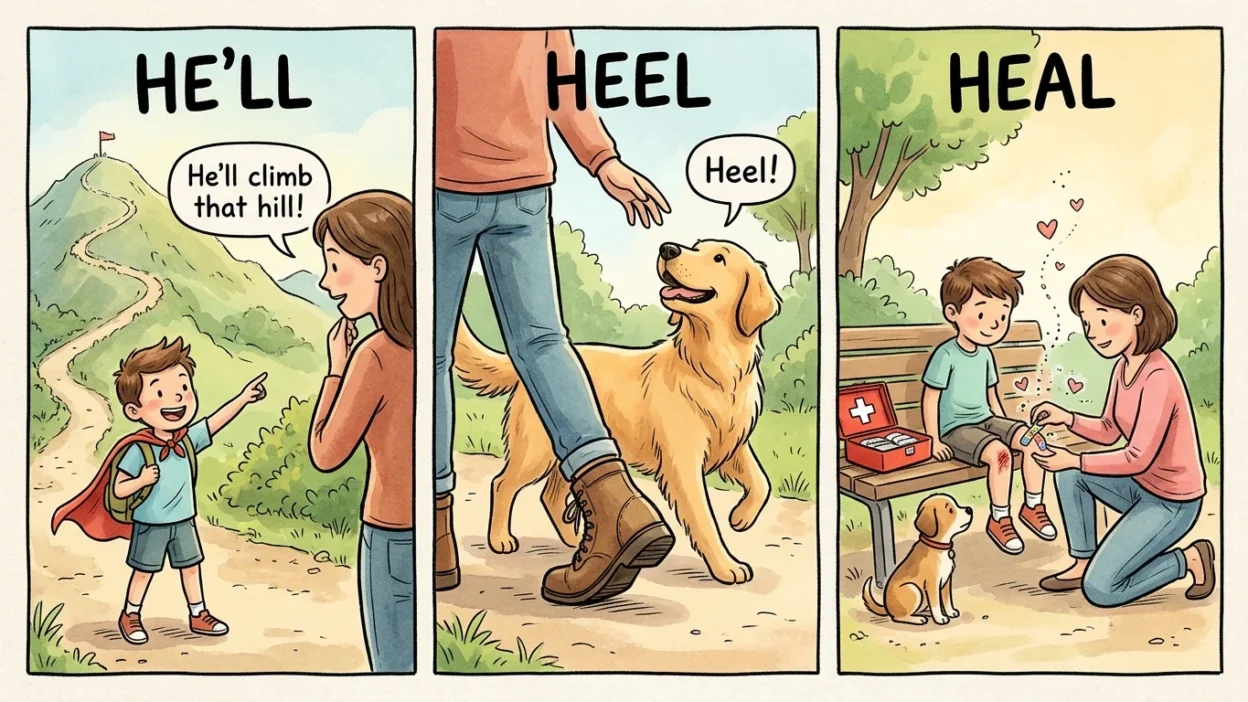
English has many words that sound exactly the same but have different meanings and spellings. He’ll, heel, and heal are three common examples. Although they sound alike, each word has a different purpose in a sentence. Understanding the difference between these words can help you improve your spelling, grammar, vocabulary, and everyday communication.
The main difference is simple: he’ll is a contraction of “he will,” heel refers to the back part of a foot or shoe, and heal means to become healthy again or recover from an injury. These words are called homophones because they share the same pronunciation but have different meanings. Whether you are writing an email, completing an English assignment, or improving your vocabulary, knowing when to use each word will help you avoid common mistakes.
Quick Answer: What Is the Difference Between He’ll, Heel, and Heal?
He’ll, heel, and heal sound alike but have different meanings. He’ll means “he will” and describes a future action. Heel is the back part of your foot or a shoe. Heal means to recover from an injury, illness, or emotional pain. Their correct use depends on the meaning of the sentence.
Why Do People Confuse He’ll, Heel, and Heal?
People often confuse these three words because they have the same pronunciation in standard English. When spoken aloud, they sound like “heel,” making it difficult to identify which spelling is correct without understanding the context.
Another reason is that English contains many homophones. These are words that sound the same but have different spellings and meanings.
For example:
- He’ll: He’ll visit us tomorrow.
- Heel: My heel hurts after walking.
- Heal: The wound will heal soon.
All three sentences sound similar when spoken, but each communicates a different idea.
The easiest way to avoid confusion is to understand the meaning and grammatical function of each word.
First Word: What Does He’ll Mean?
He’ll is a contraction of the words “he will” or, in some contexts, “he shall.” It is commonly used in everyday English to talk about something a male person is expected, willing, or planning to do in the future.
The apostrophe replaces the missing letters in the contraction. Instead of writing “he will,” English speakers often write “he’ll” to make sentences shorter and more natural.
Examples of He’ll in Sentences
- He’ll arrive at the office before noon.
- He’ll help you with your homework.
- He’ll call his mother tonight.
- He’ll become a successful teacher.
- He’ll finish the project tomorrow.
In each example, “he’ll” means “he will.”
When Should You Use He’ll?
Use he’ll when you want to describe a future action, decision, promise, or prediction involving a male person.
For example:
- Future action: He’ll travel to London next week.
- Promise: He’ll always support his family.
- Prediction: He’ll probably win the competition.
- Offer: He’ll carry your bags for you.
Remember: If you can replace “he’ll” with “he will” and the sentence still makes sense, you are probably using it correctly.
Second Word: What Does Heel Mean?
Heel is a noun that refers to the back part of the human foot, just below the ankle. It can also describe the raised back part of a shoe.
The word is commonly used when discussing footwear, walking, running, foot pain, and body parts.
Different Meanings of Heel
1. The back part of the foot
The heel is the rounded area at the bottom of your foot that touches the ground when you stand or walk.
Example: My heel hurts after running for an hour.
2. The back part of a shoe
A heel is the raised section underneath the back of a shoe. Some shoes have high heels, while others have flat heels.
Example: She bought a pair of shoes with comfortable heels.
3. A person’s behavior
In informal English, “heel” can also describe a cruel, dishonest, or unpleasant person.
Example: He treated his friends badly, so everyone considered him a heel.
Examples of Heel in Sentences
- My left heel hurts when I walk.
- She wore black high heels to the party.
- The back of my shoe rubbed against my heel.
- He injured his heel while playing football.
- The dog stayed close to its owner’s heel.
- These shoes have soft leather heels.
When Should You Use Heel?
Use heel when talking about the back part of a foot, the raised part of a shoe, or certain expressions involving the word.
Common expressions include:
- High heels: Shoes with raised heels.
- Achilles’ heel: A person’s main weakness.
- Heel of the foot: The back part of the foot.
- Heel of a shoe: The raised or supporting back section of footwear.
- At someone’s heels: Following someone closely.
Third Word: What Does Heal Mean?
Heal is a verb that means to become healthy again after an injury, illness, or emotional difficulty. It can describe physical recovery as well as emotional and spiritual recovery.
For example, when someone gets a cut, their skin gradually repairs itself. This process is called healing.
The word can also describe recovering from sadness, disappointment, grief, or painful experiences.
Different Meanings of Heal
1. Physical recovery
Heal describes the process of recovering from a physical injury or illness.
Example: The small cut on my hand will heal in a few days.
2. Emotional recovery
Heal can describe becoming emotionally stronger after a difficult experience.
Example: She needs time to heal after losing her loved one.
3. Restoring relationships
The word can also describe repairing damaged relationships or resolving disagreements.
Example: Honest communication can help heal a broken friendship.
4. Spiritual recovery
In religious and spiritual contexts, healing can refer to finding peace, comfort, and renewed strength.
Example: Prayer helped him heal emotionally during a difficult time.
Examples of Heal in Sentences
- Your wound will heal with proper care.
- Time can help heal emotional pain.
- The doctor said my broken bone would heal.
- Kind words can help heal a troubled relationship.
- Her heart needs time to heal.
- The skin will heal naturally over time.
When Should You Use Heal?
Use heal when discussing recovery, improvement, or the process of becoming healthy again.
Common expressions include:
- Heal a wound: Help an injury recover.
- Heal emotionally: Recover from emotional pain.
- Heal naturally: Recover without a specific intervention.
- Healing process: The process of becoming healthy again.
- Time heals: Time can help people recover emotionally.
He’ll vs. Heel vs. Heal: Comparison Table
The following table explains the important differences between these three commonly confused words.
| Word | Meaning | Part of Speech | Example |
| He’ll | He will | Contraction | He’ll come tomorrow. |
| Heel | Back part of the foot or shoe | Noun | My heel hurts. |
| Heal | To recover or become healthy | Verb | The wound will heal. |
Key Differences at a Glance
- He’ll is used for future actions.
- Heel refers to a body part or footwear.
- Heal describes recovery from physical or emotional pain.
Although these words sound the same, their spelling and meanings are completely different.
When Should You Use He’ll, Heel, or Heal?
Choosing the correct word becomes easier when you focus on what you want to communicate.
Use He’ll for Future Actions
Choose “he’ll” when you mean “he will.”
Examples:
- He’ll visit his grandparents.
- He’ll complete the assignment.
- He’ll be happy to see you.
Use Heel for Feet and Shoes
Choose “heel” when discussing the back part of a foot or shoe.
Examples:
- My heel is swollen.
- Her shoes have high heels.
- The heel of his boot is damaged.
Use Heal for Recovery
Choose “heal” when describing the process of getting better.
Examples:
- The injury will heal.
- She needs time to heal.
- Their relationship may heal with patience.
15 Examples of He’ll, Heel, and Heal in Sentences
Here are 15 practical examples to help you understand how these words work in everyday English.
Examples Using He’ll
- He’ll bring his books to school tomorrow.
- He’ll explain the lesson to the students.
- He’ll visit his uncle next weekend.
- He’ll finish his work before dinner.
- He’ll call you when he arrives.
Examples Using Heel
- My heel hurts after wearing tight shoes.
- She prefers comfortable shoes without high heels.
- The dog walked closely at his owner’s heel.
- The heel of my shoe broke yesterday.
- An Achilles’ heel is a person’s weakness.
Examples Using Heal
- The doctor believes the injury will heal soon.
- It takes time to heal after a painful experience.
- Rest can help your body heal.
- They worked together to heal their friendship.
- Her emotional wounds slowly began to heal.
Common Mistakes When Using He’ll, Heel, and Heal
Even fluent English speakers sometimes make spelling mistakes with homophones. Understanding these common errors can help you write more accurately.
Mistake 1: Using Heal Instead of Heel
Incorrect: My heal hurts when I walk.
Correct: My heel hurts when I walk.
Explanation: You are talking about a part of your foot, so “heel” is correct.
Mistake 2: Using Heel Instead of Heal
Incorrect: The doctor said my injury would heel soon.
Correct: The doctor said my injury would heal soon.
Explanation: The sentence describes recovery from an injury, so you need the verb “heal.”
Mistake 3: Using Heel Instead of He’ll
Incorrect: Heel come to the meeting tomorrow.
Correct: He’ll come to the meeting tomorrow.
Explanation: The sentence describes a future action. “He’ll” means “he will.”
Mistake 4: Writing He Will Incorrectly
Incorrect: Heel finish the work tomorrow.
Correct: He’ll finish the work tomorrow.
Explanation: Use the contraction “he’ll” when you mean “he will.”
Mistake 5: Forgetting the Apostrophe
Incorrect: Hell visit us tomorrow.
Correct: He’ll visit us tomorrow.
Explanation: The apostrophe is important because it shows that letters have been removed from “he will.” Without it, the spelling creates a different word.
Easy Memory Trick to Remember He’ll, Heel, and Heal
A simple memory trick can help you remember all three words without confusion.
- He’ll = He will: Remember that the apostrophe connects the contraction to the missing letters in “will.”
- Heel = Feet: The word “heel” contains two letter E’s, just like the word “feet.” Both relate to the body and walking.
- Heal = Health: Both “heal” and “health” begin with the letters “hea,” which can remind you of recovery and well-being.
A Simple Sentence to Remember All Three
He’ll hurt his heel, but it will heal.
This sentence includes all three words and demonstrates their different meanings:
- He’ll: He will.
- Heel: The back part of his foot.
- Heal: Recover from an injury.
Read this sentence a few times to remember the correct spelling and meaning of each word.
American vs. British English: Are He’ll, Heel, and Heal Different?
There is no significant spelling difference between American and British English for these three words.
Both varieties use the same spellings and meanings:
| Word | American English | British English |
| He’ll | He’ll arrive soon. | He’ll arrive soon. |
| Heel | My heel hurts. | My heel hurts. |
| Heal | The wound will heal. | The wound will heal. |
The pronunciation is also generally the same in both varieties. All three words are pronounced alike, although individual accents may vary slightly.
Therefore, you do not need to change their spelling when writing for American or British readers.
Similar Words: Other Commonly Confused Homophones
English has many words that sound alike but have different spellings and meanings. Learning these examples can improve your vocabulary and writing skills.
| Word Pair | Difference | Example |
| There / Their | Place / Belonging to them | Their house is over there. |
| Your / You’re | Belonging to you / You are | You’re holding your book. |
| To / Too | Direction / Also or excessively | I want to go too. |
| Hear / Here | Listen / In this place | Come here so I can hear you. |
| Break / Brake | Damage or separate / Stop a vehicle | Press the brake before the break in the road. |
| Right / Write | Correct or direction / Put words on paper | Write the right answer. |
| Peace / Piece | Calm / A part of something | I want a piece of peace and quiet. |
| Weak / Week | Not strong / Seven days | He felt weak for a week. |
Just like he’ll, heel, and heal, these words require attention to their meanings and sentence contexts.
Final Verdict: He’ll vs. Heel vs. Heal
He’ll, heel, and heal are homophones that sound alike but serve different purposes in English.
- He’ll is a contraction meaning “he will” and is used for future actions.
- Heel is a noun that refers to the back part of a foot or shoe.
- Heal is a verb meaning to recover from an injury, illness, or emotional difficulty.
The best way to choose the correct word is to understand the message of your sentence. If you are talking about a future action, use “he’ll.” If you mean a foot or shoe, use “heel.” If you mean recovery, use “heal.”
Frequently Asked Questions (FAQs)
1. What is the difference between he’ll, heel, and heal?
He’ll means “he will,” heel refers to the back part of a foot or shoe, and heal means to recover from an injury or emotional pain. All three words sound the same but have different spellings and meanings.
2. Are he’ll, heel, and heal homophones?
Yes, he’ll, heel, and heal are homophones. They have the same pronunciation in standard English but different spellings, meanings, and grammatical uses.
3. Is heel a body part or a shoe part?
Heel can refer to both. It is the back part of the human foot and the raised section at the back of a shoe.
4. Does heal mean to get better?
Yes. Heal means to recover or become healthy again after an injury, illness, or emotional difficulty. It can describe both physical and emotional recovery.
5. What does he’ll stand for?
He’ll is a contraction of “he will.” It is commonly used to describe a future action, promise, prediction, or decision.
Example: He’ll visit us tomorrow.
6. How can I remember the difference between heel and heal?
Remember that “heel” relates to feet and footwear, while “heal” relates to health and recovery. The extra letter A in “health” can help you connect healing with becoming healthy again.
7. Do he’ll, heel, and heal sound the same?
Yes. In standard English pronunciation, all three words sound like “heel.” Their meanings can only be understood through their spelling and the context of a sentence.
8. Which sentence is correct: My heel hurts or my heal hurts?
“My heel hurts” is correct because the sentence refers to the back part of your foot. “Heal” is a verb that describes recovery, so it cannot replace “heel” in this sentence.
Remember This
Keep these three simple definitions in mind:
- He’ll = He will
- Heel = Foot or shoe
- Heal = Recover or get better
For example: He’ll rest because his heel hurts, and he hopes it will heal soon.
Understanding these simple differences will help you use all three words correctly in everyday English.
Conclusion
He’ll, heel, and heal may sound identical, but their meanings are very different. He’ll is used when talking about future actions, heel refers to the back part of a foot or shoe, and heal describes the process of recovering from physical or emotional difficulties. Learning these differences makes English spelling and communication easier.
The easiest way to remember these words is to connect each spelling with its meaning. Think of “he’ll” as “he will,” “heel” as a part of your foot, and “heal” as becoming healthy again. With regular practice and simple sentence examples, you can avoid common mistakes and use these homophones confidently.