Till is the standard choice and the grammatically correct spelling in the English language. It is an accepted word, has the exact same meaning as until, and has been used for centuries. In fact, till predates until, making it a fully accepted form in both casual conversation and formal writing.
A simple example is, “Wait till I return” or “I am working until 5 PM today.” While many people use til as a casual shortening, most style guides, dictionaries, editors, and teachers consider til a non standard spelling. If you are in doubt, a good rule of thumb is to choose till for everyday use and until for more formal situations.
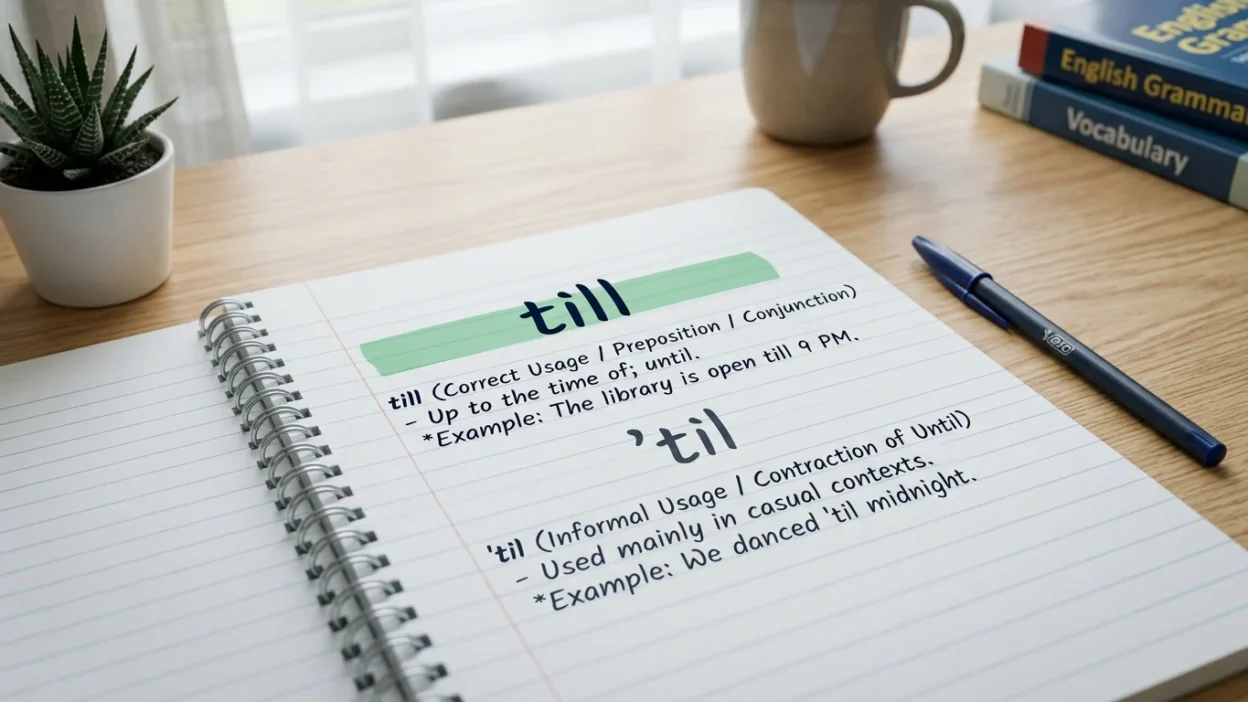
The form ’til is a contraction with a leading apostrophe and is often seen in casual writing, song lyrics, and marketing phrases, but it is usually reserved for very informal contexts. When discussing the until vs till definition, the meaning remains identical because both words indicate a certain time, event, or condition that continues until something happens or ends. The main difference is style, tone, and audience expectations rather than grammar.
From my experience reviewing professional documents, academic writing, and business communication, the safest choice is until, while till sounds more natural, conversational, and relaxed in everyday speech. Understanding this common grammar topic helps writers communicate clearly, avoid mistakes, and choose the most appropriate word choice for any situation.
Quick Answer: Simple Explanation
Here is the easiest way to understand it:
- Till is the correct and standard word in English.
- Till means “until” or “up to a time.”
- ’Til is a short, informal form of “until.”
- Til (without an apostrophe) is usually considered incorrect in formal writing.
- Both “till” and “until” mean the same thing in meaning.
- “Till” is older than “until,” not the other way around.
👉 In short:
Use “till” in normal writing. Use “’til” only in informal or creative writing. Avoid “til” without an apostrophe.
Simple Origin or Background Explanation
To understand this better, let’s go back a little in history.
- The word “till” is very old in English.
- It existed even before the word “until.”
- Later, people started using “until” to make the meaning clearer and more formal.
- Because “until” became common in formal writing, people began thinking “till” was slang or incorrect. But that is not true.
Now here is something interesting:
- “Till” and “until” mean exactly the same thing.
- “Till” is not a short form of “until.”
- Instead, “until” came from “till” by adding “un-” at the beginning.
The form “’til” appeared later as a shortened, casual style used in writing like songs, poems, or informal messages.
Clear Explanation of the Difference
Now let’s understand the real difference in a very simple way.
“Till”
- Correct standard English word
- Means: up to a time or event
- Can be used in formal and informal writing
- Example: Wait till tomorrow.
“’Til”
- Informal short form of “until”
- Used in casual writing, songs, poems
- Always has an apostrophe at the beginning
- Example: I will wait ’til morning.
“Til”
- Usually considered incorrect in formal English
- Often a spelling mistake
- Missing the apostrophe makes it unclear
- Example (not recommended): I will wait til morning.
👉 Simple rule:
If you are writing an email, essay, or school work, always use “till.”
Comparison Table (Easy to Scan)
| Word | Meaning | Correct? | Usage Type | Example |
| till | until / up to | Yes | Formal + Informal | I will wait till 5 PM. |
| ’til | until (short) | Yes | Informal only | Stay here ’til I return. |
| til | same meaning | No | Not recommended | (Avoid using it) |
Which One to Use and When
Choosing the right word is actually very simple once you understand the rule.
Use “till” when:
- Writing essays or school assignments
- Sending emails
- Writing articles or reports
- Speaking in normal conversation
Use “’til” when:
- Writing songs or poetry
- Writing casual messages to friends
- Creating creative or emotional writing
Avoid “til” when:
- Writing anything formal
- Taking exams
- Writing professional content
👉 Best safe choice: “till” works everywhere.
Common Mistakes People Make
Many learners make small mistakes with these words. Let’s fix them:
Mistake: Thinking “till” is incorrect
- Wrong idea: “Till is slang.”
- Truth: “Till is correct English.”
Mistake: Using “til” without apostrophe
- Wrong: I will wait til Monday.
- Correct: I will wait ’til Monday.
- Better: I will wait till Monday.
Mistake: Overusing “’til” in formal writing
- It makes writing look informal or careless.
Mistake: Confusing meaning with “until”
- Some people think they are different.
- In reality, they mean the same thing.
Everyday Real Life Examples
Let’s see how these words are used in real life.
Emails
- Formal email:
Please wait till further notice. - Informal email:
I’ll be here ’til evening, let me know.
Social Media
- Can’t wait till summer vacation starts!
- Stay with me ’til the end of the video ❤️
Daily Conversations
- I will stay till 10 PM.
- She waited ’til her friend arrived.
News or Instructions
- The shop is open till 9 PM.
- This offer is valid till Sunday.
These examples show that “till” is more common in real life, while “’til” is more emotional or casual.
Short Learning Section for Students and Beginners
Here is a simple way to remember everything:
Easy Memory Trick
- Till = always safe
- ’Til = casual short form
- Til = avoid
One line rule:
👉 If you are not sure, always write till.
Quick practice:
Try filling in the blank:
- Wait ___ I come back.
- She stayed ___ midnight.
- I will study ___ evening.
Answers:
- till
- till or ’til (both possible, but “till” is best)
- till
FAQ: Simple Questions and Answers
Is “till” correct English?
Yes, “till” is completely correct and widely accepted in English.
Is “til” wrong?
Yes, “til” without an apostrophe is usually considered incorrect in formal writing.
What does “till” mean?
It means “until” or “up to a time.”
Is “’til” the same as “till”?
Yes, both mean the same thing, but “’til” is informal.
Which one should I use in exams?
Always use “till” or “until,” never “til.”
Is “till” old English?
Yes, it is actually older than “until.”
Can I use “’til” in essays?
No, it is better to avoid it in formal writing.
What is the safest choice?
“Till” is the safest and most universal option.
Conclusion
The confusion between “till” and “til” is very common, but it is actually simple to fix.
- “Till” is the correct and standard word.
- “’Til” is a casual, shortened form used in informal writing.
- “Til” without an apostrophe is best avoided.
Both “till” and “until” mean the same thing, so you are not learning a new meaning—just different styles of writing.
If you remember one simple rule, you will never get confused again:
👉 Use “till” in most situations, and you will always be correct.