I still remember the first time I saw Chili, Chilli, and Chile in a recipe book at a market near a farmer’s market stall, where a cook was preparing a spicy dish with a hot bowl of chili stew, meat and beans, and fresh chili peppers. At that moment, I noticed how US English, American English, British English, and Commonwealth English (used in Australia, New Zealand, India, and South Africa) all follow different spelling variation and regional dialect patterns, even though they refer to the same pepper plant, spicy pepper, or pepper pod.
The word has a deep linguistic origin from Spanish spelling, tracing back to Aztec, Nahuatl, and chīlli, showing strong language adoption, dialect differences, and language variation across regions like the United States, American Southwest, and New Mexico, especially in Tex Mex cuisine. I often notice in food culture, whether it is chili con carne, chili powder, chilli flakes, green chilli, red chilli, or even chilli sauce, that the usage, meaning, and context depend heavily on regional preference, writing style, and international writing rules, making it important to maintain consistency, clarity, and correct spelling rules for better communication and credibility.
Quick Answer: Simple Explanation
Here is the easiest way to understand the difference:
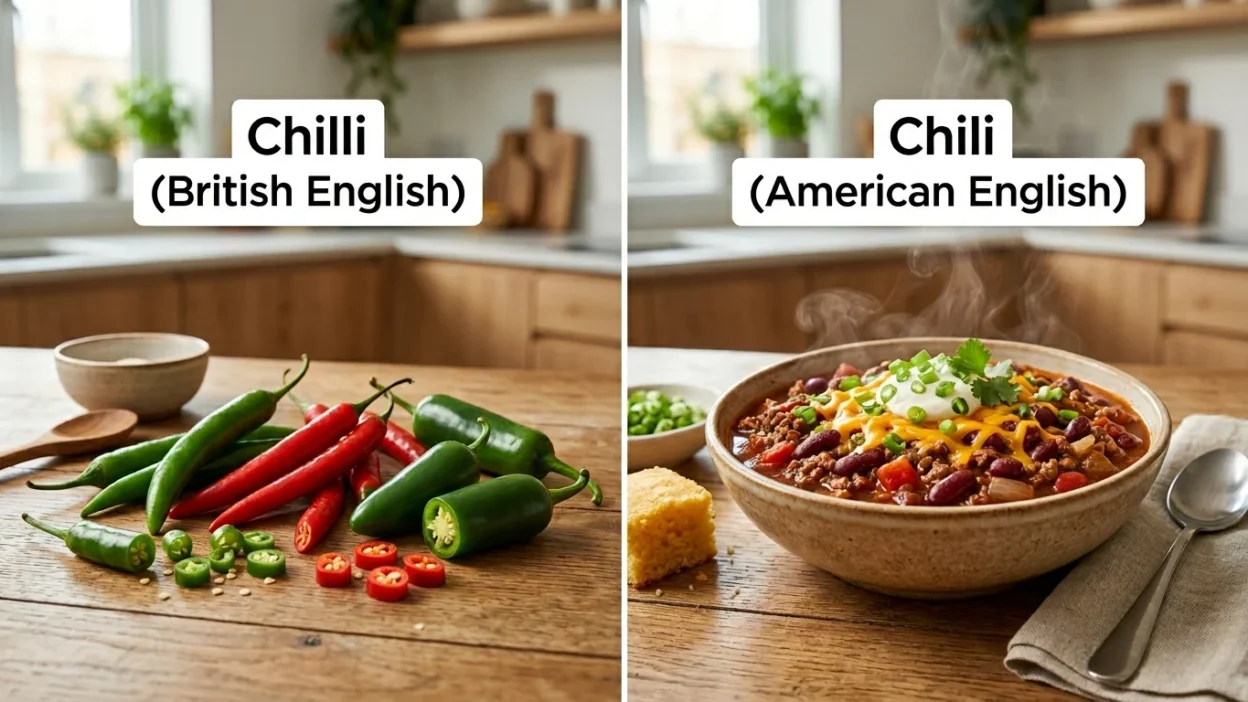
- Chilli is the British English spelling.
- Chili is the American English spelling.
- Both can mean a hot and spicy pepper.
- “Chili” can also mean a spicy meat dish, especially “chili con carne.”
- In most cases, they mean the same thing, just spelled differently.
So, the difference is mostly about spelling and usage, not meaning.
Simple Origin and Background
The word comes from a long history of languages and food culture.
The original word comes from the Nahuatl language (spoken in Mexico), where a spicy pepper was called something like “chilli.” When Spanish explorers came across it, they brought the word into European languages.
Later, English speakers adapted the word in different ways:
- In British English, it became “chilli.”
- In American English, it became “chili.”
Because English is used in many countries, both spellings became correct in their own regions.
Over time, the word also started to mean not only the pepper but also dishes made with it.
Clear Explanation of the Difference
The difference between “chilli” and “chili” is not about the food itself. It is about how English is written in different countries and how the word is used in cooking.
Chilli (British English Use)
In British English and countries that follow it (like India, Pakistan, and the UK), people usually write:
- chilli pepper
- green chilli
- red chilli sauce
Here, “chilli” mostly refers to the spicy pepper itself.
Chili (American English Use)
In American English, people write:
- chili pepper
- chili sauce
- chili powder
But there is an important extra meaning:
- Chili can also mean a cooked dish, usually made with meat, beans, and spices (like “chili con carne”).
So in American English, “chili” has a double meaning: pepper and dish.
Comparison Table (Easy to Understand)
| Feature | Chilli | Chili |
| English type | British English | American English |
| Main meaning | Spicy pepper | Spicy pepper + dish |
| Common usage countries | UK, Pakistan, India, etc. | USA, Canada |
| Food reference | Mostly vegetable/pepper | Pepper + cooked dish |
| Example phrase | green chilli | chili con carne |
| Meaning difference | Very small | Slightly wider use |
Which One to Use and When
Choosing between “chilli” and “chili” depends on where you are writing or speaking.
Use “Chilli” when:
- You are writing British English
- You are in countries like the UK, India, or Pakistan
- You are talking about fresh peppers
- You are writing school essays in British English style
Example:
- I added green chilli to the curry.
Use “Chili” when:
- You are writing American English
- You are talking about American recipes
- You mean the cooked dish (beans, meat, spices)
Example:
- We ate chili for dinner.
- Chili con carne is a popular dish in the US.
Common Mistakes People Make
Many learners mix these words in simple ways. Here are common mistakes:
Thinking they are different foods
Some people think chilli and chili are two different vegetables. That is wrong. They are the same thing.
Mixing spelling in one sentence
Example mistake:
- I added chilli powder and chili sauce.
This is confusing. It is better to choose one style depending on your English type.
Forgetting the dish meaning
Many learners do not know that “chili” can also be a dish in American English. So they only think it is a pepper.
Overthinking the difference
People sometimes think the words have deep differences. In reality, the difference is small and mostly about spelling style.
Everyday Real Life Examples
Let’s see how these words appear in daily life.
In Emails or Messages
- “Please add less chilli in the food today.”
- “Do you know how to make chili soup?”
In News or Articles
- “Farmers are growing more chilli this season due to high demand.”
- “A new chili recipe is becoming popular in restaurants.”
On Social Media
- “I love spicy food with extra chilli!”
- “Trying homemade chili for the first time!”
In Daily Conversations
- “This curry is too spicy because of the chilli.”
- “Let’s cook chili tonight.”
These examples show that both words are used naturally in everyday life.
Short Learning Section for Students and Beginners
If you are learning English, here is a simple way to remember:
- Think “chilli = British English”
- Think “chili = American English”
- Remember: both mean spicy pepper
- Only “chili” can also mean a dish in American English
Easy memory trick:
- “i” in chili = International (American English use)
- “ii” in chilli = British style double spelling
This simple trick can help you avoid confusion.
FAQ: Common Questions
Is chilli and chili the same thing?
Yes, they are the same spicy pepper. The difference is only spelling and usage.
Which spelling is correct?
Both are correct. It depends on British or American English.
Why do two spellings exist?
Because English changed differently in the UK and the US over time.
Does chili always mean food?
No. It can mean the pepper or a cooked dish in American English.
What is chili con carne?
It is a spicy dish made with meat, beans, and chili peppers.
Can I mix both spellings?
It is better not to mix them in one document. Choose one style.
Which spelling is used in Pakistan and India?
Mostly “chilli” (British English style).
Is chili very spicy?
It depends on the type. Some chilies are mild, others are very hot.
Conclusion: Simple Final Understanding
The difference between chilli and chili is actually very simple. They both come from the same spicy pepper, but the spelling changes depending on English style.
- Chilli is mostly used in British English.
- Chili is mostly used in American English.
- Both are correct and widely used.
- Only “chili” can also mean a cooked dish in American English.
Once you understand this small rule, you will never get confused again. You can now read menus, recipes, and English texts with more confidence and clarity.