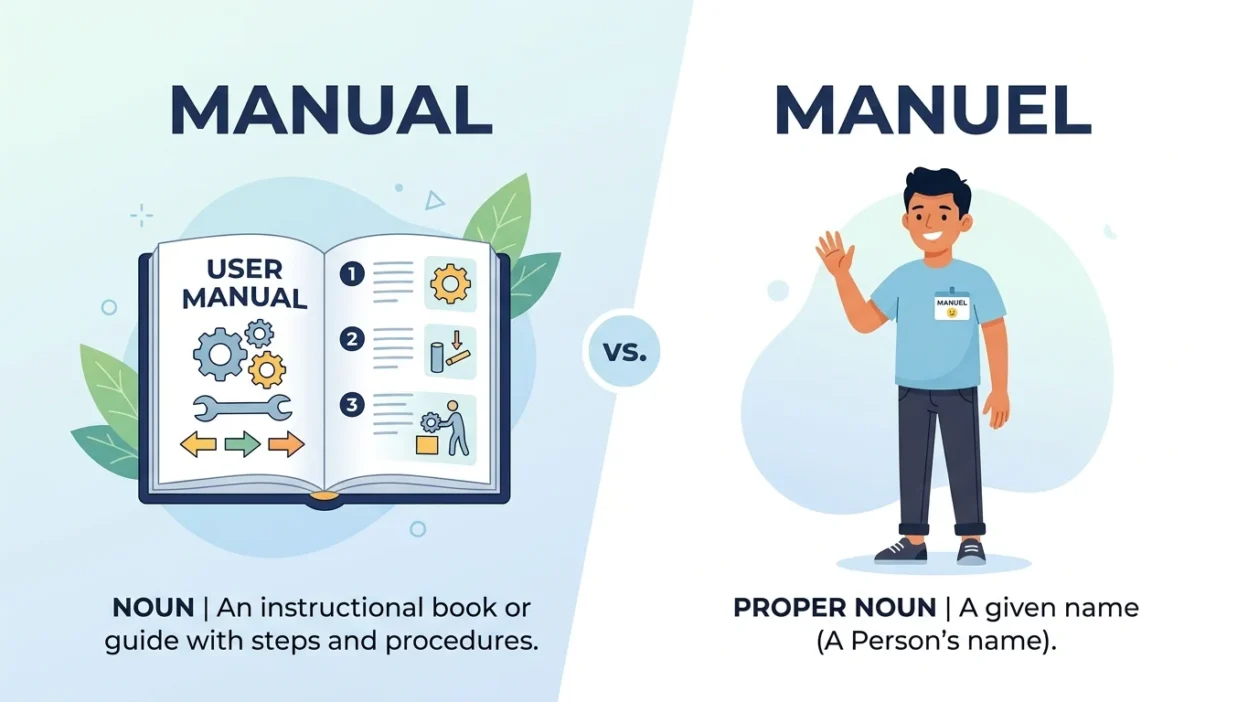
In this 2026 Simple Guide, the key point to Understand is that Manual and Manuel are not interchangeable. Manual is a common English word, used as an English noun and adjective, while Manuel is a proper noun, a personal name, male given name, and first name found in Spanish, Portuguese, French, and other European cultures. A manual can mean an instruction book, instruction guide, handbook, guidebook, user guide, booklet, documentation, or instructional document containing instructions for a car, vehicle, machine, software, equipment, devices, systems, and technology.
From my experience in technical writing, business communication, and professional writing, the most common spelling confusion happens when writers accidentally replace Manual with Manuel, creating grammar errors, spelling errors, and reducing credibility, readability, and writing accuracy.
A useful memory trick is simple: Manual relates to hand, hands, manual labor, physical work, physical labor, hand operated actions, or something done by hand, while Manuel refers to a person and should be capitalized according to capitalization conventions. You may see user manual, instruction manual, repair manual, owner’s manual, employee manual, training manual, safety manual, service manual, operations manual, or product manual in education, engineering, healthcare, manufacturing, and the automotive industry.
Meanwhile, Manuel Neuer, Lin Manuel Miranda, Manuel Noriega, Manuel Garcia, Manuel Rodriguez, and Manuel Santos are examples of people whose name is Manuel. Whether you are writing articles, emails, reports, school essays, web content or choosing the correct word improves clarity, professionalism, search visibility, content quality, user experience, and overall communication.
Quick Answer: Simple Meaning in Easy Words
Here is the fastest way to understand both words:
- Manual
- Means something done by hand
- Also means an instruction book or guide
- Very common in English
- Manuel
- Usually a person’s name
- Common in Spanish, Portuguese, and other languages
- Not used for instructions or books in English
👉 Simple idea:
- “Manual” = instructions or hand work
- “Manuel” = a name for a person
Simple Origin or Background of the Words
The word “Manual”
The word manual comes from Latin roots meaning “hand.” In old times, it was used to describe anything done using hands instead of machines.
Over time, the meaning expanded. Now, it has two main uses:
- Something done by hand (manual work)
- A book that gives instructions (user manual)
So, the idea of “hand” is still inside the word.
The word “Manuel”
The word Manuel is not originally an English word. It is mostly used as a first name in many countries, especially:
- Spain
- Portugal
- Latin American countries
It comes from a religious background meaning “God is with us” in some traditions.
So, unlike “manual,” it is not connected to instructions or work.
Clear Explanation of the Difference
The main difference is very simple:
1. Meaning difference
- Manual = instructions or hand based work
- Manuel = a person’s name
2. Usage difference
- Manual is used in everyday English writing
- Manuel is used when talking about a person named Manuel
3. Grammar difference
- Manual is a common English word (noun or adjective)
- Manuel is a proper noun (name of a person)
4. Context difference
- If you are reading a book or guide → it is “manual”
- If you are talking about someone → it is “Manuel”
Comparison Table: Manuel vs Manual
| Feature | Manual | Manuel |
| Type | English word | Personal name |
| Meaning | Instructions or hand work | A person’s name |
| Usage | Books, machines, work | Talking about a person |
| Language origin | Latin (hand related) | Spanish/Portuguese name |
| Example | user manual, manual labor | Manuel is my friend |
| Common in English | Yes | Only as a name |
Which One to Use and When
Knowing when to use each word is very important.
Use “Manual” when:
- You are talking about instructions
- You are describing something done by hand
- You are referring to a guidebook
Examples:
- “Read the manual before using the machine.”
- “This work is manual, not automatic.”
- “I lost the instruction manual for my phone.”
Use “Manuel” when:
- You are talking about a person named Manuel
Examples:
- “Manuel is my classmate.”
- “I met Manuel at school.”
- “Manuel lives in Spain.”
👉 Simple rule:
If it is not a person’s name, do NOT use “Manuel.”
Common Mistakes People Make
Many learners mix these two words. Here are the most common mistakes:
1. Writing “manuel” instead of “manual”
This happens because of spelling confusion.
Wrong:
- “Read the manuel before using it.”
Correct:
- “Read the manual before using it.”
2. Thinking both words have the same meaning
Some people assume they are different spellings of the same word. They are not.
3. Using “manual” as a name
This is also wrong in most cases.
Wrong:
- “Manual is my friend.”
Correct:
- “Manuel is my friend.”
4. Mixing pronunciation ideas
They may sound similar, but meaning is different.
Everyday Real Life Examples
Let’s see how both words appear in real life.
Emails
- “Please check the user manual before installation.”
- “Manuel will send you the report tomorrow.”
Social Media
- “I finally read the manual for my camera!”
- “Happy birthday, Manuel!”
Daily Life Conversations
- “Do you have the manual for this phone?”
- “Manuel is coming to our house today.”
School or Study Use
- “The lab manual explains all experiments.”
- “Manuel helped me with homework.”
Short Learning Section for Students and Beginners
If you are learning English, here is a very simple way to remember:
Easy Memory Trick
- Manual = Machine + Instructions
- Manuel = Name of a person
Think like this:
👉 Manual = “how to do something”
👉 Manuel = “who is someone”
Practice Tip
Try making your own sentences:
- Write 3 sentences using “manual”
- Write 3 sentences using “Manuel”
This helps your brain remember the difference quickly.
FAQ: Simple Questions and Answers
1. Is “manuel” a correct English word?
No, “manuel” is not used in English for instructions. It is usually a name.
2. What does “manual” mean?
It means a guidebook or something done by hand.
3. Can “Manuel” mean instruction book?
No, it is only a personal name.
4. Why do people confuse these words?
Because they look and sound very similar.
5. Is “manual work” the same as “automatic work”?
No. Manual work means done by hand, not by machine.
6. Is Manuel a common name?
Yes, it is a very common name in Spanish speaking countries.
7. Can I use “manual” for a person’s name?
No, that would be incorrect.
8. What is the easiest way to remember the difference?
Remember:
- Manual = instructions
- Manuel = person
Conclusion: Simple Final Understanding
The confusion between “manuel” and “manual” is very common, especially for English learners. But the difference is actually very simple.
- Manual is an English word used for instructions or hand based work.
- Manuel is a personal name used for people.
Once you remember this simple rule, you will never confuse them again. Just think: if it is about a guide or process, it is “manual.” If it is a person’s name, it is “Manuel.”
Learning small differences like this makes your English much clearer and more confident.