
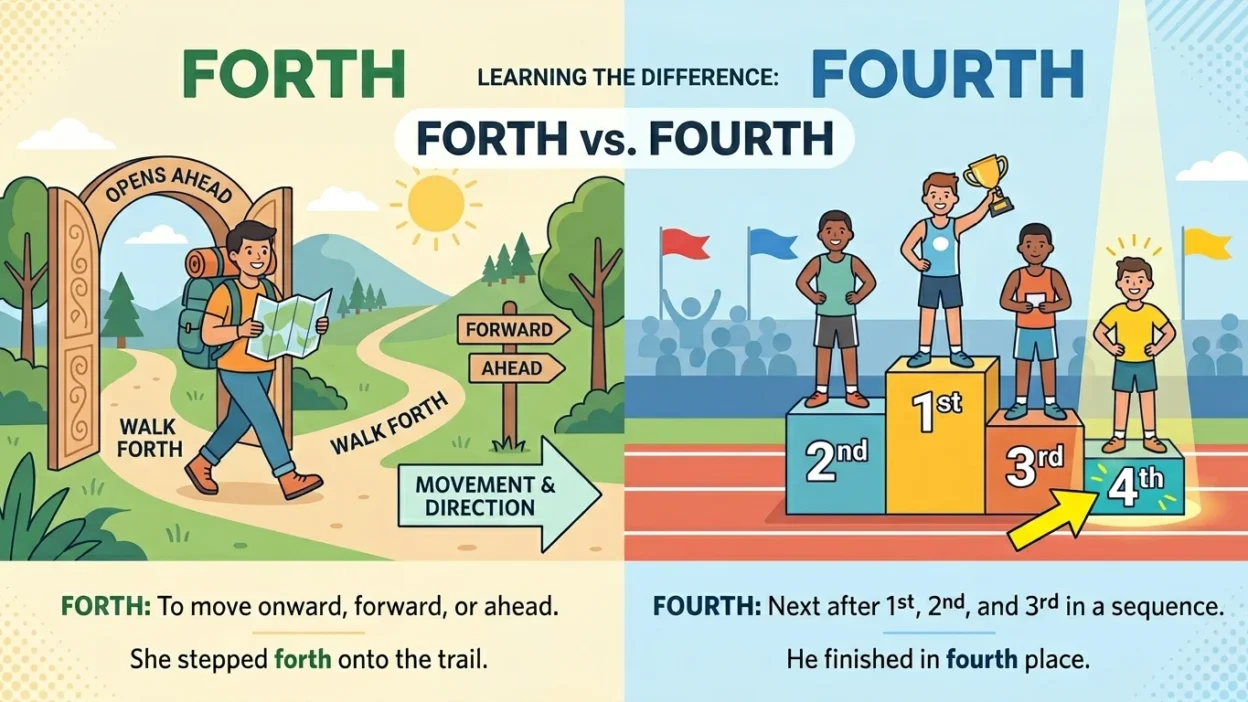
When people see forth and fourth, they often feel confused because these are homophones, meaning they are pronounced same but spelled differently and carry different meanings. In my experience while teaching basic English, this is one of those words that students mix up most because both sound natural in everyday talk and writing.
The key distinction is simple: fourth is an ordinal number that relates to four, showing numerical position, rank, or order in specific sequences, while forth is an adverb that shows moving forward, onward movement, or going ahead in time, place, or progression.
To make it easy remember, I often tell learners a small mental trick: think of fourth linked 4, like first, second, third, fourth, where it sits in a sequence, just like a baseball batting order, cleanup hitter, or a fourth grade class assignment. On the other side, forth brings movement forward, like someone stepping into the forefront, a speaker stepping up to bring or put forward a detailed oral or written account, or ideas being expressed in a formal discussion or waiting room talk.
Even in historical or cultural references, forth appears in expressions like set forth, bring forth, or go forth, often used in formal writing, communication, or explanation of evidence. The difference becomes clearer when you see how forth connects to progression and action, while fourth stays tied to position, fraction like one quarter, or numerical order in lists, intervals, or ranks across everyday usage in school, social media posts, emails, or professional communication.
Quick Answer
Here is the easiest way to understand the difference:
Simple trick:
- If you are talking about movement, use forth
- If you are talking about counting or position, use fourth
Examples:
- “He went forth into the field.” (movement)
- “She finished in fourth place.” (order)
Simple Origin or Background Explanation
Both words come from Old English, but they developed in different ways.
Forth
The word “forth” comes from an old idea meaning:
- forward movement
- going out
- moving ahead
It was often used in older English texts like “go forth,” meaning “go forward” or “leave and move ahead.”
Fourth
The word “fourth” comes from the number “four.”
- It is used when counting positions
- It shows order in a list (1st, 2nd, 3rd, 4th)
So:
- Forth = direction
- Fourth = number position
Even though they sound similar, they are not related in meaning.
Clear Explanation of the Difference
Let’s break it down in the simplest way possible.
Forth (direction word)
“Forth” is used when something moves:
- forward
- outward
- into action
It is often used in formal or old style English.
Examples:
- “The soldiers marched forth.”
- “She brought forth a new idea.”
- “The flowers came forth in spring.”
It always gives a feeling of movement or action.
Fourth (number word)
“Fourth” is used when talking about:
- position in a list
- ranking
- order of things
Examples:
- “He came fourth in the race.”
- “This is my fourth attempt.”
- “April is the fourth month of the year.”
It is always connected to counting.
Easy Memory Trick
- Forth = Forward
- Fourth = Number Four
If you remember this, you will never mix them up again.
Comparison Table (Easy to Scan)
| Feature | Forth | Fourth |
| Meaning | Forward or out | Number 4 position |
| Type | Direction word | Number word |
| Usage | Movement or action | Counting or ranking |
| Example | Go forth | Fourth place |
| Feeling | Action / movement | Order / position |
Which One to Use and When
Use “forth” when:
- Talking about movement
- Describing action or progress
- Writing formal or old style English
Examples:
- “He stepped forth to speak.”
- “The truth came forth.”
Use “fourth” when:
- Counting something
- Talking about position in a list
- Mentioning dates or rankings
Examples:
- “She is in fourth grade.”
- “It is the fourth time I called you.”
Simple rule:
Ask yourself:
- Am I talking about movement? → use forth
- Am I counting something? → use fourth
Common Mistakes People Make
Many learners mix these words because they look similar.
Mistake 1: Using “fourth” instead of “forth”
Wrong:
- “He went fourth into the room.”
Correct:
- “He went forth into the room.”
Mistake 2: Using “forth” instead of “fourth”
Wrong:
- “She finished forth place.”
Correct:
- “She finished fourth place.”
Mistake 3: Thinking they are interchangeable
They are NOT interchangeable. Even one small change can make the sentence wrong.
Mistake 4: Pronunciation confusion
They sound similar in fast speech, but:
- “forth” has a soft ending
- “fourth” has a “th” sound with number meaning
Everyday Real Life Examples
Everyday real life examples
Emails
- “Please send forth the updated report.”
- “This is the fourth reminder for payment.”
News
- “The leader stepped forth to address the nation.”
- “The team finished in fourth position in the tournament.”
Social Media
- “I’m going forth with my new project!”
- “This is my fourth attempt at baking a cake 😂”
Daily Conversation
- “Let’s move forth with the plan.”
- “This is the fourth time I told you!”
Easy Pattern to Notice
- If it shows action or progress, it is forth
- If it shows counting or order, it is fourth
Short Learning Section for Students and Beginners
Here is a simple way to remember both words quickly.
Step 1: Think of “forth”
- Think: forward
- Think: go ahead
- Think: move out
Step 2: Think of “fourth”
- Think: number 4
- Think: position in a list
- Think: ranking
Step 3: Practice sentences
Try completing these:
- He went ______ into the room. (forth)
- She came ______ in the race. (fourth)
- The idea came ______ from his mind. (forth)
- It is the ______ chapter of the book. (fourth)
Practice helps your brain remember the difference faster.
FAQ (Frequently Asked Questions)
What is the main difference between forth and fourth?
“Forth” means forward movement, while “fourth” means number 4 in order.
Can forth and fourth be used the same way?
No, they cannot be used the same way because their meanings are different.
Why do forth and fourth sound similar?
They sound similar because of English pronunciation, especially in fast speech, but their meanings are not related.
Is forth still used in modern English?
Yes, but it is less common. It is often used in formal writing or expressions like “go forth.”
Where do we use fourth in daily life?
We use “fourth” when talking about:
- ranking
- dates
- positions
- counting things
What is an easy trick to remember both words?
- Forth = Forward (movement)
- Fourth = Number four (counting)
Which one is more common in daily English?
“Fourth” is more common because people often talk about numbers and rankings.
Can I use forth in casual conversation?
Yes, but it is not very common. Most people use simpler words like “go ahead” or “move forward.”
Conclusion
“Forth” and “fourth” may look and sound similar, but they have completely different meanings. One is about movement forward, and the other is about number order.
If you remember one simple idea, you will never mix them again:
- Forth = forward action
- Fourth = number 4 position
With a little practice, you can use both words correctly and confidently in writing and speaking.