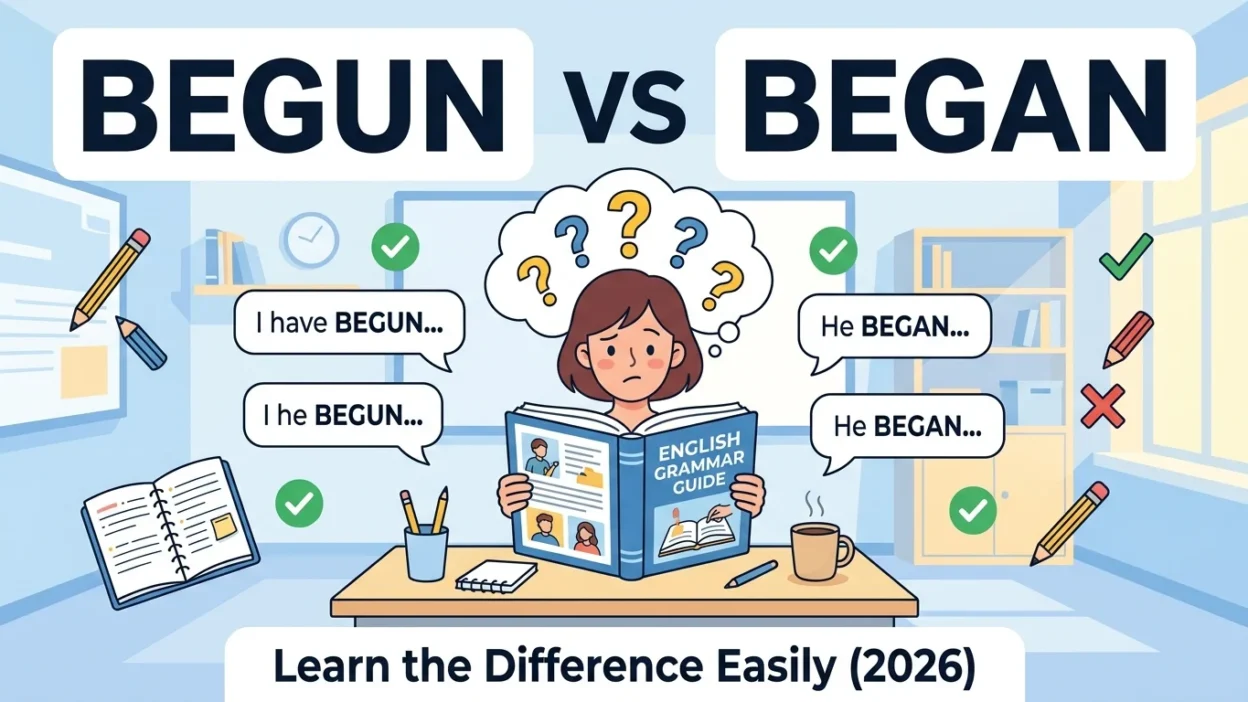
Many English learners get confused about “begun” and “began.”
At first, they seem almost the same because both come from the verb “begin.”
You may see sentences like:
- The class began at 9:00.
- The class has begun.
Both are correct. But why is one began and the other begun?
The confusion happens because these two words are different forms of the same verb, and they are used in different sentence structures.
The good news is that once you understand one simple rule, it becomes very easy to know which one to use.
This guide explains everything in very simple English so you can understand it clearly and use both words correctly in daily life.
Quick Answer
Here is the simple answer:
- Began = simple past tense
(used for something that started in the past) - Begun = past participle
(used with helping verbs like has, have, had)
Easy rule to remember
Use began when the sentence stands alone in the past:
✅ The meeting began late.
Use begun when you use helping verbs:
✅ The meeting has begun.
A quick memory trick:
Has / Have / Had → Begun
No helping verb → Usually Began
A Simple Background of the Word
Both words come from the base verb:
Begin
English verbs often change form depending on time.
For example:
| Base Form | Past Form | Past Participle |
| Begin | Began | Begun |
This is called an irregular verb because it does not follow the normal -ed pattern.
For example:
- Walk → Walked
- Play → Played
But:
- Begin → Began → Begun
That is why learners often mix them up.
Understanding the Difference Clearly
The main difference is about grammar structure.
What Does “Began” Mean?
Began is the simple past form of begin.
It tells us that something started in the past.
Examples:
- The movie began at 8 PM.
- She began her homework after dinner.
- It began to rain suddenly.
In each sentence, the action happened in the past.
What Does “Begun” Mean?
Begun is the past participle form.
It cannot usually stand alone.
It needs a helping verb such as:
- Has
- Have
- Had
- Was
- Were (in some passive forms)
Examples:
- The movie has begun.
- They have begun the project.
- The rain had begun before we arrived.
Notice that begun always follows a helping verb.
Comparison
Here is an easy table to help you remember.
| Feature | Began | Begun |
| Type | Simple past | Past participle |
| Used alone? | Yes | Usually no |
| Needs helping verb? | No | Yes |
| Time meaning | Past action | Completed/connected action |
| Example | She began reading. | She has begun reading. |
This is the easiest way to see the difference.
Which One Should You Use and When?
Use this simple guide.
Use “Began” When:
You are talking about a past action directly.
Examples:
- The game began at noon.
- He began studying yesterday.
- Our trip began on Monday.
Think:
What happened in the past?
Use “Begun” When:
You are using helping verbs.
Examples:
- The game has begun.
- He had begun studying before lunch.
- We have begun our journey.
Think:
Do I see has, have, or had?
If yes, use begun.
Common Mistakes People Make
Many learners make these mistakes.
Mistake 1: Using “Begun” Without a Helping Verb
❌ The class begun at 10.
✅ The class began at 10.
Why?
There is no helping verb.
Mistake 2: Using “Began” After “Has”
❌ The class has began.
✅ The class has begun.
Why?
After has, use the past participle begun.
Mistake 3: Mixing Tenses
❌ We had began dinner.
✅ We had begun dinner.
“Had” needs begun, not began.
Mistake 4: Guessing Based on Sound
Some learners choose the word that “sounds right.”
This is risky.
Always check the sentence structure.
Ask yourself:
Is there a helping verb?
If yes → Begun
If no → Began
Everyday Real Life Examples
Let’s look at how these words are used in daily life.
In Emails
Correct:
- The meeting began late yesterday.
- The discussion has begun.
Wrong:
- The meeting begun late.
In News Reports
- The event began this morning.
- Rescue efforts have begun.
News writing often uses both forms.
On Social Media
People might post:
- Summer has officially begun!
- The concert began an hour ago.
At School
Teachers may say:
- The exam began at 9:00.
- The test has begun, so please be quiet.
In Daily Conversation
- It began raining.
- The movie has begun already.
These examples show how common both words are.
A Short Learning Section for Students
Here is a very easy learning trick.
Think of the three forms together:
Begin – Began – Begun
Say them out loud:
Begin, Began, Begun
This helps your memory.
You can also practice with this pattern:
Present
I begin my work.
Past
I began my work.
Present Perfect
I have begun my work.
Repeating this pattern helps you learn naturally.
Quick Practice
Choose the correct word.
- The class has ______.
- The game ______ at 6 PM.
- They had ______ their trip.
- She ______ reading yesterday.
Answers:
- Begun
- Began
- Begun
- Began
If you got them right, you understand the difference.
Frequently Asked Questions
1. Is “begun” correct English?
Yes.
“Begun” is correct, but it needs a helping verb.
Example:
The show has begun.
2. Is “began” past tense?
Yes.
“Began” is the simple past tense of begin.
Example:
The lesson began early.
3. Can I say “has began”?
No.
This is incorrect.
Correct:
Has begun
4. Can I say “it begun”?
Usually no.
Correct:
It began
Or:
It has begun
5. Why is English so confusing here?
Because begin is an irregular verb.
It does not follow normal patterns like:
Play → Played
Instead:
Begin → Began → Begun
6. How can I remember the difference?
Use this rule:
- No helping verb → Began
- Has / Have / Had → Begun
7. Which is more common?
Both are common.
It depends on the sentence.
- Simple past → began
- Perfect tense → begun
8. Is “begun” more formal?
Not really.
It is just used in a different grammar structure.
A Simple Memory Trick
Here is a very easy trick:
A = Alone → BegAn
(Began can stand alone)
U = Used with helping verbs → BegUn
This small memory trick can help you quickly choose the right word.
Conclusion
The difference between began and begun is actually simple once you know the rule.
Use began for a simple past action:
- The meeting began at 10.
Use begun with helping verbs like has, have, and had:
- The meeting has begun.
Remember this:
Began = Past action
Begun = Used with helping verbs
With practice, choosing the correct word will become natural.
The next time you write or speak English, simply check:
Do I have a helping verb?
If yes, use begun.
If no, use began.