
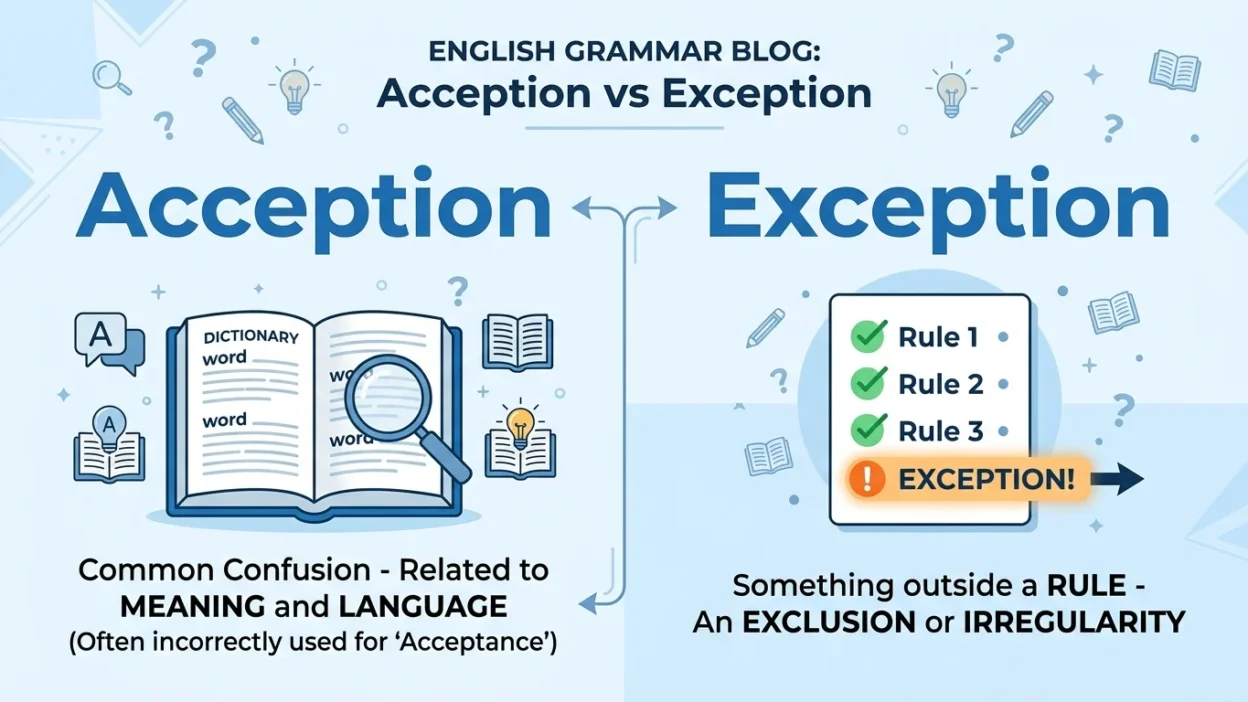
Many English learners get confused between acception and exception because the two words look and sound somewhat similar. When reading or writing, it is easy to think they have related meanings.
The confusion becomes even bigger because exception is a common English word, while acception is very rare. Most people use exception regularly in conversations, emails, schoolwork, and daily life, but they may never see acception at all.
If you have ever wondered which word is correct, when to use it, and whether they mean the same thing, this guide will explain everything in simple English.
Quick Answer
- Exception is a common English word.
- Exception means something that does not follow the usual rule.
- Acception is a real word, but it is very rare.
- Acception means the acceptance or meaning of a word in certain contexts.
- In modern everyday English, you will almost always need exception.
- Most students and English learners may never need to use acception.
Simple Origin or Background Explanation
Where Does “Exception” Come From?
The word exception comes from an old Latin word that means “to take out.
This idea still exists today. An exception is something that is taken out of a general rule.
For example:
- Most students wear uniforms.
- John does not have to wear one.
John is the exception.
Where Does “Acception” Come From?
The word acception comes from a Latin word related to accepting or receiving something.
Over time, it became a special word used mainly in language studies to describe a particular meaning of a word.
Today, it is rarely used in normal conversations.
Clear Explanation of the Difference
The biggest difference is that these words have completely different meanings.
What Does Exception Mean?
An exception is a person, thing, or situation that does not follow the usual rule.
Think of it as something that is different from what is normally expected.
Examples:
- Everyone must submit the assignment by Friday, with no exceptions.
- Cats usually dislike water, but my cat is an exception.
- The store opens every day except Sunday, with no exceptions.
In all these examples, something is outside the normal rule.
What Does Acception Mean?
Acception refers to a specific meaning or sense of a word.
It is mostly found in old books, dictionaries, or language discussions.
Example:
- The word had a different acception in earlier English.
Most native English speakers rarely use this word in daily life.
Instead, they usually say:
- meaning
- definition
- sense
These words are much more common and easier to understand.
Comparison
| Feature | Acception | Exception |
| Is it a real word? | Yes | Yes |
| Common in daily English? | No | Yes |
| Meaning | A particular meaning of a word | Something outside a rule |
| Used in conversation? | Rarely | Very often |
| Used in school writing? | Rarely | Frequently |
| Easy for most people to understand? | Not always | Yes |
| Recommended for beginners? | Usually no | Yes |
Which One to Use and When
Use “Exception” When Talking About Rules
Choose exception when something does not follow the normal pattern.
Examples:
- There is one exception to the rule.
- Nobody is allowed inside without a ticket, with no exceptions.
- She is an exception to the trend.
Use “Acception” Only in Special Language Discussions
Choose acception only when discussing the meaning of a word.
Examples:
- The ancient acception of the word was different.
- Scholars discussed the acception of the term.
For everyday communication, you can usually replace it with:
- meaning
- definition
- sense
Easy Rule to Remember
Ask yourself:
Am I talking about a rule?
- Yes → Use exception.
Am I talking about the meaning of a word?
- Yes → Possibly use acception, although “meaning” is usually better.
Common Mistakes People Make
Mistake 1: Using Acception Instead of Exception
Incorrect:
- There is one acception to the rule.
Correct:
- There is one exception to the rule.
This is probably the most common mistake.
Mistake 2: Thinking the Words Mean the Same Thing
These words are not synonyms.
Incorrect idea:
- Acception and exception have the same meaning.
Correct idea:
- They have completely different meanings.
Mistake 3: Using Acception in Everyday Writing
Many learners believe acception is simply a more formal version of exception.
It is not.
Incorrect:
- Everyone must follow the rules with no acception.
Correct:
- Everyone must follow the rules with no exception.
Mistake 4: Forgetting That Acception Is Rare
Even many native English speakers never use acception in daily life.
In most situations, using “meaning” is clearer.
Everyday Real Life Examples
Emails
Correct:
- We do not offer refunds, with one exception.
Correct:
- The policy applies to everyone without exception.
Incorrect:
- The policy applies to everyone without acception.
News
Examples:
- The law applies to all citizens without exception.
- The weather was warm across the country, with a few exceptions.
These are common uses of exception.
Social Media
Examples:
- Everyone loves this movie, and I’m no exception.
- The challenge is open to everyone without exception.
These sentences sound natural in modern English.
Daily Conversations
Examples:
- There is one exception to that rule.
- She is the exception, not the rule.
- Nobody gets special treatment without exception.
These are phrases people use regularly.
Short Learning Section for Students and Beginners
Simple Memory Trick
Think about the word except.
The word exception comes from the same idea.
Examples:
- Everyone came except Ali.
- Ali is the exception.
This connection makes exception easy to remember.
Remember This Formula
- Rule broken = Exception
- Word meaning = Acception
Quick Practice
Which word is correct?
- Everyone must wear a badge, with no ______.
- The old ______ of the word is no longer used.
- She is an ______ to the rule.
- The dictionary explains a different ______ of the term.
Answers:
- exception
- acception
- exception
- acception
FAQ
Is acception a real English word?
Yes. It is a real word, but it is very uncommon in modern English.
Is exception a real English word?
Yes. It is a common and widely used English word.
Which word is used more often?
Exception is used far more often than acception.
Can I use acception instead of exception?
No. They have different meanings and cannot normally replace each other.
What does exception mean in simple words?
It means something that does not follow the usual rule.
What does acception mean in simple words?
It means a particular meaning or sense of a word.
Do native English speakers use acception?
Some may use it in special language discussions, but most rarely use it in everyday conversation.
What should English learners remember?
In most situations, use exception. Only use acception when talking about the meaning of a word.
Conclusion
The difference between acception and exception is actually simple once you know their meanings. Exception is the common word that refers to something outside a rule or pattern. It appears regularly in conversations, schoolwork, emails, news articles, and everyday English.
Acception, on the other hand, is a rare word that refers to a particular meaning of a word. Most people do not use it in daily communication, and in many cases, the word meaning is a clearer choice.
If you remember one thing, remember this: exception deals with rules, while acception deals with meanings. Knowing that simple difference will help you use both words correctly and avoid common mistakes.